Fountain Maintenance Services in California
Fountain maintenance is system management. A fountain that runs clean today can develop pump strain, mineral buildup, and algae problems within weeks if the underlying system is not monitored as a whole. Water chemistry, pump performance, filtration capacity, basin condition, and environmental exposure all interact. A problem in one area accelerates failure in the others.
Koi Pros provides scheduled fountain maintenance across California, with Orange County as our primary service area and coverage extending to Los Angeles County, Riverside County, San Diego County, the Inland Empire, and the Palm Springs and Palm Desert corridor. Every maintenance visit follows a systems-based evaluation: water quality, pump and motor function, filtration efficiency, surface and basin condition, and environmental stress factors assessed together rather than as isolated checklist items. Problems are identified before they become failures.
California’s C-53 Swimming Pool Contractor license, issued by the Contractors State License Board, authorizes work on recirculating water systems including fountains, pumps, filtration, and plumbing. Most fountain service providers in Southern California operate without this license. Koi Pros holds an active C-53 and has maintained water feature systems for over 40 years, which means every maintenance visit is backed by the legal authority and field knowledge to diagnose, service, and repair the full mechanical system rather than just clean the basin and leave.
- We assess your pond’s condition, system design, and location before recommending any next steps.
What Fountain Maintenance Covers and Why Each Task Matters
Every fountain operates as a closed-loop recirculating system. Water moves from the basin through a pump, passes through filtration, flows through the fountain’s display feature, and returns to the basin. Maintenance exists to keep every stage of that loop performing within the tolerances the system was designed for. When one stage degrades, the load shifts to the others, and the entire system moves toward failure faster than any single component would on its own.
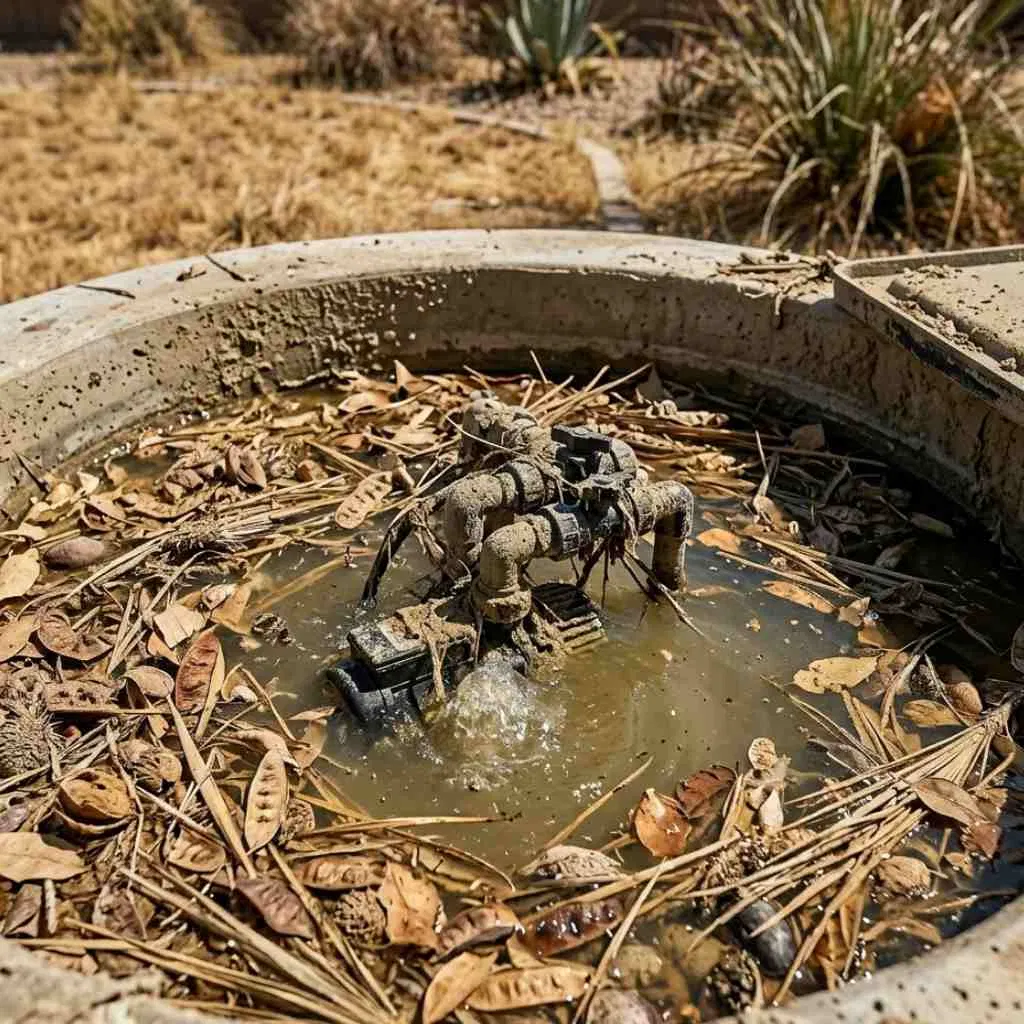
Basin and surface cleaning removes the organic and inorganic material that accumulates in the basin, on fountain surfaces, and around intake screens. Leaves, dust, pollen, and insect debris settle into the water and decompose. Decomposing organic matter releases phosphates and nitrates, which are the primary fuel sources for algae growth. Left in place, this material also migrates toward the pump intake, where it clogs pre-filters and restricts water flow. Reduced flow forces the pump motor to work harder to maintain circulation, which generates excess heat in the motor housing and shortens the motor’s operational life. A basin that looks dirty is already creating mechanical stress on the pump.
Pump and motor inspection evaluates flow rate, motor temperature, impeller condition, and electrical draw. A pump that is running but producing less flow than its rated output is not functioning correctly. Common causes include impeller wear, partial intake obstruction, air intrusion in the plumbing line, or a motor that is drawing more amperage than spec as its bearings degrade. Catching a flow reduction early means cleaning an impeller or clearing an obstruction. Missing it means replacing the entire pump assembly after the motor burns out, which costs several times more and leaves the fountain offline until parts arrive and installation is scheduled.
Water quality management addresses the chemical and mineral conditions in the water itself. Fountain water in Southern California accumulates dissolved minerals rapidly because municipal water supplies in Orange County and surrounding areas run high in total dissolved solids. As water evaporates from the basin, those minerals concentrate. Over weeks, calcium and lime deposits form on basin surfaces, pump components, and fountain heads. Mineral scaling inside a pump housing reduces the clearance around the impeller, which drops flow efficiency and increases motor strain. On fountain surfaces, scaling creates a rough texture that accelerates biological attachment, giving algae a foothold it would not have on a clean surface. Water quality checks measure pH, total dissolved solids, and alkalinity so that treatment can be applied before scaling reaches the point where mechanical removal is required.
Filtration system service covers the filter media, housing, flow paths, and bypass valves that keep particulate matter and biological material from recirculating through the system. A filter that is partially clogged does not stop working. It restricts flow. The pump compensates by increasing pressure, which accelerates wear on seals and gaskets. When those seals fail, water escapes the plumbing loop and the basin water level drops. In a fountain without an auto-fill valve, a slow leak from a failing seal can drain the basin enough to expose the pump intake to air, which causes the pump to run dry. A pump that runs dry for even a short period can seize. Filtration service prevents a chain of failures that starts with a dirty filter and ends with a dead pump.
Algae prevention is a water chemistry discipline, not a cleaning task. Algae growth in fountains is driven by three conditions: nutrient availability (from decomposing organic matter), sunlight exposure, and warm water temperature. Southern California delivers all three year-round. Reactive algae removal, scrubbing green buildup off surfaces after it appears, does not address the conditions that caused the growth. Within days, the algae returns. Preventive treatment manages nutrient levels and applies EPA-registered algaecides at concentrations calibrated to the fountain’s water volume, surface material, and sun exposure. The goal is to keep conditions below the threshold where algae colonizes, not to chase it after it arrives.
Electrical system checks inspect wiring connections, ground fault circuit interrupter function, timer and controller operation, and lighting circuits. Fountain electrical systems run in wet environments continuously, which accelerates corrosion at junction points and terminal connections. A corroded connection increases electrical resistance, which generates heat at the connection point. Over time, that heat degrades the wire insulation and can trip the GFCI, shutting the fountain down. In systems with underwater lighting, a compromised seal on a light fixture allows water into the electrical housing, which creates a ground fault. Regular inspection of electrical components catches corrosion and seal degradation before they cause outages or safety hazards.
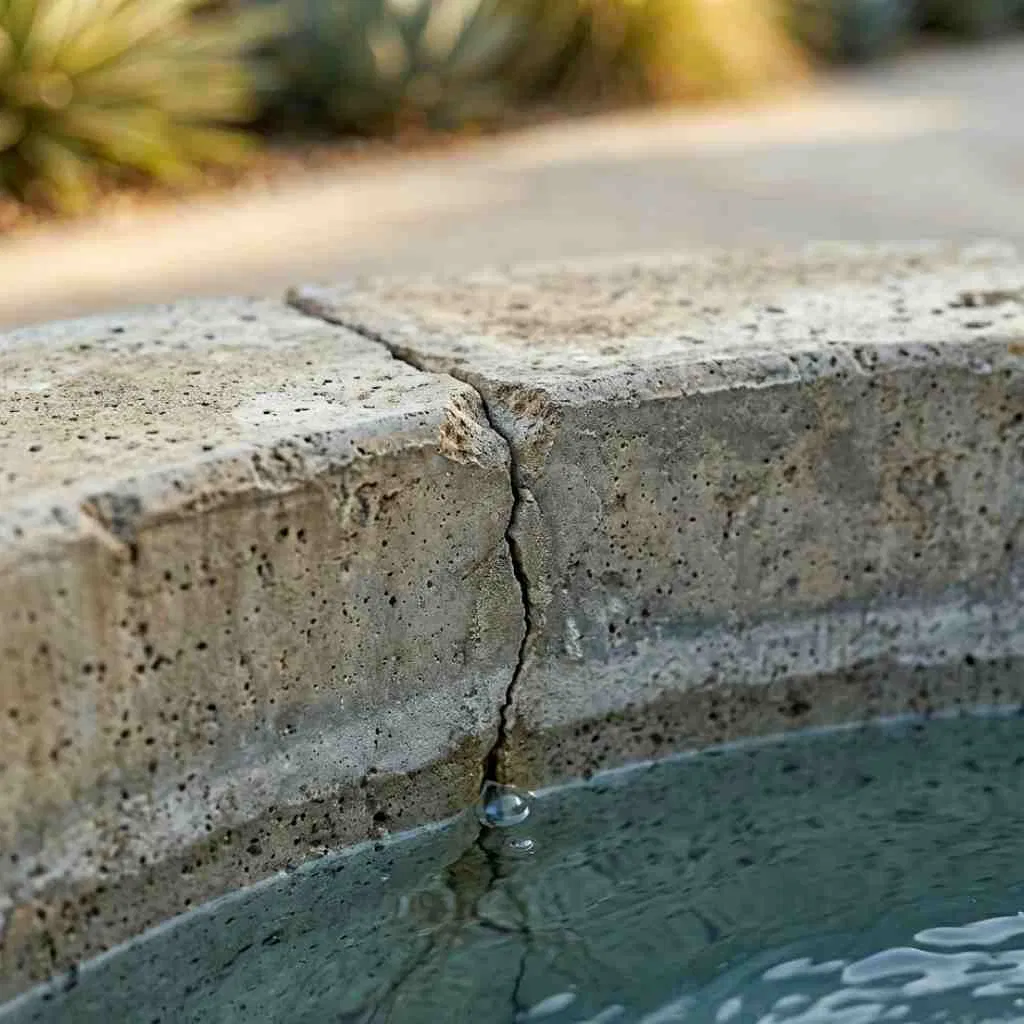
Basin and structural inspection evaluates the physical condition of the fountain body: basin integrity, mortar joints, sealant condition, plumbing connections, and surface finish. Concrete and cast stone fountains in Southern California are exposed to thermal cycling, where daytime surface temperatures can exceed 130°F in direct sun and drop 50 or more degrees overnight. This repeated expansion and contraction opens hairline cracks in mortar joints and basin walls. A crack that is cosmetic in January can become a leak path by summer. Structural inspection during routine maintenance catches cracks at the hairline stage, when they can be sealed in place. Once a crack propagates through the basin wall, the repair scope escalates from sealant application to structural work, which may require draining the system, removing components, and rebuilding the affected section. When a maintenance visit identifies structural damage that extends beyond routine sealing, the scope shifts from maintenance to fountain repair.
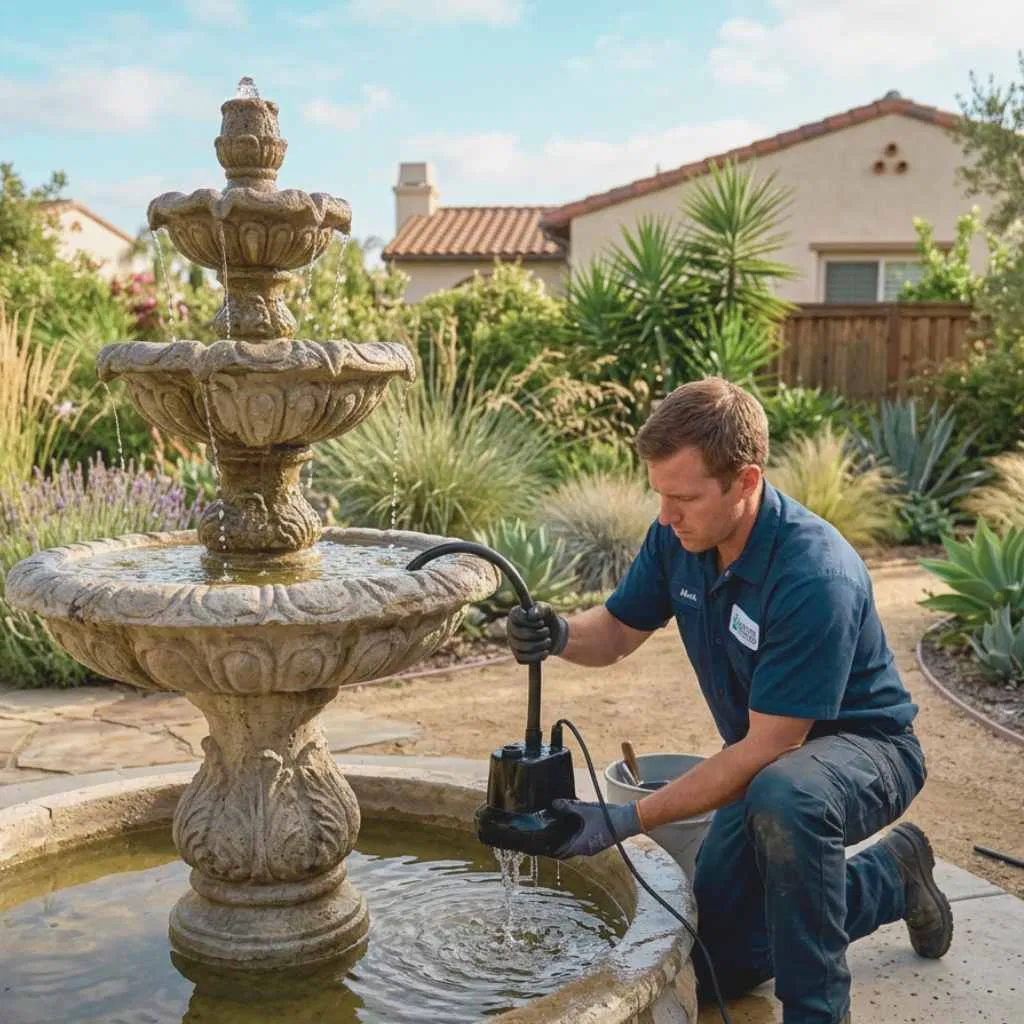
Fountain Types and How Maintenance Requirements Differ
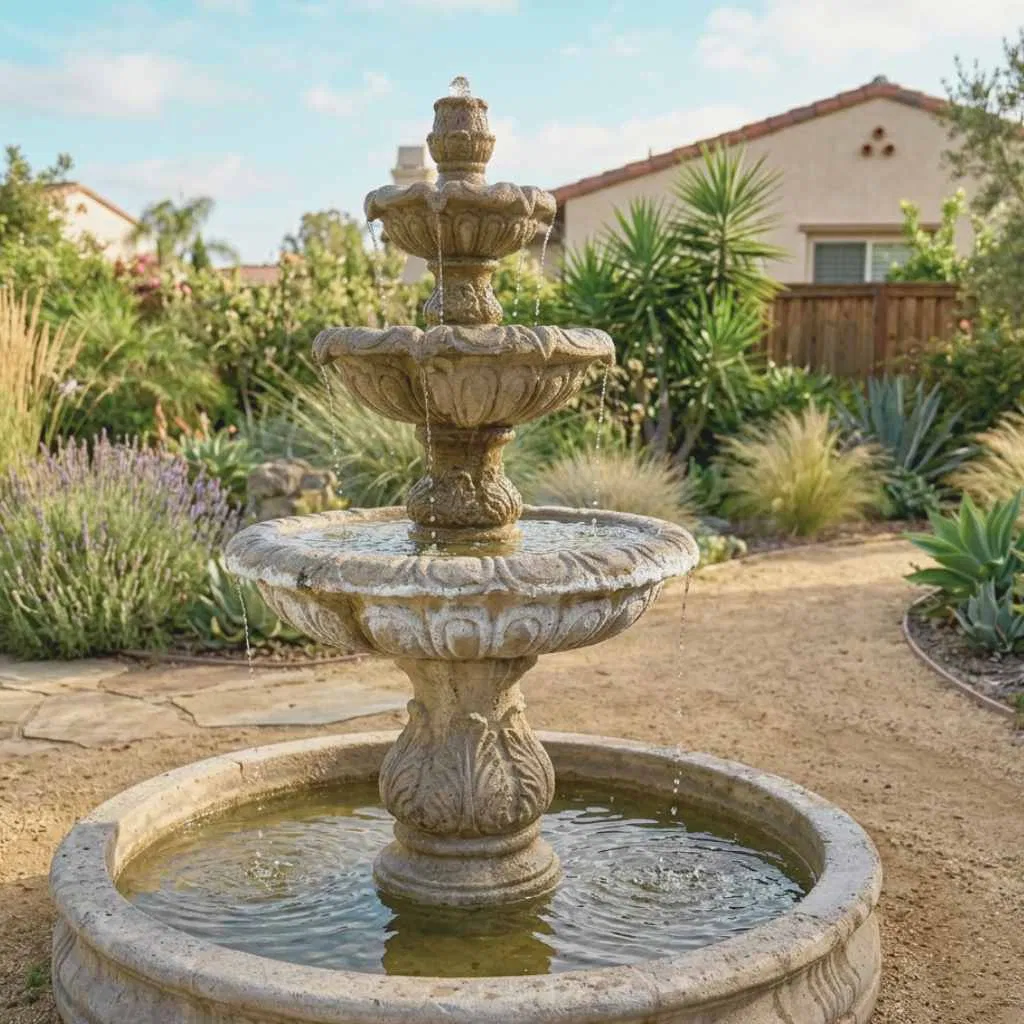
Not every fountain is maintained the same way. The pump configuration, basin design, water volume, material composition, and exposure profile differ by fountain type, and those differences determine what fails first, how quickly problems develop, and what each maintenance visit needs to prioritize. A maintenance approach designed for a tiered cast stone fountain will miss critical checkpoints on a pondless recirculating system, and a program built for a small wall-mounted unit will underservice a commercial architectural feature. Fountain type dictates the maintenance protocol.
Southern California Climate and What It Does to Fountains
Fountain maintenance guides written for national audiences assume a climate cycle that does not exist in Southern California. They describe spring startup procedures, winter shutdown and draining, freeze protection for pumps and plumbing, and seasonal dormancy periods where the fountain sits empty for months. None of that applies here. Fountains in California run year-round, which means every component accumulates wear twelve months a year with no off-season recovery period. The maintenance implications of that continuous operation are compounded by three regional conditions that accelerate system degradation faster than most property owners expect.
Hard water and mineral scaling is the most persistent maintenance factor in Southern California. Municipal water supplies across Orange County, Los Angeles County, and the Inland Empire deliver water with total dissolved solids concentrations that routinely exceed 300 ppm in many service districts. Some areas of eastern Orange County and western Riverside County test above 400 ppm. At those concentrations, every gallon of water that evaporates from a fountain basin leaves behind a measurable deposit of calcium, magnesium, and silica on every surface the water touches. In a fountain that loses two to three gallons per day to evaporation during summer months, the mineral load in the remaining basin water concentrates rapidly. Within weeks, white calcium deposits begin forming on tier surfaces, pump housings, fountain heads, and basin walls. Inside the plumbing, scaling narrows the internal diameter of pipes and fittings, which reduces flow rate and increases the pressure the pump must generate to maintain circulation. Left untreated for a full season, mineral scaling can reduce pump efficiency enough to shorten motor life by a year or more. Descaling is a standard part of every maintenance visit for any fountain operating on Southern California municipal water. The frequency and intensity of treatment depends on the local water district’s TDS levels and the fountain’s evaporation rate, which is why maintenance programs in this region cannot follow a one-size-fits-all national schedule.
UV exposure and algae growth operate on a different timeline in Southern California than in regions with seasonal cloud cover or winter dormancy. Algae requires three conditions to colonize: nutrient availability, warm water temperature, and sunlight. In a climate that delivers 280 or more sunny days per year, with summer water temperatures in exposed basins regularly exceeding 80°F, two of those three conditions are present almost continuously. The third condition, nutrients, is supplied by decomposing organic matter in the basin, by phosphates and nitrates in the municipal water supply, and by airborne pollen and dust that settle into the water surface. A fountain in full sun in Irvine or Anaheim faces algae pressure in February that a fountain in Portland or Chicago would not face until June. This compressed timeline means that preventive algae treatment must begin earlier, repeat more frequently, and be calibrated to higher baseline temperatures than maintenance programs designed for seasonal climates. Reactive treatment, waiting until green buildup is visible before addressing it, does not work in this environment because the regrowth cycle is measured in days, not weeks.
Santa Ana winds create debris loads that no other climate factor matches. These hot, dry offshore wind events push through the inland valleys and canyons of Orange County, Riverside County, and San Bernardino County at sustained speeds that strip leaves, bark, seed pods, and fine dust from trees and landscaping and deposit them into every open water surface in the path. A fountain basin that was cleaned two days before a Santa Ana event can accumulate enough organic debris in a single wind cycle to clog a pump intake screen, overload a pre-filter, and seed a fresh round of nutrient-driven algae growth. The debris is not just leaves. Santa Ana winds carry fine particulate matter, including soil dust and ash during fire season, that suspends in the water column and passes through standard intake screens into the pump housing. This fine particulate acts as an abrasive on impeller surfaces and accelerates wear on pump seals. Properties in wind-exposed corridors, particularly those in the Santa Ana Canyon, Tustin Hills, Anaheim Hills, and foothill communities along the 241 and 91 corridors, face higher debris loads than properties in coastal areas shielded by the prevailing onshore flow. Maintenance frequency for fountains in these locations needs to account for post-wind-event service visits beyond the regular schedule.
Year-round operation without shutdown is the compounding factor that makes every other climate condition more consequential. In regions with freezing winters, fountains are drained, pumps are removed or winterized, and the system gets a three-to-four-month rest period where no mechanical wear occurs, no scaling accumulates, and no algae grows. In Southern California, that reset never happens. Pumps run continuously. Scaling accumulates continuously. Algae pressure is present in every month. Debris enters the basin in every season, with spikes during Santa Ana events in fall and early winter and again during spring pollen season. The cumulative effect is that fountain components in Southern California age faster on a calendar basis than identical components in seasonal climates. A pump rated for a five-year lifespan in a climate with winter shutdown may reach end of life in three to four years under continuous Southern California operation. Maintenance programs in this region must account for shorter replacement intervals, more frequent water chemistry treatment, and a debris management cadence that has no true off-season.
How a Maintenance Visit Works
Every scheduled maintenance visit follows the same sequence regardless of fountain type or property size. The sequence exists because each step informs the next. Skipping a step or performing them out of order means missing conditions that only become visible when the prior step has been completed.
Arrival and initial system observation begins before any tools come out. The technician evaluates the fountain while it is running: water flow pattern, sound, water clarity, and visible surface condition. A fountain that is operating but producing less flow than its previous visit tells the technician something before any inspection begins. A change in sound, particularly a higher-pitched hum or intermittent rattling from the pump, indicates mechanical stress that the technician will investigate during the pump inspection step. Water that is cloudy or tinted green establishes the baseline for water quality testing later in the visit. This initial observation takes less than five minutes but sets the diagnostic direction for everything that follows.
System shutdown and access comes next. The pump is turned off, the electrical supply is disconnected or locked out where applicable, and the technician gains access to the pump, filtration, and plumbing components. For fountains with submersible pumps, this means reaching into the basin. For systems with external pump rooms, this means accessing the mechanical enclosure. For pondless systems, this means opening the vault access point and exposing the buried reservoir. The shutdown step is where the technician checks the electrical disconnect, GFCI function, and any timer or controller settings before proceeding. Electrical issues are easier and safer to identify when the system is being deliberately powered down rather than discovered accidentally during a hands-in-water cleaning step.
Debris removal and basin cleaning addresses the accumulated organic and inorganic material in the basin, on fountain surfaces, and around intake points. The technician removes leaves, sediment, insect debris, and any windblown particulate that has settled since the last visit. In tiered fountains, each tier is cleaned individually from top to bottom so that loosened material flows downward into the basin rather than redepositing on a lower tier that was already cleaned. Basin walls and floor are scrubbed to remove biofilm, the slippery biological layer that forms on submerged surfaces and provides the attachment point for algae colonization. Removing biofilm is more important than removing visible algae because biofilm is what allows algae to reestablish after cleaning. A basin that looks clean but still has biofilm on its walls will grow visible algae again within days.
Pump and filtration inspection is performed with the pump removed from the water or disconnected from the plumbing loop. The technician inspects the intake screen, impeller, pump housing, and seal condition. Mineral deposits on the impeller are removed. The intake screen is cleared of any debris that passed through the pre-filter or accumulated against the screen mesh. The technician checks the impeller for wear, specifically looking for pitting, erosion, or deformation that indicates abrasive particulate has been passing through the pump. Filter media is inspected and cleaned or replaced depending on the filter type. Cartridge filters are rinsed or swapped. Sand filters are checked for channeling, where water finds a path through the sand bed rather than filtering evenly across the full media surface, which reduces filtration effectiveness without any visible indicator on the pressure gauge until the channeling is advanced. The technician also inspects plumbing connections, check valves, and unions for leaks, corrosion, or mineral obstruction.
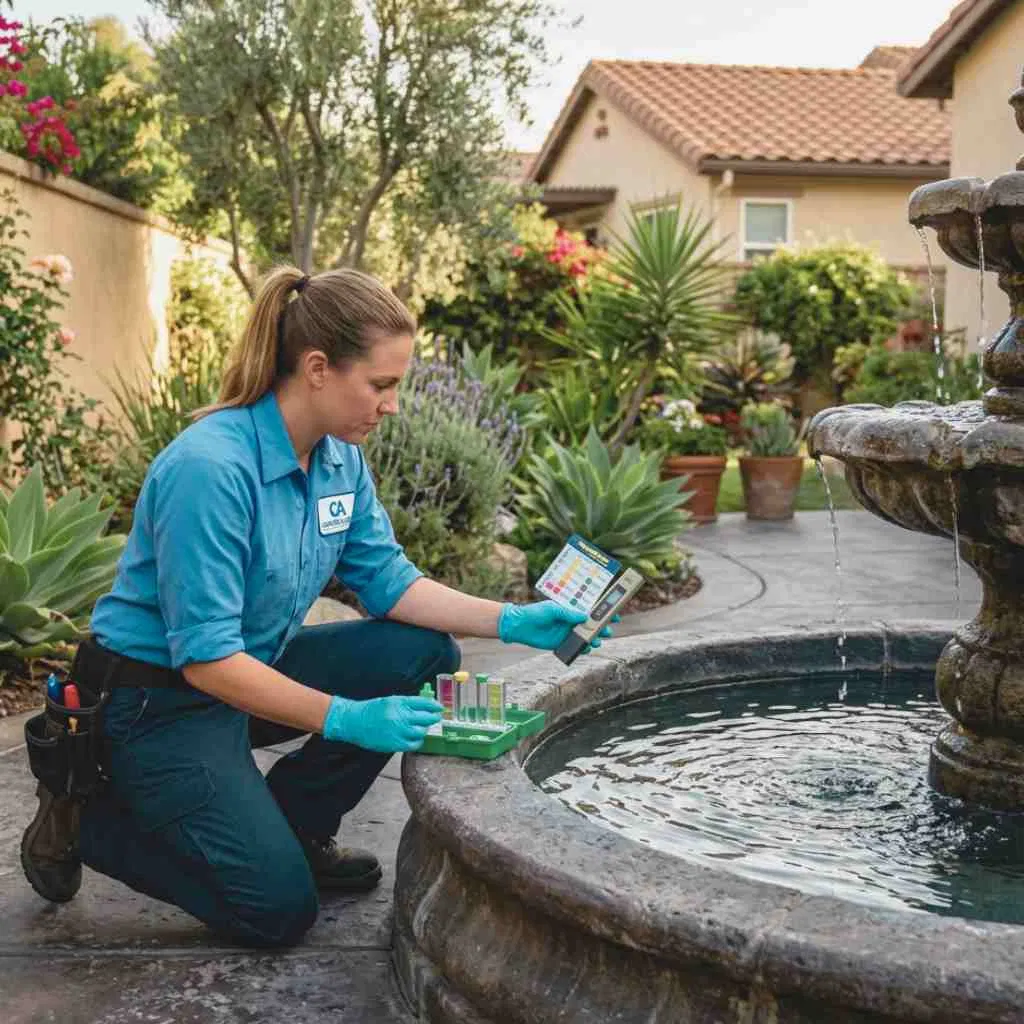
Water quality testing is performed after the basin has been cleaned and refilled to operating level. Testing before cleaning would measure the contaminated water rather than the baseline condition of the refilled system. The technician tests pH, total dissolved solids, and alkalinity. Results are compared against the fountain’s historical readings from prior visits to identify trends. A TDS reading that has climbed 50 ppm since the last visit in a fountain on the same water source indicates that evaporation is concentrating minerals faster than the current maintenance interval accounts for. A pH shift outside the 7.0 to 8.0 range signals a water chemistry condition that may require treatment adjustment. Based on the test results, the technician applies algaecide, mineral treatment, or pH adjustment at quantities calculated for the fountain’s specific water volume.
Surface and basin condition check is the structural inspection step. The technician examines the basin walls, floor, mortar joints, sealant lines, and fountain body for cracks, chips, spalling, staining, or sealant failure. On cast stone and concrete fountains, the inspection focuses on joints between tiers, the base-to-basin connection, and any areas where water sits in contact with the stone surface continuously. On metal or composite fountains, the inspection targets coating integrity, corrosion points, and fastener condition. This step identifies problems that are cosmetic today but structural tomorrow. A hairline crack in a mortar joint is a sealant repair at this visit. The same crack six months later, after thermal cycling has widened it, is a basin leak that requires draining the system and rebuilding the joint.
Restart, test, and documentation closes the visit. The pump is reinstalled or reconnected, the system is powered on, and the technician verifies that flow rate, spray pattern, and water level are operating within normal parameters. Any lighting is tested. Timer and controller settings are confirmed. The technician documents the visit with a record of work performed, water quality test results, current condition observations, any issues identified, and recommended actions for the next visit. For commercial and HOA properties, this documentation feeds into the property’s maintenance records and supports budget planning when a future visit identifies a repair or replacement need. The next visit date is confirmed before the technician leaves the property.
Fountain Maintenance for Commercial and HOA Properties
Commercial property managers and HOA board members evaluate fountain maintenance differently than residential homeowners. A homeowner asks whether the fountain looks clean and runs properly. A property manager asks whether the vendor can document every visit, provide reporting that supports budget forecasts, coordinate service across multiple water features without disrupting tenants or residents, and respond within a defined timeframe when something fails between scheduled visits. The maintenance work itself overlaps, but the operational framework around it is entirely different.
Vendor accountability and visit documentation is the baseline requirement for any commercial or HOA maintenance engagement. Every visit produces a written record that includes the date, technician name, work performed, water quality test results, current system condition, and any issues identified with recommended actions. This is not optional reporting. Property management companies and HOA boards need this documentation for three reasons. First, it creates a verifiable service history that protects the association or property owner if a maintenance-related failure leads to a liability claim. Second, it provides the data trail that boards use to evaluate whether the current maintenance provider is performing at the contracted scope. Third, it feeds directly into reserve study inputs when the property’s reserve analyst needs to project replacement timelines for fountain pumps, filtration systems, and structural components. A maintenance provider who shows up, does the work, and leaves without documentation creates a gap in the property’s records that the board or manager has to fill retroactively, which rarely happens accurately.
Budget forecasting and reserve study support matters because fountain maintenance costs are a line item in operating budgets and fountain replacement costs are a line item in reserve studies. Boards and property managers need to know what maintenance will cost on an annual basis and when capital expenditures for pump replacement, basin resurfacing, or full system overhaul will come due. A maintenance provider who tracks system condition over time, documents component age and wear progression, and reports on approaching end-of-life thresholds gives the property manager usable data for budget planning. A provider who only reports what was done at each visit, without forward-looking condition assessment, forces the board to guess at capital timing. That guessing leads to either deferred maintenance, where a failing pump runs until it dies and creates an unbudgeted emergency expense, or premature replacement, where a component is swapped out based on age alone when it still had serviceable life remaining. Condition-based reporting eliminates both of those outcomes by tying replacement decisions to measured system performance rather than arbitrary timelines.
Multi-feature coordination is a logistical requirement that residential maintenance does not involve. A commercial property or HOA community may have an entry fountain, a courtyard water wall, a pool-adjacent decorative feature, and a retention basin with an aerating fountain, all requiring maintenance on different schedules with different system configurations. Coordinating service across multiple features means the maintenance provider builds a site profile for the property that documents each feature’s system configuration and tracks each feature’s maintenance history independently. The technician arriving on site needs to know which systems require attention that day, what was found at the last visit on each feature, and what follow-up actions were flagged, without the property manager needing to walk them through it each time. That level of preparation only happens when the provider maintains a living site profile rather than treating each visit as a standalone event.
Community standards and aesthetic expectations are present in every HOA maintenance engagement. CC&Rs frequently include provisions that require common area water features to be maintained in operating condition. Orange County has one of the highest concentrations of HOA-managed communities in California, and property management companies operating across Irvine, Mission Viejo, Rancho Santa Margarita, and Laguna Niguel typically require vendors to meet specific documentation and maintenance frequency standards for common area water features as a condition of the service agreement. Board members receive complaints from residents when a fountain is down, discolored, or producing visible algae. The standard is not just functional operation. It is visual presentation consistent with the community’s maintained appearance. A fountain that runs but has visible mineral staining on the basin, algae tint in the water, or debris floating on the surface generates the same complaints as a fountain that is not running at all. Maintenance for HOA properties must account for this aesthetic threshold in addition to the mechanical and chemical maintenance that keeps the system functional. Cleaning frequency, algae treatment concentration and application intervals, and descaling schedules may need to be higher for an HOA entry fountain than for a comparable fountain on a private residential property, purely because of the visibility and complaint sensitivity.
Response time and unscheduled service is the operational concern that separates commercial and HOA maintenance from residential service. A homeowner with a stopped fountain can wait until the next scheduled visit or call to arrange service at their convenience. An HOA entry fountain that stops running on a Friday afternoon generates board calls by Saturday morning. A hotel lobby water wall that develops a pump noise during a weekend event needs same-day attention. Commercial and HOA maintenance agreements need to define response time expectations for unscheduled service calls, distinguish between conditions that require emergency response and conditions that can wait for the next scheduled visit, and establish a communication protocol so the property manager knows who to call, what information to provide, and what the expected resolution timeline is. When evaluating a fountain maintenance provider for a commercial or HOA property, the response time clause in the service agreement matters as much as the scope of work. A provider who defines response windows in the contract, specifies the communication channel for unscheduled requests, and distinguishes between emergency and non-emergency response gives the property manager a framework to manage expectations with the board rather than reacting to each incident without a protocol.
Scheduled Maintenance Programs
Fountain maintenance frequency is not a preference. It is determined by the fountain’s system configuration, environmental exposure, water volume, and how the property uses the feature. A fountain that runs continuously in direct sun on hard municipal water in a wind-exposed corridor needs a different visit cadence than a shaded courtyard fountain on a private estate with filtered well water. The right program prevents problems from developing between visits. The wrong program either overspends on service the fountain does not need or underspends and allows conditions to compound until a maintenance visit becomes a repair call.
Monthly maintenance fits fountains that operate under high-stress conditions. This includes fountains in direct sun with no shade canopy, fountains on municipal water with TDS above 300 ppm, fountains in wind-exposed locations that accumulate debris between visits faster than the filtration system can manage, and fountains that run continuously with no scheduled downtime. Most HOA entry fountains fall into this category. They run around the clock in high-visibility landscaped settings where debris loads from surrounding planted beds are constant and the aesthetic standard requires the fountain to look clean at all times, not just after a service visit.
Commercial properties with customer-facing water features, hotel fountains, retail center displays, and corporate campus entry features, also operate in this range because downtime and visual degradation carry business consequences. For residential properties, a monthly program applies when the fountain is large, exposed, and central to the landscape design. A homeowner with a tiered cast stone fountain in full sun on a south-facing patio in Anaheim Hills or Tustin will see mineral scaling and algae pressure develop within two to three weeks of a cleaning. Waiting longer than a month between visits means each visit starts with remediation rather than maintenance.
Bi-monthly maintenance works for fountains that operate under moderate conditions. A residential fountain with partial shade, a basin volume under 100 gallons, and average debris exposure from surrounding landscaping can hold stable between visits on a six-week to eight-week cycle if the system is in good mechanical condition. Estate properties with multiple water features often land in this range. The estate manager or property caretaker handles basic tasks between professional visits, topping off water levels, clearing visible debris from the basin surface, and monitoring pump operation. The professional visit then covers the work that requires technical access: pump and filtration inspection, water chemistry testing and treatment, descaling, biofilm removal, and structural condition checks. This division of responsibility between on-site staff and the maintenance provider extends the effective service interval without allowing conditions to degrade. Bi-monthly also suits pondless recirculating systems where the buried reservoir protects the water from surface-level debris and UV exposure, reducing the rate at which algae and scaling develop compared to an open-basin fountain in the same location.
Quarterly maintenance is the minimum responsible frequency for any fountain that operates year-round in Southern California. A quarterly schedule fits low-exposure residential fountains: small wall-mounted units in shaded locations, courtyard fountains protected from wind and direct sun, or decorative features that run only part of the day on a timer. These fountains accumulate maintenance needs more slowly because their environmental stress is lower, their water volumes are small enough that a full water change at each visit resets the chemistry baseline, and their pump systems are simple enough that inspection intervals can stretch without elevated risk. Quarterly is not appropriate for any fountain in direct sun, any fountain on high-TDS water without supplemental treatment between visits, or any fountain where the property owner is unable or unwilling to monitor water levels between professional service dates. A fountain left unmonitored for three months in a Southern California summer will develop conditions that a single quarterly visit cannot resolve in one session. The visit becomes a restoration rather than a maintenance check, which costs more and delivers a worse outcome than two bi-monthly visits would have.
Selecting the right frequency is part of the initial assessment. Before recommending a program, the technician evaluates the fountain’s type, basin volume, pump configuration, sun and wind exposure, water source TDS, landscaping proximity, and the property owner’s willingness and ability to perform basic monitoring between visits. A program recommendation that does not account for all of these variables will either overservice the fountain, which wastes money, or underservice it, which creates compounding problems that cost more to resolve than the skipped visits would have. Frequency is not locked in permanently. If a fountain consistently shows advanced scaling, algae regrowth, or pump strain at the start of scheduled visits, that pattern indicates the current interval is too wide and needs to tighten. The adjustment is based on what the technician finds at each arrival, not on a calendar assumption made months earlier. Property managers overseeing multiple sites often run different frequencies across their portfolio. An entry fountain in full sun may be on a monthly program while a shaded courtyard feature at the same property runs quarterly. The program is matched to the feature, not applied uniformly across the property.
When Maintenance Reveals a Bigger Problem
Routine maintenance is not just service. It is diagnostics. Every scheduled visit puts a technician in front of the system with tools in hand and the previous visit’s documentation as a baseline. That combination of access and historical context is what makes maintenance the earliest detection point for problems that have not yet produced visible symptoms. A pump that is running today but drawing higher amperage than it drew three months ago is not a pump that needs maintenance. It is a pump signaling the early stage of motor failure.
Some conditions are caught only during maintenance because they develop below the surface of normal operation.
Pump and motor decline follows a pattern. Flow rate drops gradually. Motor temperature rises incrementally. Amperage draw creeps upward. None of these changes are visible to the property owner. The fountain still runs. Water still moves. But the technician comparing current readings against the previous visit’s documentation can see the trajectory. A pump losing 10% of its rated flow over two consecutive visits is not holding steady. It is on a decline curve that ends with a seized motor if the underlying cause, whether impeller wear, bearing degradation, or intake restriction, is not addressed. Catching the decline at the measurement stage means the repair is a component service. Missing it means the repair is a full pump replacement, with the added cost of emergency scheduling and system downtime.
Basin cracking in concrete and cast stone fountains starts small. Hairline fractures appear in mortar joints, at the base-to-basin connection, or along stress points where thermal cycling expands and contracts the material daily. During a maintenance visit, the technician inspects these joints and surfaces with the basin drained or at low water level, conditions that do not exist during normal operation. A crack that is invisible when the basin is full becomes visible when the water is drawn down for cleaning.
At the hairline stage, the fix is sealant application. A thirty-minute task during a scheduled visit.
That same crack six months later, after hundreds of thermal cycles have widened it, becomes a leak path. Water migrates through the basin wall, erodes the substrate behind it, and undermines the fountain’s structural base. At that point, the repair requires draining the system, removing components, and rebuilding the affected section. What started as a sealant application during a maintenance visit has become a structural project that may require the scope of cement fountain repair.
Plumbing leaks in fountain systems are rarely sudden. A union fitting that has loosened a quarter turn over months of vibration from the pump produces a slow drip that does not register as a water level problem until the cumulative loss exceeds the evaporation rate the owner is accustomed to. Underground plumbing in pondless systems is even harder to detect. A fitting leak below grade saturates the surrounding soil without any visible water loss at the surface. The technician checking the reservoir level against the expected evaporation rate for the current season, and comparing it to the previous visit’s reading, is the only reliable detection method for slow plumbing leaks before they escalate.
Electrical deterioration in wet environments is a safety concern before it becomes a performance concern. Corroded terminal connections, degraded wire insulation, and compromised GFCI devices do not always announce themselves by shutting the system down. Sometimes they produce intermittent faults: a pump that trips the breaker once and then runs fine for a week, a light fixture that flickers, a controller that resets itself. These intermittent symptoms are easy for a property owner to dismiss. A technician inspecting electrical connections during a maintenance visit recognizes them as warning signs of wiring that is deteriorating in a wet environment and will eventually fail completely or create a ground fault hazard.
System-level decline is the hardest condition to identify because no single component has failed. The pump still runs but at reduced efficiency. The filtration still operates but with diminished capacity. The basin is intact but scaling has roughened every surface. Water chemistry is manageable but requires increasing treatment quantities at each visit. Individually, none of these conditions triggers a repair call. Together, they describe a system that is consuming more maintenance resources at each visit while delivering less performance. At some point, the cost of maintaining a declining system exceeds the cost of replacement.
That is the conversation a maintenance provider should initiate, not wait for the property owner to discover on their own.
When the cumulative condition of the fountain reaches the point where continued maintenance and repair cannot restore the system to reliable, cost-effective operation, the appropriate path is fountain construction rather than another repair cycle. A maintenance provider who tracks system condition over time has the data to support that recommendation with specifics rather than opinion.
Every condition described in this section is identifiable during a routine maintenance visit. That is the diagnostic value of scheduled service. The alternative is discovering these problems after they have progressed to the point where fountain repair or replacement is the only remaining option, at higher cost and with more downtime than early intervention would have required.
Frequently Asked Questions
It depends on the fountain’s type, environmental exposure, and operating conditions. A tiered cast stone fountain in full sun on high-TDS municipal water in Orange County needs monthly service. A shaded wall-mounted fountain on a timer may hold stable on a quarterly schedule. The determining factors are sun exposure, water source mineral content, wind and debris exposure, basin volume, and whether the property owner performs basic monitoring between visits. There is no universal frequency that applies to every fountain.
A full visit follows a diagnostic sequence: system observation while running, shutdown and electrical check, debris removal and basin cleaning with biofilm removal, pump and filtration inspection, water quality testing, surface and structural condition check, and restart with flow verification. Every visit also produces documentation that records work performed, water quality readings, current system condition, and any issues identified with recommended next steps.
The scope is the same whether the fountain is residential or commercial. The complexity of each step varies by system.
Cost varies by fountain type, system complexity, water volume, and visit frequency. A small residential fountain on a quarterly program costs less per visit than a large commercial feature on a monthly schedule with multi-component filtration and lighting systems. Koi Pros does not publish flat-rate pricing because every fountain operates under different conditions. The initial assessment determines what the system needs, and the maintenance program is scoped and priced from that evaluation.
The tasks are the same year-round. What changes is intensity.
Summer increases evaporation rates, which concentrates minerals in the basin faster and requires more aggressive descaling and water chemistry treatment. Spring pollen season adds organic debris load that feeds algae growth. Fall and early winter bring Santa Ana wind events that can deposit enough debris in a single cycle to clog intake screens and overload pre-filters. Southern California does not have a winter shutdown period the way colder climates do, so there is no seasonal break in maintenance. The program runs twelve months.
Three things matter more than price.
First, licensing. A California C-53 license means the provider is authorized to work on recirculating water systems. Most fountain cleaning operators do not hold this license, which limits their legal scope of work to cleaning and basic service. If a problem is found during maintenance, an unlicensed provider cannot legally perform the repair.
Second, documentation. A provider who records water quality readings, system condition, and identified issues at every visit is building the data trail that supports informed maintenance and budget decisions. A provider who shows up, cleans, and leaves without documentation gives you no visibility into whether the fountain’s condition is stable, improving, or declining.
Third, system knowledge. Fountain types differ. Pump configurations differ. Filtration systems differ. A provider who applies the same cleaning protocol to every fountain regardless of type is not performing system-specific maintenance. Ask whether they adjust their approach based on the fountain’s mechanical configuration and environmental exposure.
Not every company can. Many fountain cleaning services handle debris removal, basin scrubbing, and basic pump checks but do not have the licensing or technical capability to perform mechanical repair, electrical diagnostics, plumbing work, or structural restoration. A provider who holds a C-53 Swimming Pool Contractor license is authorized to work on recirculating water systems including pumps, filtration, plumbing, and associated electrical. That license scope covers both maintenance and repair under a single provider, which eliminates the coordination gap that occurs when one company cleans the fountain and a different company is called when something breaks.
A single provider who maintains and repairs the system also has the diagnostic advantage. They know the fountain’s history, its trending measurements, and its previous issues. A separate repair contractor arriving cold has none of that context.
The maintenance tasks are the same. The operational framework around them is different.
Commercial and HOA properties require vendor accountability documentation at every visit, reporting that feeds into reserve studies and budget forecasts, coordination across multiple water features on a single property, adherence to CC&R standards for visual presentation, and defined response time windows for unscheduled service. A residential homeowner typically needs none of those operational layers.
The maintenance frequency also tends to be higher for commercial and HOA fountains because they run continuously in high-visibility locations where downtime and visual degradation generate immediate complaints. A residential homeowner can tolerate a day of cloudy water. An HOA board cannot.
Schedule Your Fountain Maintenance Assessment
Every maintenance program starts with a system evaluation. We assess your fountain’s type, pump configuration, water chemistry, basin condition, environmental exposure, and current maintenance history before recommending a service schedule or scope of work.
We assess your fountain’s condition, system design, and location before recommending any next steps.
reviews
Our Service Areas Include:
- California
- Los Angeles
- Beverly Hills
- Santa Monica
- Pasadena
- Long Beach
- Glendale
- West Hollywood
- Malibu
- Orange County
- Rancho Santa Margarita
- Seal Beach
- Riverside
- Corona
- Lake Elsinore
- Murrieta
- Norco
- Palm Desert
- Palm Springs
- San Jacinto
- Rancho Santa Margarita
- Seal Beach
- Riverside
- Corona
- Lake Elsinore
- Murrieta
- Norco
- Palm Desert
- Palm Springs
- San Jacinto
- Rancho Santa Margarita
- Seal Beach
- Riverside
- Corona
- Lake Elsinore
- Murrieta
- Norco
- Palm Desert