Professional pond maintenance is the ongoing management of water quality, filtration systems, and biological balance to keep a pond stable, healthy, and functional over time. It is not a cosmetic service aimed at making water look clear for a short period. It is a system based approach that prevents recurring algae blooms, reduces fish stress, and protects pumps and filters from premature failure by keeping the entire pond environment in balance.
Most ponds do not fail all at once. They slowly drift out of balance. Water starts turning green again weeks after cleaning. Filters clog more often. Fish become stressed after water changes. These are signs of a system problem, not a lack of effort. In this guide, you will learn how professional pond maintenance actually works in practice. We will break down how professionals assess pond health, service filtration and circulation systems, test and interpret water quality, and prevent common problems before they turn into costly repairs.
What Professional Pond Maintenance Means (Not Just Pond Cleaning)
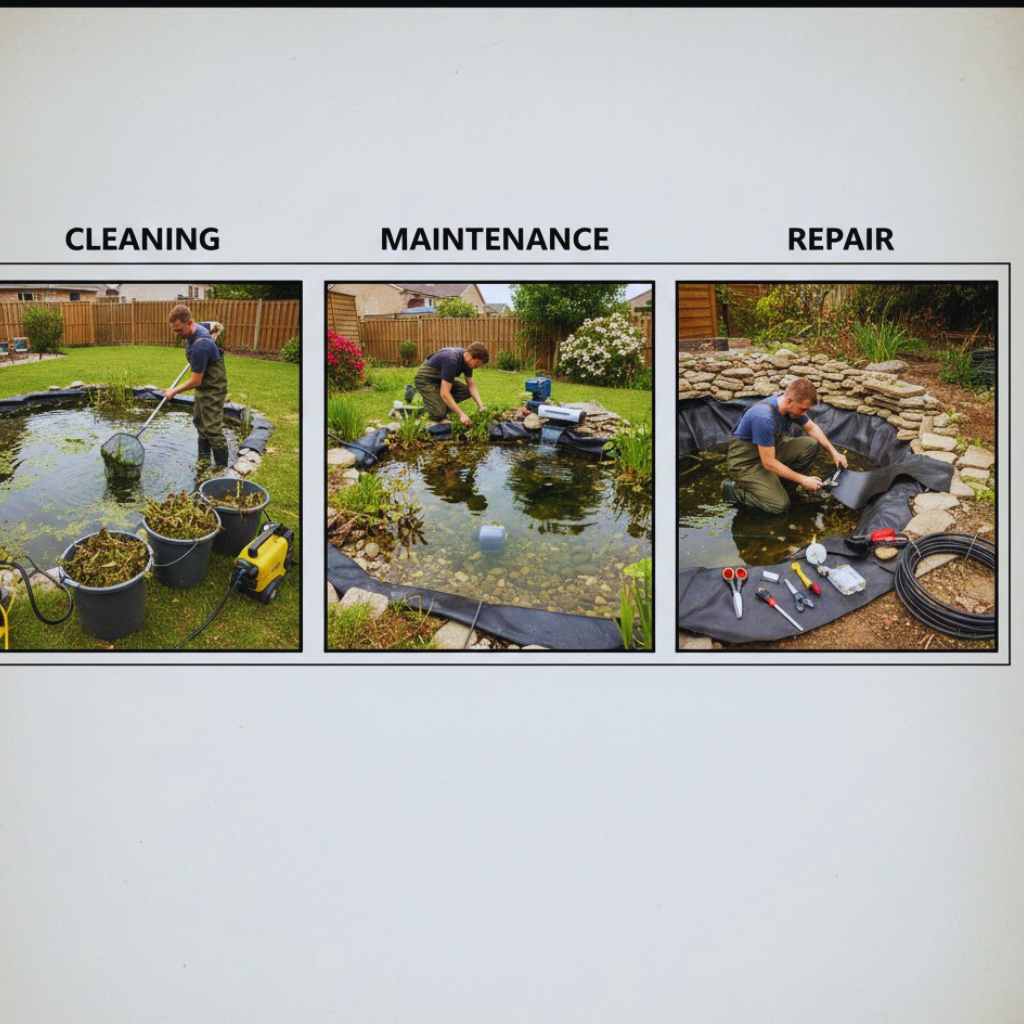
Before getting into tools or schedules, it helps to reset how this service is defined. Many pond owners use the terms cleaning, maintenance, and repair interchangeably. That confusion is one of the main reasons ponds stay stuck in a loop of short term fixes without lasting improvement.
Is Professional Pond Maintenance a One Time Service?
No, professional pond maintenance is not a one time service. It is an ongoing system of care designed to keep a pond stable over time, not just clean on a single day. Maintenance focuses on how the entire pond ecosystem functions week after week, including how waste is processed, how water moves through filtration systems, and how equipment performs under continuous load.
At a system level, professional maintenance manages living processes. Beneficial bacteria break down waste, filtration systems remove solids and support biological activity, and water chemistry must stay within a narrow range to avoid stress on fish. When one part drifts out of balance, pressure shows up elsewhere. Filters clog faster, algae gains a foothold, and fish become stressed. Preventative care is what keeps those small shifts from turning into recurring problems.
Are Pond Cleaning, Pond Maintenance, and Pond Repair the Same Thing?
No, they solve different problems and serve different purposes. Treating them as interchangeable is what leads to repeated cleanings without real progress.
Pond cleaning focuses on removing debris and sludge. It deals with leaves, sediment, and visible buildup that restrict flow or affect appearance. Cleaning can improve conditions temporarily, but it does not correct the biological or mechanical causes of that buildup.
Pond maintenance is about ongoing system stability. It includes routine inspection, filtration servicing, water testing, and small adjustments that keep biological and mechanical systems working together. Maintenance is what prevents the same symptoms from returning after a cleaning.
Pond repair addresses failure. This includes fixing broken pumps, damaged filters, leaks, or structural issues. Repairs become necessary when maintenance has been inconsistent or when equipment reaches the end of its usable life.
Understanding these differences matters. When cleaning, maintenance, and repair are treated as the same service, ponds tend to cycle through short term improvements followed by the same problems resurfacing.
What Professional Pond Maintenance Is Designed to Prevent
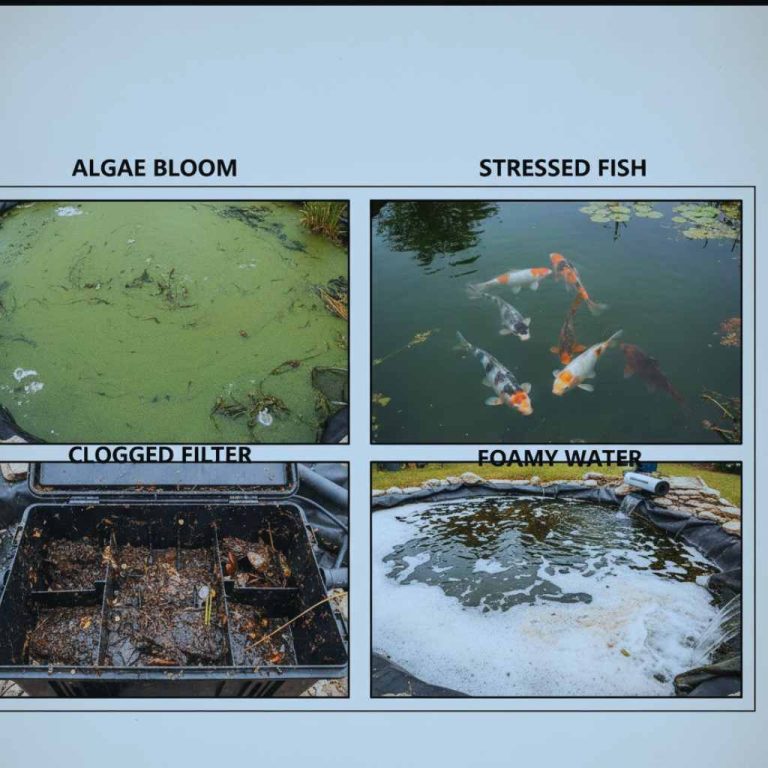
Most people do not call for professional maintenance because they want a cleaner looking pond. They call because something keeps going wrong. The same issues show up again and again, even after time, money, and effort have already been spent.
Do Algae Blooms Keep Coming Back Even After Cleaning?
Yes, recurring algae blooms usually mean the pond system is out of balance, not that it needs another cleaning. Algae grows when excess nutrients build up faster than the pond can process them. Skimming debris or rinsing filters may improve appearance for a short time, but it does not reduce the nutrient load feeding the algae.
Professional maintenance focuses on why nutrients are accumulating in the first place. That includes how waste breaks down, how effectively filtration is supporting beneficial bacteria, and whether circulation is moving water through the system properly. When those pieces are managed together, algae loses its advantage and becomes easier to control long term.
Can Poor Maintenance Cause Fish Stress or Unexplained Losses?
Yes, fish stress is often tied to water quality swings caused by inconsistent maintenance. Fish respond quickly to changes in ammonia levels, oxygen availability, and temperature stability. These changes are not always visible, especially in ponds that still look clear.
Without routine testing and system checks, small chemistry shifts can build quietly until fish show signs of stress. That may look like reduced appetite, lethargy, or gasping near the surface. In more severe cases, it can lead to illness or sudden losses. Maintenance helps keep conditions stable so fish are not constantly adapting to fluctuating water quality.
Do Pumps and Filters Burn Out Faster Without Proper Care?
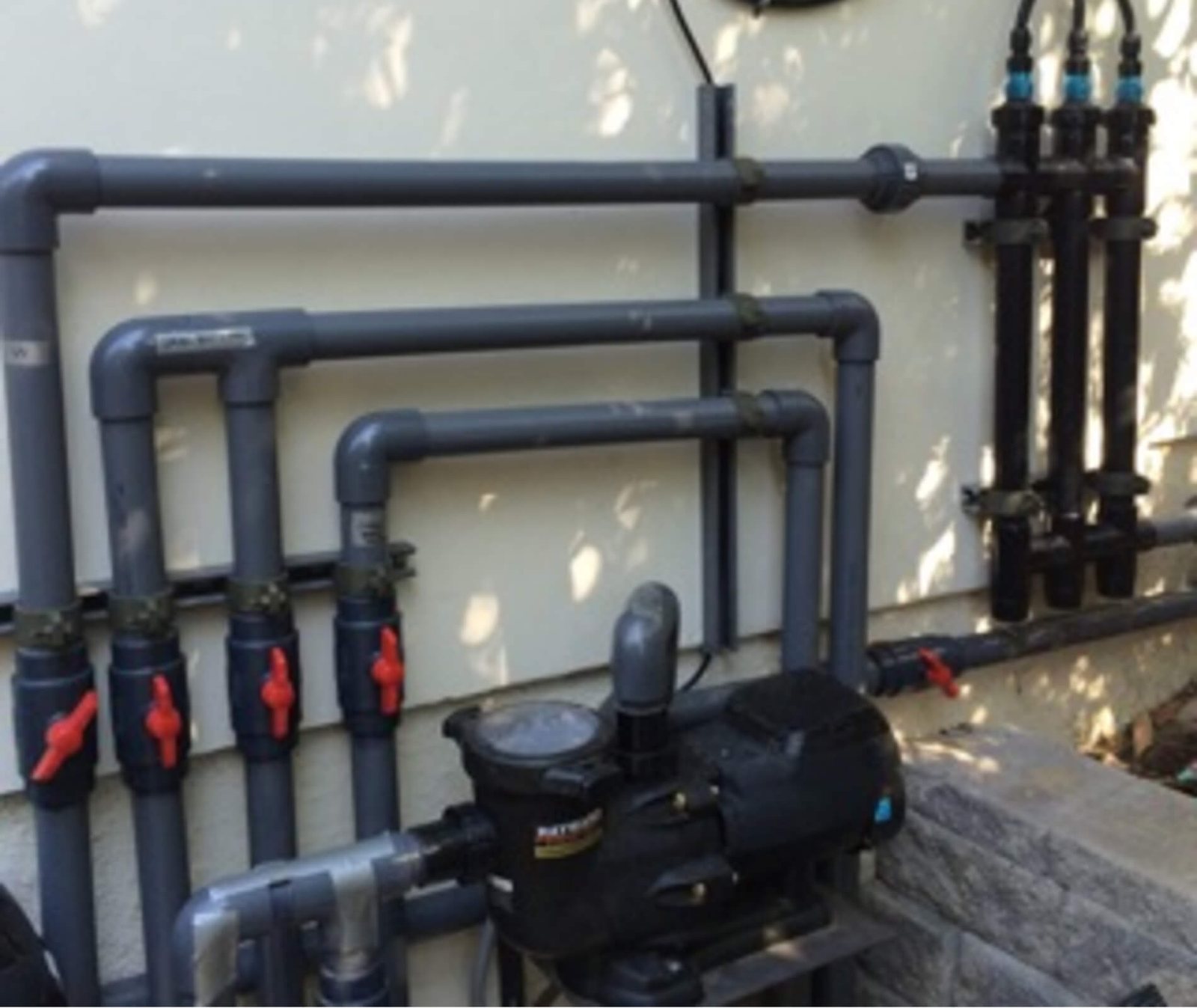
Yes, improper or irregular maintenance shortens the life of pond equipment. Pumps and filters are designed to move water and manage waste continuously. When filters clog or pumps pull against restricted flow, they work harder than intended.
Over time, that extra strain leads to overheating, reduced performance, and eventual failure. Professional maintenance catches these issues early by monitoring flow, cleaning components correctly, and adjusting the system before equipment damage occurs. Preventing burnout is usually far less expensive than replacing failed parts.
Are Odors, Sludge, and Discolored Water Warning Signs?
Yes, foul odors, sludge buildup, and water discoloration usually signal biological breakdown. These issues often develop when organic material accumulates faster than beneficial bacteria can process it. As waste breaks down improperly, oxygen levels drop and anaerobic conditions can form.
This is why some ponds develop a sulfur like smell or dark, murky water even after surface debris is removed. Maintenance addresses how waste is processed throughout the system, not just what is visible at the surface, which is key to restoring normal biological function.
Why Does a Pond Look Clean but Still Keep Failing?
Because cleaning treats symptoms while maintenance addresses the system. A pond can look clear and still be unstable underneath. When filtration, circulation, and water chemistry are not working together, problems resurface weeks later in slightly different forms.
This is the cycle many pond owners get stuck in. The pond is cleaned, it improves briefly, and then algae returns, fish show stress, or equipment struggles again. Professional maintenance is designed to break that cycle by stabilizing the system as a whole instead of reacting to each symptom individually.
Who Actually Needs Professional Pond Maintenance (and Who Doesn’t)
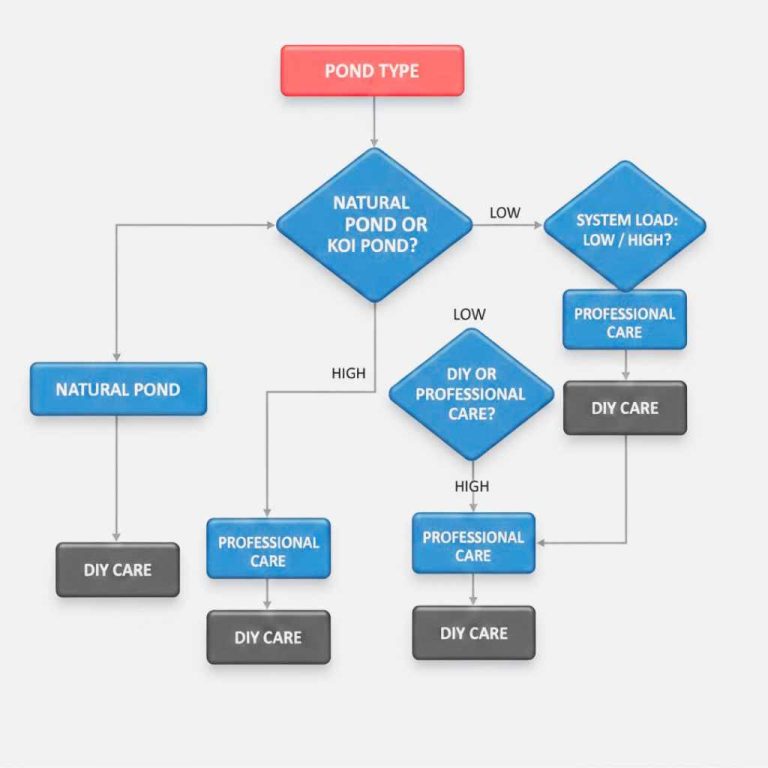
One of the most common mistakes pond owners make is assuming every pond needs the same level of care. Some people overpay for services they do not actually need. Others try to manage complex systems on their own and end up dealing with repeat failures. The difference usually comes down to system load. How much waste the pond produces, how complex the equipment is, and how tightly water quality needs to be controlled all determine whether professional maintenance is optional or necessary.
Do Some Ponds Require Professional Maintenance?
Yes, ponds with higher biological and mechanical demands usually require professional maintenance to stay stable. These systems operate within tighter limits, which leaves little room for missed checks or inconsistent care.
-
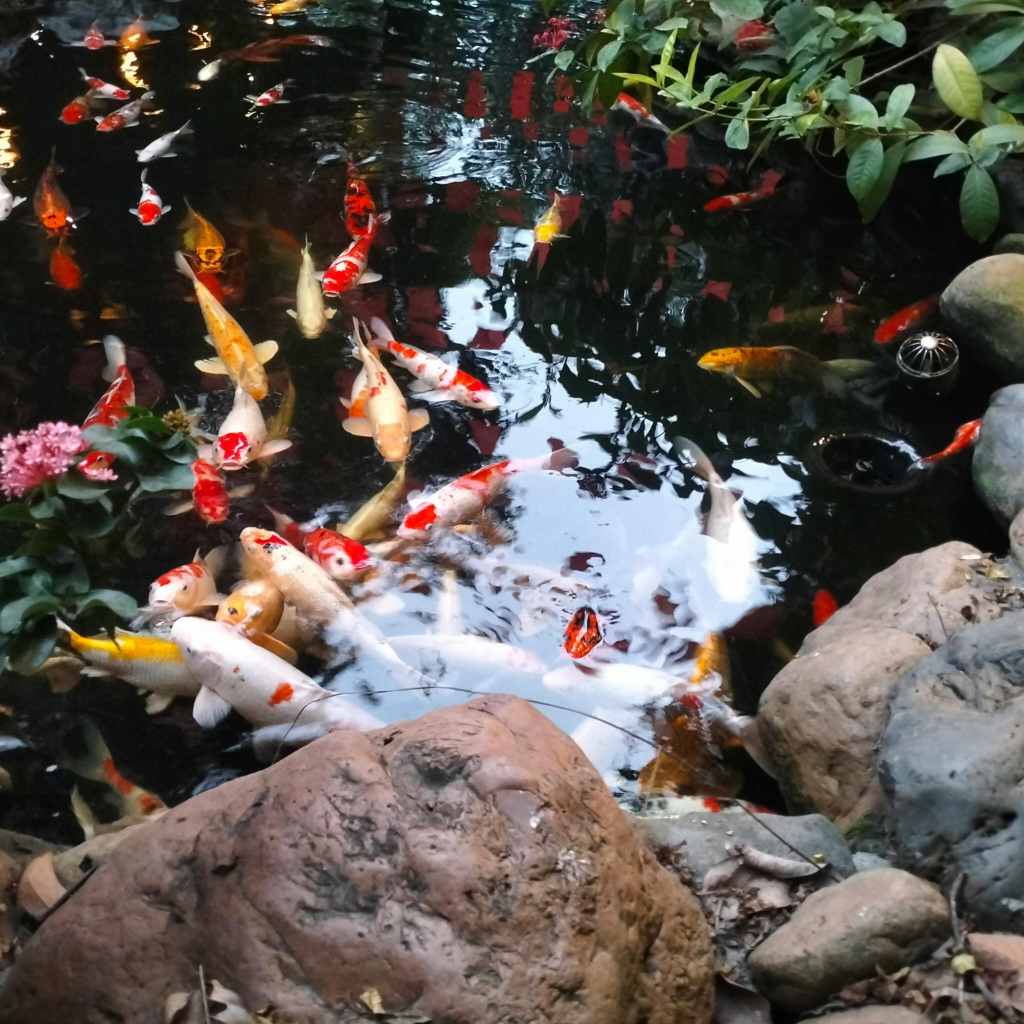
Koi ponds with high fish load. Fish waste accumulates continuously, and the more fish a pond supports, the faster water quality can shift. When biological filtration falls behind, stress shows up first in fish behavior and then in recurring water problems.
-
Ponds with complex filtration or waterfalls. Multiple pumps, filters, skimmers, or waterfall circuits increase flow demands and create more points where small issues can turn into system wide problems. These setups rely on routine adjustments to keep water moving and filters working as intended.
-
Ponds in high sun, warm climates with constant algae pressure. Warm temperatures and direct sunlight accelerate biological activity. Algae grows faster, oxygen demand rises, and chemistry changes happen more quickly, which makes ongoing oversight more important.
-
Commercial ponds, HOA ponds, and high visibility water features. These ponds are expected to perform consistently, not just look acceptable after occasional cleanings. Scheduled maintenance is what keeps them stable under constant use and exposure.
Can Some Ponds Be Maintained Without Professional Help?
Yes, DIY care can be sufficient when system demands are low and conditions change slowly. The key factor is whether the pond functions as a simple environment rather than a tightly managed system.
-
Lightly stocked decorative ponds. With minimal fish waste and basic circulation, these ponds are more forgiving and often stay stable with routine debris removal and observation.
-
Wildlife ponds without mechanical systems. Natural ponds that rely on plant balance rather than pumps or filters tend to shift gradually and do not require frequent intervention.
-
Seasonal only features. Ponds that operate part of the year or are shut down during colder months may not justify ongoing professional maintenance.
The boundary is clear. As soon as fish density increases, filtration becomes more complex, or water quality needs to stay within narrow limits, DIY care starts breaking down. Knowing where a pond sits on that spectrum prevents wasted effort and helps set realistic expectations.
The Professional Pond Maintenance Workflow (Step by Step)
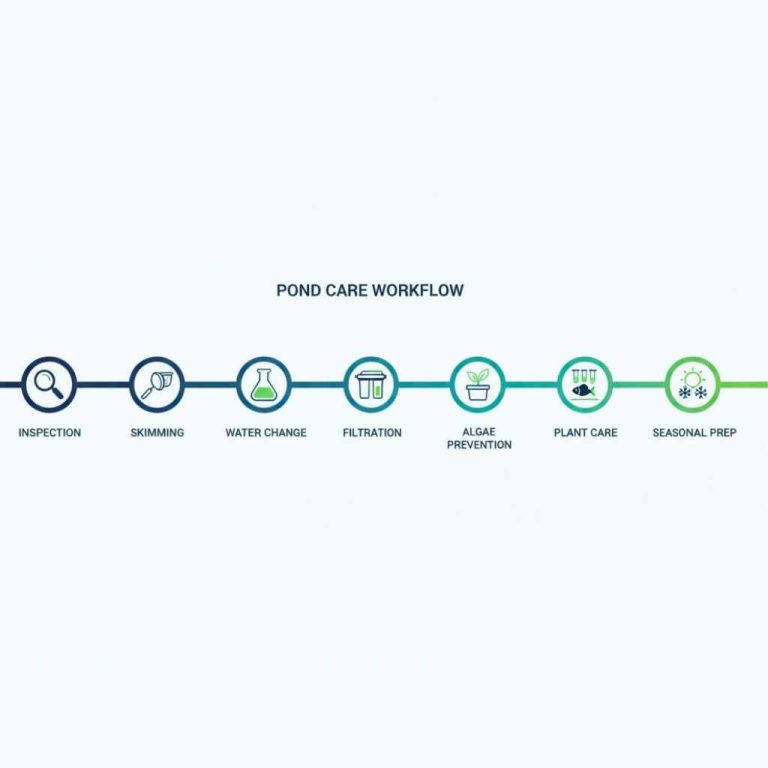
Most pond problems persist because the work being done is incomplete or done out of order. Professional pond maintenance follows a consistent workflow that starts with observation and ends with prevention. Each step builds on the one before it. When steps are skipped or rushed, small imbalances turn into recurring problems.
Step 1: On-Site Assessment and Baseline Inspection
Yes, every professional maintenance visit begins with a baseline inspection before any cleaning takes place. This step establishes context so the work that follows addresses the real problem instead of surface symptoms.
A visual water assessment looks at clarity, color, surface foam, and odor. These signs often indicate whether nutrients are accumulating or oxygen levels are under strain. Fish behavior is evaluated at the same time. Reduced activity, surface gasping, or sudden hiding patterns are early indicators of stress that may not yet be visible in the water itself.
Professionals also distinguish between leak indicators and normal evaporation. Consistent water loss near fittings or plumbing points suggests a system issue, while uniform loss across the pond usually reflects weather conditions. An equipment inventory follows so pumps, filters, UV clarifiers, and aeration systems are identified and assessed based on how the system is actually configured.
Step 2: Debris Removal and Surface Skimming
Yes, surface debris and skimmer baskets are cleared early, but only to restore flow and access. This step removes obstructions without disturbing the biological structure of the pond.
Leaves, organic debris, and clogged skimmer baskets restrict circulation and reduce oxygen exchange. Clearing these areas allows the system to function normally again. Intake protection is also checked so debris does not reach pumps or impellers.
What professionals deliberately avoid is aggressive disturbance of settled sediment or unnecessary scrubbing of surfaces. Over-cleaning at this stage can release trapped nutrients and disrupt biological balance, which often worsens algae and water quality issues later.
Step 3: Filtration System Servicing
Yes, filtration is serviced carefully to restore function without harming biological stability. The goal is to improve performance, not reset the system.
How Is Mechanical Filtration Cleaned Properly?
Yes, mechanical filtration is cleaned to restore flow rather than appearance. Filter media is rinsed using pond water or dechlorinated water so debris is removed without killing beneficial organisms. Reduced waterfall output or rising water levels inside filter chambers are common signs of flow restriction.
Why Is Biological Filtration Protected During Maintenance?
Yes, biological filtration must be preserved because it processes waste continuously. Beneficial bacteria live on filter media and pond surfaces. Over-cleaning or using untreated tap water can destroy these colonies. When that happens, ammonia and nitrite levels rise and system stability breaks down.
How Are UV Clarifiers Checked for Effectiveness?
Yes, UV clarifiers are inspected even if they appear to be operating. Bulbs lose effectiveness with age, and sleeves can foul with mineral buildup or biofilm. A visible light does not always mean the unit is still controlling suspended algae.
Step 4: Pump, Plumbing, and Circulation Checks
Yes, circulation is evaluated as a system, not just by whether water is moving. Flow rates are assessed through system behavior rather than numbers alone.
Weak waterfalls, stagnant areas, or uneven surface movement signal circulation problems. Impellers and intake screens are inspected for buildup that reduces efficiency. Plumbing connections are checked for air leaks, and oxygen-poor zones are identified because these areas often become starting points for algae growth or waste accumulation.
Step 5: Water Testing and Interpretation
Yes, water testing is used to understand trends rather than capture isolated readings. Results only make sense when interpreted alongside system performance.
Testing focuses on how well the pond is processing waste, maintaining stability, and supporting fish health over time.
How Does the Nitrogen Cycle Affect Pond Stability?
Yes, ammonia, nitrite, and nitrate levels show how effectively waste is being processed. Elevated ammonia or nitrite indicates biological filtration stress even when the water still looks clear.
Why Do pH and Alkalinity Matter Together?
Yes, pH stability depends on adequate alkalinity. Low alkalinity allows rapid pH swings, which stress fish and beneficial bacteria. Stable alkalinity buffers the system against sudden changes.
Why Are Temperature and Dissolved Oxygen Checked?
Yes, warmer water holds less oxygen while increasing biological demand. Monitoring both helps prevent fish stress during hot periods.
Why Is Chlorine or Chloramine a Concern After Water Additions?
Yes, untreated tap water can harm fish and beneficial bacteria. After top-offs or water changes, disinfectants must be neutralized before circulation resumes fully.
Step 6: Algae Control and Nutrient Management
Yes, algae control focuses on reducing nutrient pressure rather than killing algae directly. Different algae types such as string algae, green water, or surface films point to specific imbalances.
Maintenance targets nutrient sources like decomposing debris, excess feeding, or poor circulation. Non-destructive strategies are used so algae pressure decreases gradually without shocking the system or harming fish.
Step 7: Fish Health Check and Feeding Guidance
Yes, fish health is evaluated because fish respond first to instability. Stress indicators include erratic swimming, isolation, or surface gasping.
Feeding practices are reviewed based on season and water temperature. Overfeeding increases waste load, while underfeeding weakens fish. Stocking density is also assessed because crowding increases oxygen demand beyond what filtration can support.
Step 8: Top-Offs, Partial Water Changes, and Safe Refill Practices
Yes, water changes are used strategically, not automatically. Partial changes may be appropriate when nutrients accumulate faster than the system can process them.
Dechlorination is always addressed, and temperature differences are managed carefully. Sudden changes can cause more harm than leaving water chemistry slightly off balance.
Step 9: Preventative Planning and Documentation
Yes, documentation is what turns maintenance into prevention. Maintenance logs track filter servicing, water test results, and equipment observations.
This history helps identify patterns before failures occur. Seasonal planning accounts for temperature shifts, debris load, and equipment age so the system is prepared rather than reactive.
How Often Professional Pond Maintenance Should Be Done
Does Maintenance Frequency Depend on Pond Type and System Load?
Yes, maintenance frequency depends heavily on pond type and how much biological and mechanical load the system carries. Different ponds behave very differently even when they are the same size.
Koi ponds typically require the most frequent maintenance. Fish produce waste every day, and higher stocking density increases pressure on filtration and oxygen levels. Because water quality can shift quickly, these ponds benefit from consistent oversight to prevent stress and system instability.
Decorative ponds usually require less frequent maintenance. With few or no fish, waste production is lower and biological demand is lighter. As long as circulation and filtration remain functional, these ponds tend to stay stable longer between visits.
Wildlife ponds operate differently. When they rely primarily on plants and natural balance instead of pumps or filters, changes happen more slowly. Maintenance needs are less frequent, but when problems do develop, they often take longer to correct.
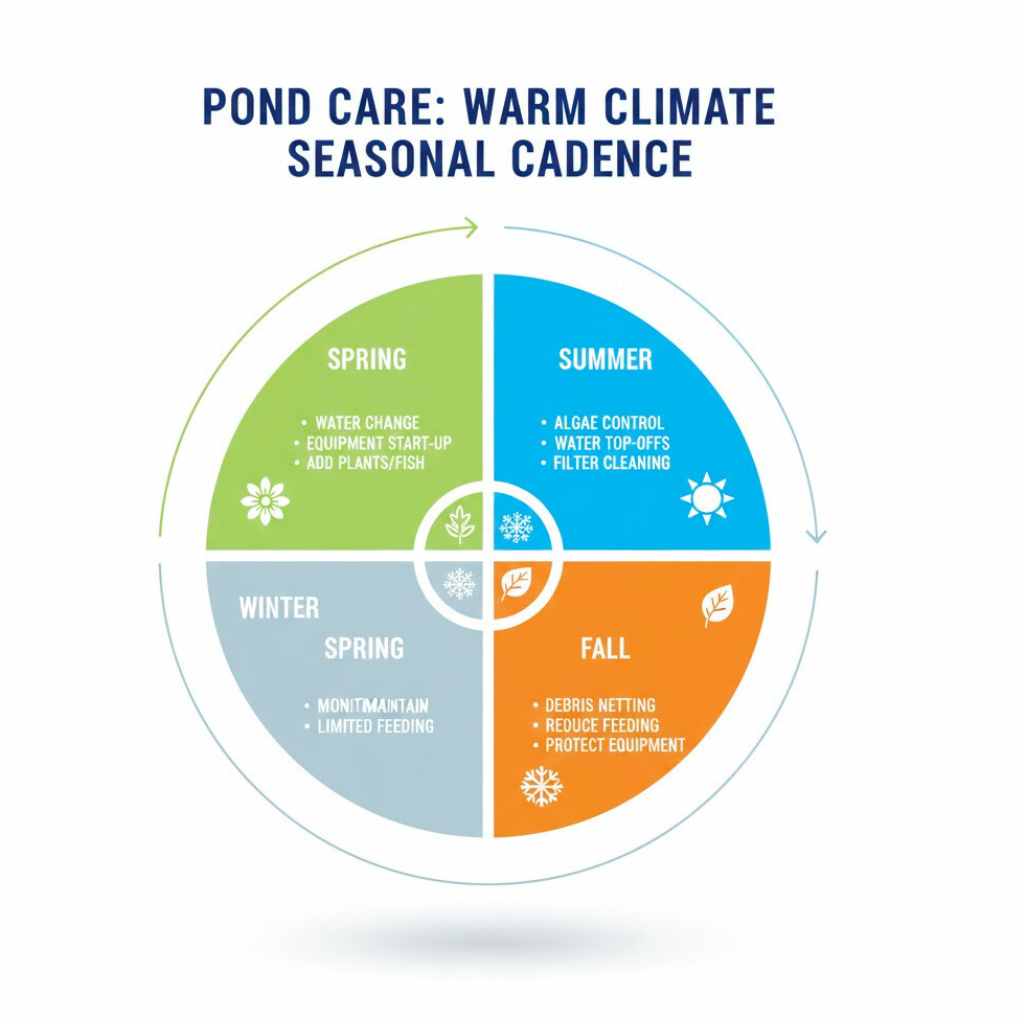
Does Maintenance Follow Seasonal Patterns in Warm Climates?
Yes, seasonal conditions strongly influence how often maintenance is needed, especially in warm climates. Temperature and sunlight affect biological activity throughout the year.
Spring startup is a critical period. As water warms, biological activity increases and systems come back online after slower winter conditions. Filters, pumps, and water quality need closer attention during this transition to prevent early season algae growth.
Summer creates the highest demand. Warm water holds less oxygen while increasing fish metabolism and algae growth. During this period, maintenance often needs to happen more frequently to manage nutrient buildup, circulation, and oxygen availability.
Fall shifts the focus. Falling leaves and organic debris add to the nutrient load, even as temperatures begin to drop. Managing debris and keeping filtration clear helps prevent problems that can carry into winter.
Winter adjustments depend on climate and system design. In milder regions, ponds may continue operating year round with reduced biological activity. Maintenance during this period focuses on monitoring equipment, maintaining circulation, and preventing gradual decline rather than active intervention.
Are There Warning Signs That Maintenance Is Overdue?
Yes, visible warning signs usually appear after the pond has already been under strain for some time. By the time these show up, the system is reacting, not operating normally.
Sudden green water indicates that nutrient levels have exceeded what the filtration and biological processes can manage. This is often a late signal, not an early one.
Fish gasping near the surface points to oxygen stress. This commonly develops during warm periods or when circulation has been restricted long enough for dissolved oxygen levels to drop.
Reduced waterfall flow signals clogged filters, restricted plumbing, or pump strain. This affects both water movement and gas exchange and tends to worsen quickly if left unaddressed.
Odors or persistent foam indicate biological breakdown. These conditions form when organic waste accumulates faster than beneficial bacteria can process it.
When these signs appear, the pond is already compensating for imbalance. Regular maintenance is what prevents conditions from reaching this stage rather than reacting after the fact.
What a Professional Pond Maintenance Visit Typically Includes
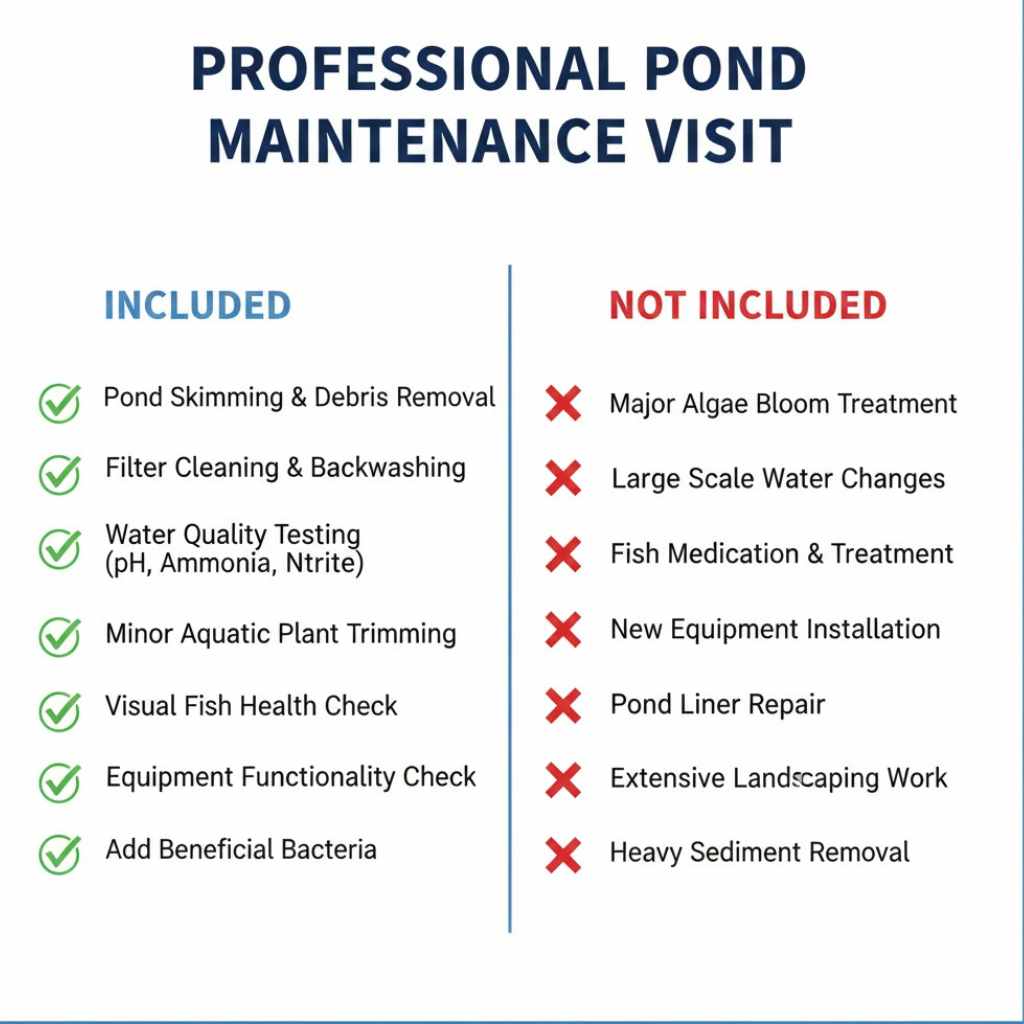
A lot of frustration around pond maintenance comes from one simple misunderstanding. People expect everything to be fixed in one visit. When that does not happen, it feels like something was missed. In reality, a professional maintenance visit is not meant to reset the entire pond. It is meant to keep the system steady and stop small problems from turning into bigger ones. Once that’s clear, the rest of the visit makes a lot more sense.
What Is Typically Included in a Standard Maintenance Visit?
Yes, a professional maintenance visit is focused on system health and prevention, not major corrective work. The goal is to keep things operating where they should be and catch early signs of trouble.
Every visit starts with inspection. Water condition, fish behavior, and overall system performance are looked at before anything is touched. That first look matters. It shows whether the pond has been slowly drifting or if something changed suddenly since the last visit.
Skimmer and filter servicing comes next. Skimmer baskets are cleared so surface water can move properly again. Filters are serviced carefully to restore flow without stripping away the biological layer that keeps waste processing stable. This is not about making equipment look clean. It is about keeping water moving and systems working as designed.
Pump and flow checks are part of routine care. Flow is judged by what the system is doing, not by assumptions. A weaker waterfall, uneven circulation, or slower surface movement usually points to early restriction that can be corrected before equipment starts working harder than it should.
Water testing supports decisions rather than guesswork. Ammonia, pH, alkalinity, and temperature are checked in context with fish load and recent conditions. Numbers are used to confirm what the system is already showing, not to trigger drastic changes.
Minor adjustments are made when needed. That might mean fine tuning flow, correcting a small imbalance, or adjusting feeding guidance. These small changes are where maintenance does most of its long term work. They keep the pond steady instead of chasing problems after they show up.
What Is Usually Not Included Unless Quoted Separately?
Yes, some types of work fall outside routine maintenance and are handled separately. These jobs take more time, specialized tools, or structural access.
Major repairs are one example. Replacing failed pumps, fixing damaged filters, or correcting plumbing problems goes beyond routine care and is usually quoted once the issue is identified.
Leak detection is another. Tracking down a leak often involves isolation testing or physical inspection that cannot be done during a standard visit.
Equipment replacement is not part of routine maintenance. Worn or failing components may be identified, but replacing pumps, UV units, or filtration hardware requires separate planning and approval.
Full drain and clean services are also outside normal maintenance. These are disruptive procedures used only in specific situations and are not part of ongoing system care.
Structural rebuilds fall entirely outside the scope of maintenance. Liner failure, structural settling, or major redesign work requires a dedicated project, not a routine visit.
Understanding these boundaries helps clarify what maintenance is meant to do. It keeps systems stable and problems small. It is not a catch all solution for every issue a pond can develop.
Pond Cleaning vs Pond Maintenance vs Repair (When Each Is Needed)
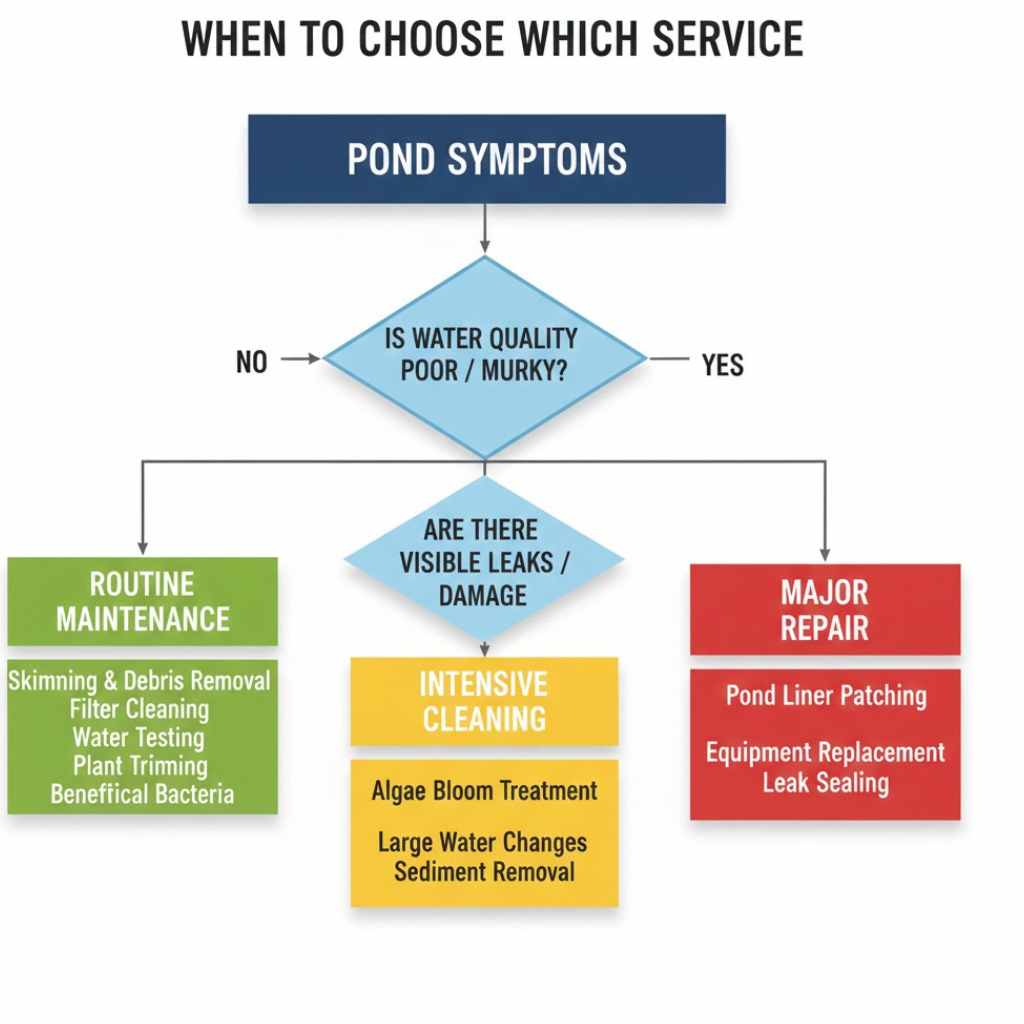
A lot of pricing friction and frustration comes from mixing these three services together. Pond cleaning, pond maintenance, and pond repair are related, but they solve different problems. Knowing which one a pond actually needs prevents wasted money, unrealistic expectations, and repeat issues that never fully go away.
When Is Pond Cleaning Alone Appropriate?
Yes, pond cleaning alone can be appropriate when the system itself is healthy and only surface conditions have declined. Cleaning makes sense when debris buildup is the main issue, not system imbalance.
This typically applies to ponds where circulation is working, filtration is keeping up, and water quality remains stable once debris is removed. Leaves, sediment, and organic matter can accumulate faster than normal during certain seasons, especially after storms or heavy leaf drop. In those cases, removing physical waste restores flow and appearance without needing deeper system work.
Cleaning is also appropriate for lightly stocked decorative ponds where biological demand is low. As long as water quality stays consistent after cleaning, there may be no need for ongoing maintenance beyond periodic debris removal.
When Is Ongoing Pond Maintenance Necessary?
Yes, ongoing maintenance is necessary when the pond relies on mechanical and biological systems to stay stable. Once fish load increases or filtration becomes more complex, cleaning alone stops being enough.
Maintenance is needed when problems return weeks after cleaning. Algae comes back quickly, filters clog repeatedly, or fish show stress despite clear water. These are signs that the system is drifting out of balance, not that it needs more frequent cleaning.
Ongoing maintenance keeps biological filtration functioning, supports stable water chemistry, and reduces stress on equipment. It focuses on preventing conditions that cause recurring issues rather than reacting to symptoms after they appear.
When Is Professional Repair Unavoidable?
Yes, professional repair becomes unavoidable when components fail or structural problems develop. At this point, neither cleaning nor routine maintenance can correct the issue.
Repairs are necessary when pumps stop moving water, filters crack or collapse, plumbing leaks develop, or liners fail. These problems interrupt system function directly and require physical correction. Continuing to clean or adjust water chemistry without addressing the failure only delays the inevitable and often increases damage.
Repair is also unavoidable when equipment has reached the end of its service life. Wear, heat, and constant use take a toll over time. Replacing or rebuilding components restores function so maintenance can once again do its job.
Understanding when to clean, when to maintain, and when to repair removes guesswork. Each service has a purpose. Using the right one at the right time is what keeps ponds stable instead of cycling through short term fixes.
Why DIY Pond Care Often Breaks Down
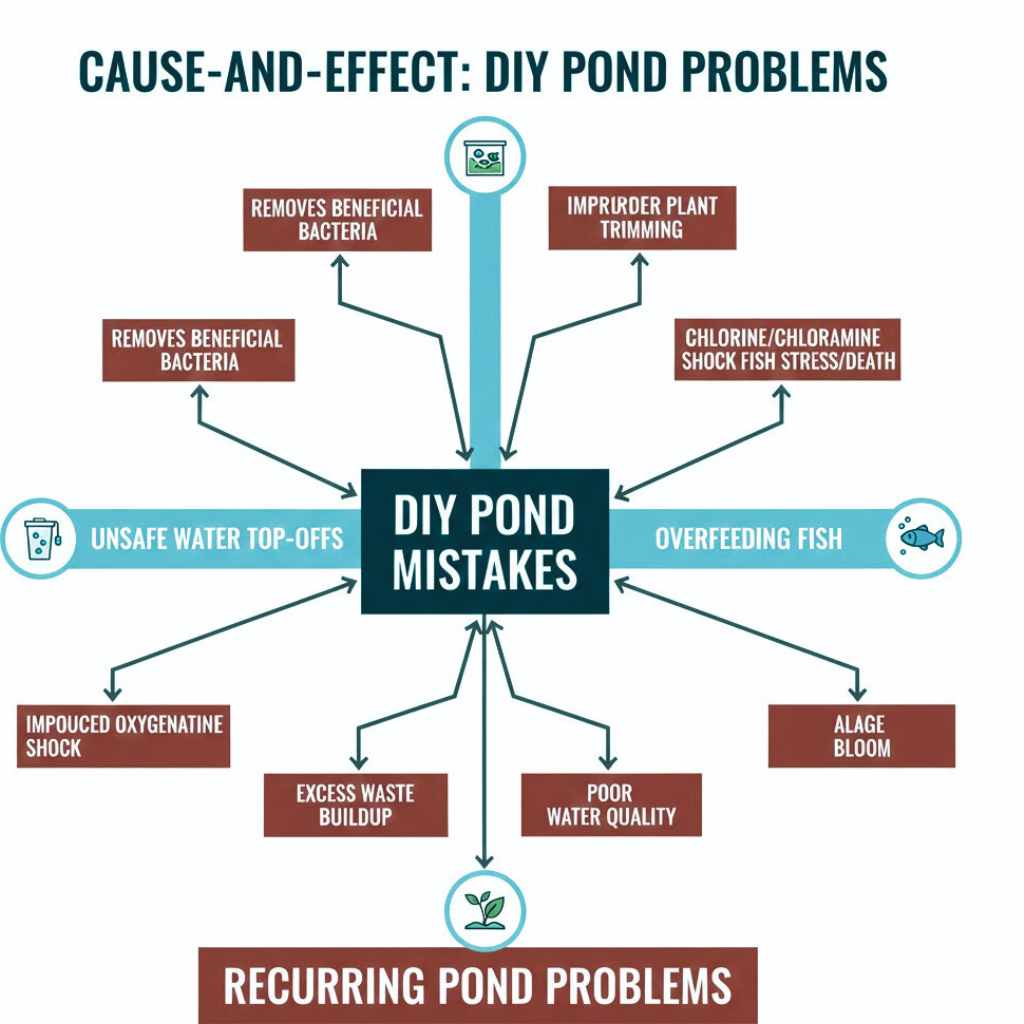
Most pond owners start with DIY care for a good reason. It feels manageable at first, and many problems seem small when they first appear. The frustration usually comes later, when the same issues keep returning despite regular effort. DIY care often breaks down not because people are careless, but because ponds behave like systems, not simple features.
Does Treating Symptoms Instead of Nutrient Load Cause Repeat Problems?
Yes, treating symptoms without addressing nutrient load is one of the most common reasons DIY care stalls. Clearing green water, skimming debris, or rinsing filters can make a pond look better temporarily, but it does not reduce the nutrients feeding algae and bacteria.
Nutrients come from fish waste, decomposing organic matter, and excess feeding. If those inputs stay the same, the system remains under pressure. The result is a cycle where the pond improves briefly and then slips back into the same condition weeks later.
Can Cleaning Filters the Wrong Way Disrupt the System?
Yes, cleaning filters incorrectly can damage the biological processes that keep water stable. Beneficial bacteria live on filter media and surfaces throughout the pond. These bacteria process waste continuously and cannot be replaced instantly.
Rinsing filters with untreated tap water or over-cleaning them removes those bacteria. When that happens, ammonia and nitrite levels can rise quickly, even if the water still looks clear. Many DIY efforts accidentally reset the system instead of supporting it.
Are Water Top Offs Risky When Done Incorrectly?
Yes, unsafe water top offs can stress fish and disrupt water chemistry. Adding fresh water seems harmless, but untreated tap water often contains chlorine or chloramine that can harm fish and beneficial bacteria.
Temperature differences matter as well. Adding large volumes of cold or hot water too quickly can shock fish and alter dissolved oxygen levels. Without proper dechlorination and gradual adjustment, top offs can create more problems than they solve.
Does Ignoring Circulation Dead Zones Lead to Hidden Issues?
Yes, poor circulation creates dead zones where problems develop quietly. Areas with weak water movement collect debris, lose oxygen, and become breeding grounds for algae and waste buildup.
These zones are easy to miss because surface water may still look fine. Over time, dead zones contribute to odors, sludge accumulation, and recurring algae growth that seems to come from nowhere.
Can Overusing Algae Treatments Make Things Worse?
Yes, overusing algae treatments often worsens long term stability. Chemical treatments may kill visible algae quickly, but they do not remove the nutrients that caused the growth.
When algae dies off suddenly, it decomposes in the pond, increasing oxygen demand and releasing nutrients back into the water. This can stress fish and trigger the next bloom. Repeated treatment without system correction keeps the pond in a reactive cycle.
How Do Small Equipment Issues Turn Into Larger Failures?
Yes, small equipment issues often snowball when they go unnoticed. A partially clogged intake, a slowing pump, or a minor air leak may not stop the system outright, but they reduce efficiency.
Over time, restricted flow increases strain on pumps and filters. Equipment runs hotter, clogs faster, and fails sooner than expected. What starts as a minor maintenance issue can turn into a costly repair simply because it was not caught early.
DIY care usually fails at the system level, not the effort level. Without consistent oversight of nutrients, circulation, and equipment performance, small imbalances compound until they overwhelm the pond.
How Much Professional Pond Maintenance Costs (and What Drives Price)
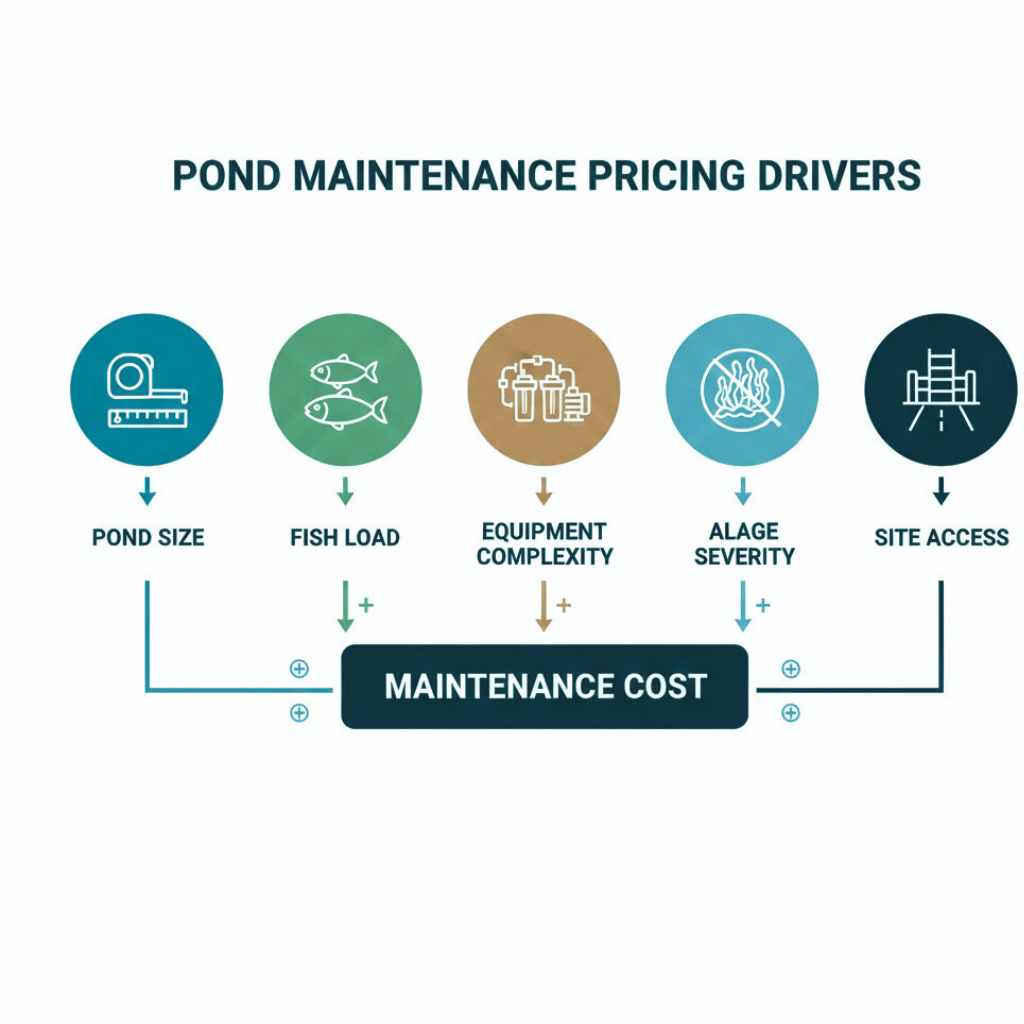
Pricing confusion usually starts with comparison. One pond owner pays far less than another, and it is not obvious why. The difference almost never comes down to appearance. It comes down to system load. What the pond is being asked to handle day after day determines how much work it actually requires to stay stable.
What Factors Influence Professional Pond Maintenance Pricing?
Yes, pricing is driven by how hard the system has to work, not just how large the pond looks. Two ponds of similar size can require very different levels of care once biology and equipment are considered.
Pond size and depth affect how much water is being managed and how long routine tasks take. Deeper ponds hold more water, which increases circulation demands and makes temperature and oxygen changes more impactful.
Fish load is often the biggest cost driver. A heavily stocked koi pond produces far more waste than a lightly stocked decorative pond. More waste means more pressure on filtration, more frequent checks, and less margin for error.
Filtration complexity matters because every added component increases service time. Multiple pumps, filters, skimmers, waterfalls, or UV units require inspection and adjustment. More equipment also means more places where small issues can quietly develop.
Algae severity reflects how stressed the system already is. Persistent algae usually points to excess nutrients or circulation limitations. Managing that pressure takes more time than basic upkeep.
Access and frequency influence cost as well. Ponds that are difficult to reach, require special access, or need more frequent visits due to system demand take more time to service consistently.
Is One Time Service Different From Ongoing Maintenance Programs?
Yes, one time service and ongoing maintenance solve different problems and carry different long term costs. A single visit addresses what is visible today. Ongoing maintenance focuses on keeping conditions from drifting tomorrow.
One time service is often used when a pond has fallen behind or when a specific issue needs attention. It can improve conditions in the short term, but it does not stop the system from slowly drifting again once normal load resumes.
Ongoing maintenance spreads work across the season. Instead of waiting for visible problems, the system is monitored and adjusted regularly. Over time, this approach usually costs less than repeated corrective visits because small issues are handled before they become expensive ones.
Why Do Cheaper Services Often Skip Critical Steps?
Because lowering price usually means reducing time on site. Maintenance takes observation, testing, and careful adjustment. When pricing drops too far, those steps are often the first to go.
Lower cost services tend to focus on fast, visible work. Debris removal, quick filter rinsing, and surface cleanup improve appearance, but deeper system checks are skipped. Water testing may be limited. Circulation issues and early equipment strain are missed.
This is why inexpensive services often lead to repeat visits without lasting improvement. The pond looks better briefly, then slips back into the same condition. Critical steps were skipped, not because they were unnecessary, but because there was not time to do them properly.
Understanding what drives cost makes pricing easier to evaluate. Professional maintenance is not priced by how fast it can be done, but by how effectively it keeps the system stable over time.
How Long It Takes to See Results from Professional Pond Maintenance
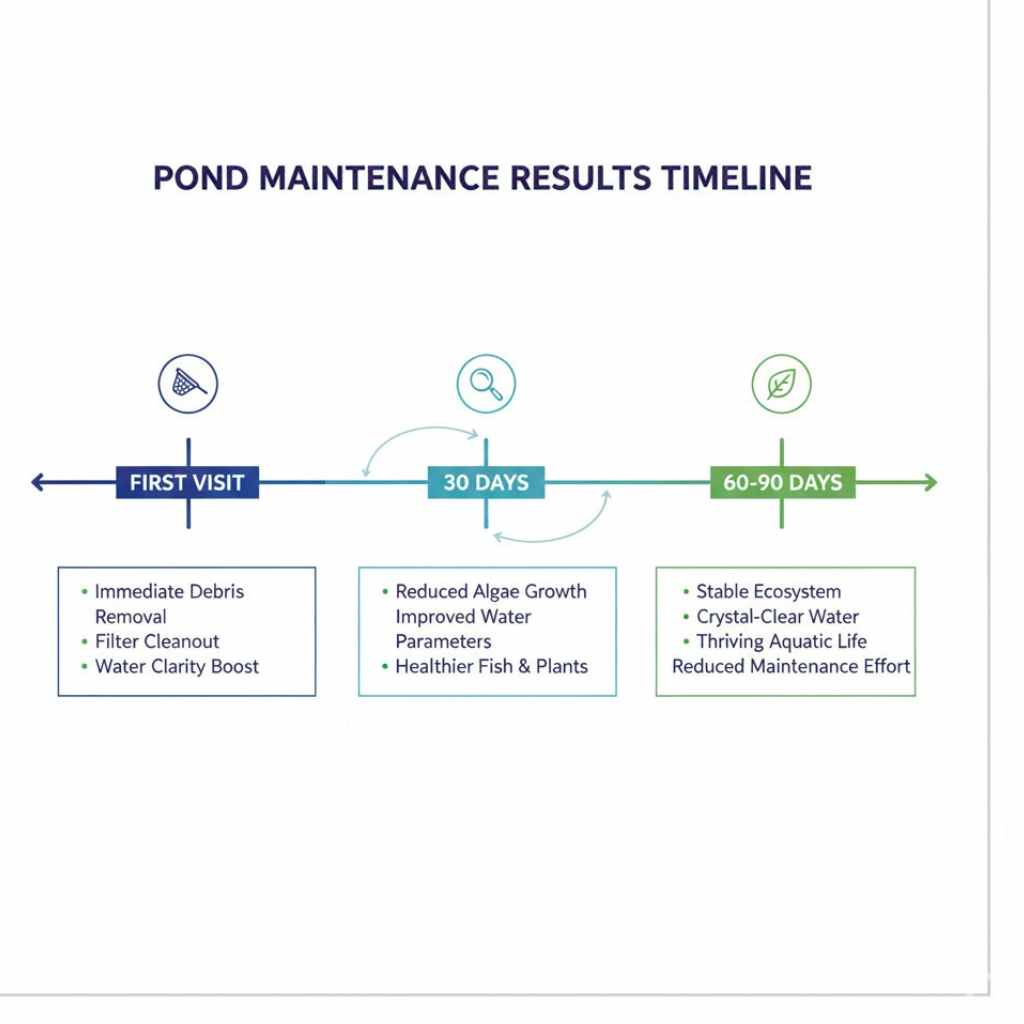
One of the most important expectations to set is timing. Pond systems do not reset instantly, even when maintenance is done correctly. Results come in stages because biological and mechanical systems need time to respond to changes. Knowing what improves first and what takes longer helps avoid frustration and unrealistic expectations.
What Improves After the First Maintenance Visit?
Yes, some improvements usually appear after the first visit, but they are early signs, not final results. The most noticeable changes tend to be functional rather than visual.
Circulation often improves quickly once debris is cleared and filters are serviced properly. Water movement becomes more consistent, waterfalls regain strength, and surface skimming works more effectively. Fish behavior may also improve as oxygen levels stabilize and immediate stressors are reduced.
What usually does not happen right away is perfect clarity. The system has been corrected, but it has not yet had time to rebalance fully.
Is There a 30 Day Stabilization Period?
Yes, the first 30 days are typically a stabilization phase. During this window, the pond begins adjusting to restored flow, cleaner filtration pathways, and more consistent water chemistry.
Beneficial bacteria populations start rebuilding where they were disrupted or underperforming. Water parameters become more predictable, even if they are not yet ideal. Algae pressure may fluctuate during this time as the system rebalances rather than moving in a straight line.
This period is about settling the system, not forcing rapid change.
Does Full Ecosystem Balance Take 60 to 90 Days?
Yes, meaningful biological balance usually develops over 60 to 90 days with consistent maintenance. This is when longer term improvements become noticeable.
By this stage, beneficial bacteria populations are more established, nutrient processing becomes more efficient, and algae growth is easier to manage. Water clarity improves more consistently, fish stress decreases, and equipment runs under less strain.
This timeline reflects how living systems respond. Biological processes do not accelerate just because maintenance was done once.
Why Don’t Algae and Water Clarity Correct Overnight?
Because algae and clarity are symptoms, not switches that can be flipped off. Algae responds to nutrient availability, light, and circulation. Even when conditions improve, existing algae must complete its life cycle before it fades.
Killing algae instantly often causes more problems than it solves. Sudden die off increases oxygen demand and releases nutrients back into the water. Professional maintenance focuses on gradually changing conditions so algae loses its advantage naturally.
Clear water that stays clear is the result of balance over time, not immediate intervention. Understanding that timeline is what separates realistic expectations from constant disappointment.
How to Choose a Pond Maintenance Company
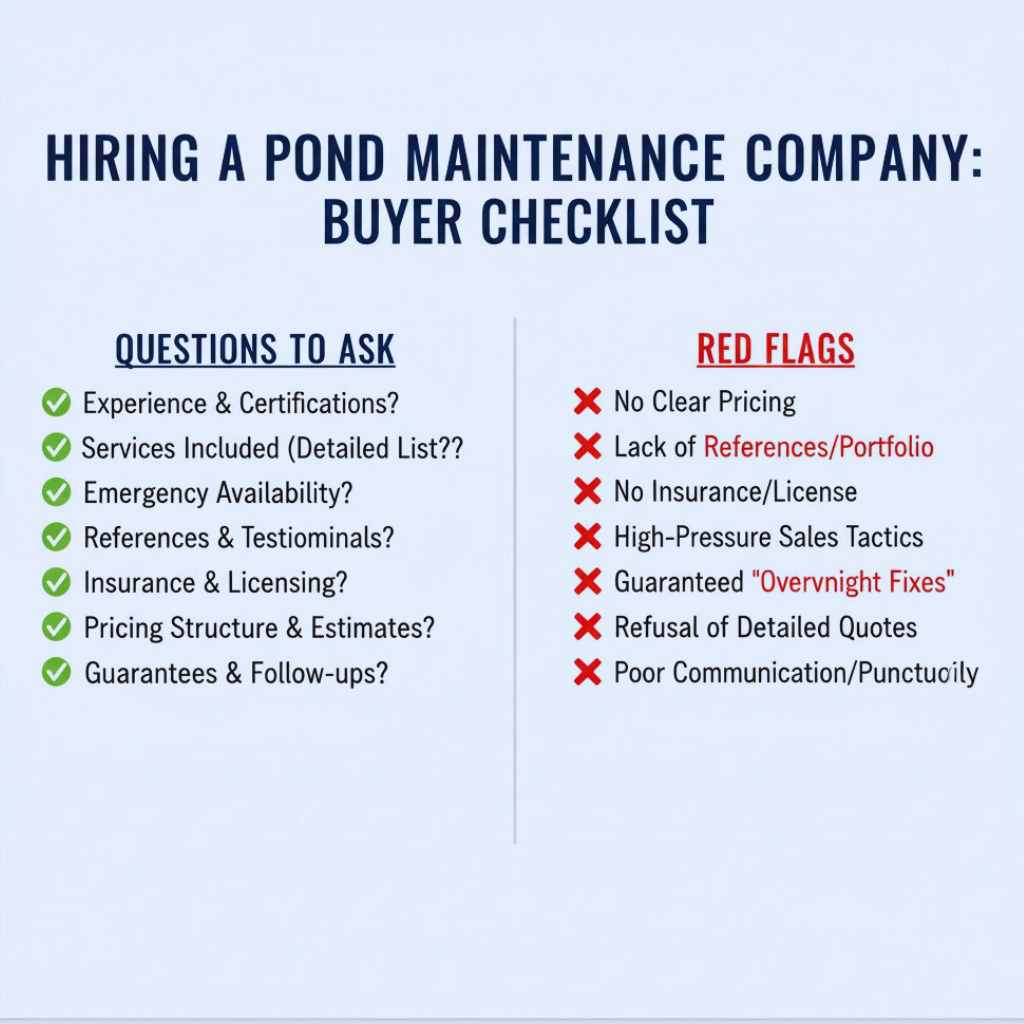
Once someone decides they need professional help, the next challenge is knowing who to trust. Pond maintenance is not a standardized service, and two companies can offer very different levels of care under the same label. Asking the right questions and knowing what to watch for makes it easier to spot real system management versus surface level cleanup.
What Questions Should You Ask Before Hiring a Pond Maintenance Company?
Yes, the way a company answers basic questions tells you a lot about how they actually work. Good maintenance follows a process. It is not vague or improvised from visit to visit.
Water testing practices are a good place to start. Ask what parameters are tested and how the results are used. A qualified provider should be able to explain why those readings matter and how they guide adjustments, not just say that testing is done.
Filter cleaning methods matter more than most people expect. Ask how filters are cleaned and what water is used. A clear explanation about protecting beneficial bacteria usually indicates the company understands system stability rather than just appearance.
Equipment familiarity is another strong signal. A maintenance provider should be comfortable explaining how pumps, filters, UV units, and aeration systems work together in your specific setup. Hesitation or generic answers often point to inconsistent care.
Documentation and follow up are often overlooked. Ask whether visits are logged, observations are recorded, and changes are tracked over time. Maintenance without documentation makes it hard to tell whether the system is improving or just being reset repeatedly.
What Are Red Flags When Evaluating Pond Maintenance Services?
Yes, certain approaches consistently signal shortcuts rather than professional care. These warning signs usually show up early.
A drain every visit approach is one of the clearest red flags. Regular draining disrupts biological balance and often means the system itself is not being managed properly.
Chemical first fixes are another concern. When treatments are used without addressing nutrients, circulation, or filtration, problems tend to return and fish stress increases.
No testing or explanations is a major warning sign. If results are promised without measurements or reasoning, the work is likely reactive rather than preventative.
What Should Good Maintenance Look Like After 30 to 60 Days?
Yes, meaningful results should be noticeable after 30 to 60 days when maintenance is done correctly. These changes reflect system stability rather than quick fixes.
Water clarity should become more consistent instead of cycling between clear and green. Algae rebound should slow as nutrient pressure is reduced rather than treated repeatedly.
Flow should remain steady between visits. Waterfalls, returns, and surface movement should not decline quickly after service.
Fish behavior often becomes calmer. Reduced stress shows up as more consistent feeding, fewer surface gasping episodes, and steadier activity overall.
These outcomes do not come from a single visit. They indicate the pond is being maintained as a system and that care is addressing causes rather than symptoms.
Common Pond Maintenance Questions Explained
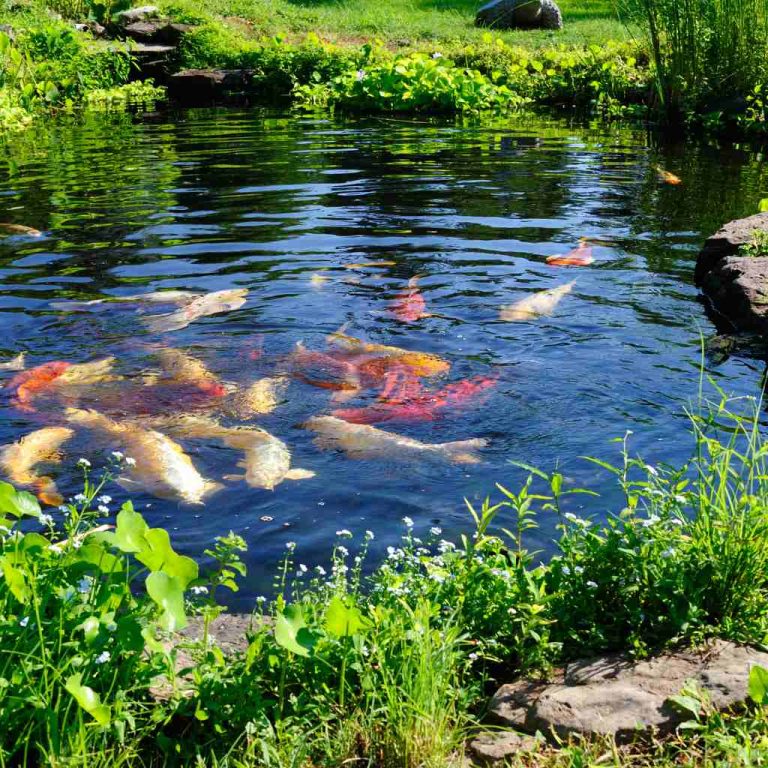
This section brings together the questions pond owners ask once they start looking past surface fixes and into how their system actually works. These are not edge cases. They show up repeatedly because they sit at the overlap between maintenance, biology, and equipment behavior.
Is Pond Maintenance the Same as Pond Cleaning?
No, pond maintenance and pond cleaning are not the same thing. Pond cleaning focuses on removing visible debris, sludge, or buildup. Pond maintenance manages how the entire system functions over time.
Cleaning can improve appearance temporarily. Maintenance focuses on filtration performance, water chemistry balance, circulation, and biological stability. A pond can be clean and still unstable if maintenance is not happening consistently.
How Long Does a Professional Pond Maintenance Visit Take?
It depends on the system, not just the pond size. A routine maintenance visit typically takes longer than a simple cleaning because it includes inspection, testing, and adjustment.
Time is spent evaluating equipment, checking flow rates, reviewing water parameters, and making small corrections. Faster visits usually mean fewer system checks were performed.
Do Ponds Need Water Testing Every Visit?
Yes, regular water testing is necessary for professional maintenance. Water parameters change based on fish load, feeding, temperature, and seasonal conditions.
Testing allows adjustments to be based on data rather than appearance. Skipping testing turns maintenance into guesswork, even if the pond looks fine on the surface.
Can Ponds Be Maintained Without Draining?
Yes, most ponds can and should be maintained without draining. Draining disrupts beneficial bacteria and resets biological balance.
Professional maintenance focuses on keeping systems stable while water remains in place. Draining is typically reserved for structural repairs, major rebuilds, or severe neglect situations.
Why Does My Pond Turn Green After Cleaning?
Because cleaning removed debris but did not correct nutrient balance. Green water usually results from excess nutrients combined with light and circulation conditions.
When cleaning stirs up sediment or removes beneficial bacteria, nutrients can become more available to algae. Without system level correction, algae responds quickly and water clarity declines again.
How Often Should Koi Ponds Be Serviced?
Most koi ponds require regular ongoing maintenance rather than occasional visits. High fish load increases waste production and reduces tolerance for imbalance.
Frequency depends on stocking density, filtration capacity, and seasonal conditions, but koi ponds generally need more consistent care than decorative or wildlife ponds.
What Causes Pumps to Fail Repeatedly?
Repeated pump failure is usually caused by flow restriction or overwork. Clogged intakes, dirty filters, or poor circulation force pumps to run under strain.
Heat buildup, cavitation, and debris ingestion shorten pump lifespan. Regular inspection and flow management are what prevent repeat failures.
Do I Need a Dechlorinator Every Time I Add Water?
Yes, a dechlorinator is required whenever treated tap water is added. Chlorine and chloramine can harm fish and beneficial bacteria even in small amounts.
Dechlorination protects both biological filtration and fish health. Skipping it during top offs is a common cause of unexplained stress and instability.
What Is the Safest Way to Control Algae Without Harming Fish?
The safest approach is reducing nutrients and improving system balance rather than killing algae directly. Algae responds to excess nutrients, light exposure, and circulation gaps.
Gradual correction through filtration performance, feeding control, debris management, and circulation adjustments limits algae naturally. Chemical treatments should be used cautiously and only as part of a broader system strategy.
What Professional Pond Maintenance Actually Comes Down To
-
Professional pond maintenance is preventative, not cosmetic.
It focuses on keeping biological and mechanical systems stable so problems do not keep recurring, rather than just improving appearance for a short time. -
Long term pond stability comes from system balance, not quick fixes.
Clear water and healthy fish result from controlled nutrients, protected beneficial bacteria, and proper circulation, not from repeated cleanings or treatments. -
Consistent maintenance reduces equipment failure, long term costs, and fish loss.
Small adjustments made regularly prevent pump burnout, filter collapse, algae rebounds, and stress-related fish issues that lead to expensive repairs.
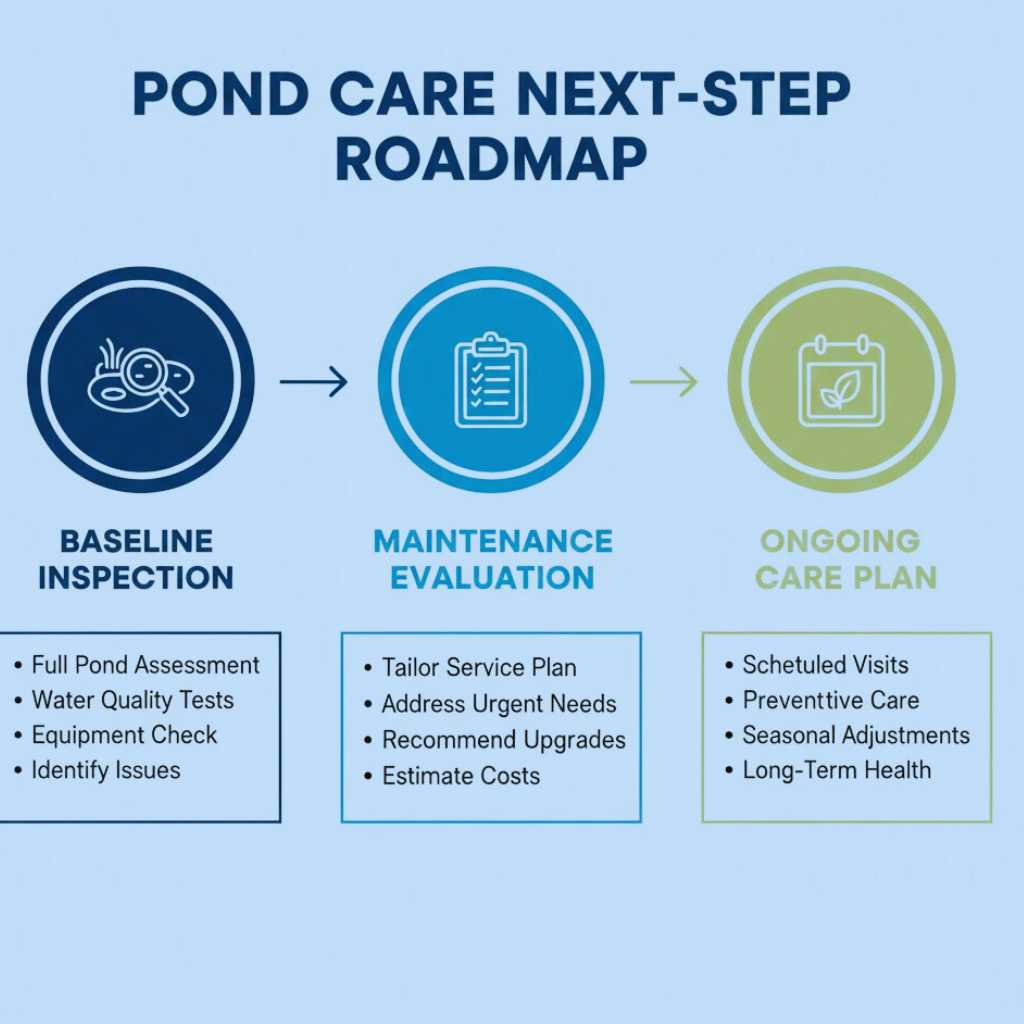
What to Do After Learning How Pond Maintenance Works
Once you understand how professional pond maintenance actually works, the next step is not guessing or reacting to symptoms as they appear. The goal is to move from uncertainty to clarity, then from clarity to stability.
-
Baseline inspection
Start by establishing the current condition of the pond as a system. This includes water quality, filtration performance, circulation patterns, fish behavior, and equipment health. Without a baseline, it is impossible to tell whether changes are real improvements or short-term swings. -
Maintenance evaluation
With a baseline in place, evaluate how the pond has been cared for up to this point. This is where gaps usually become visible, such as inconsistent filter care, skipped water testing, or circulation issues that quietly compound over time. A proper evaluation connects visible problems back to their causes. -
Ongoing care planning
From there, long-term care can be planned realistically. Maintenance frequency, seasonal adjustments, and preventative checks should match the actual system load rather than assumptions. This is what turns pond care from reactive work into predictable, stable management. From there, ongoing care planning should match the actual system load, which is why many owners look at an ongoing pond care planning approach instead of repeating one-off cleanings.
Professional pond maintenance works best when it begins with understanding instead of urgency. The right next step is always the one that clarifies how the system is functioning now and what it needs to stay balanced going forward.

Written by Warren Glenn
Hi, I’m Warren Glenn, an environmental specialist with a passion to water quality management and pond maintenance. I love sharing tips and insights to help you keep your aquatic ecosystems healthy and thriving.
Email Us
Call (714) 20613-0123
Send a quick Inquiry
If you have any questions or would like to get a custom quote, please reach out:
By completing this form, you’ll be added to our contact list and may receive our newsletter. You can unsubscribe whenever you like.
RECENT POSTS
OUR SERVICES
Pool Maintenance Service
Pond Cleaning Services
Lake Cleaning Services
Lake Maintenance Service
Fountain Construction Services
See All Services
Categories
- Pond Cleaning & Maintenance
- Fountain
Need a hand with your pond?
Koi Pros designs, builds, maintains and repairs ponds, waterfalls, fountains and lakes across Southern California and Arizona. Start with an on-site assessment.