
Pond Construction Services in California
Professional pond construction focused on long-term water quality, structural stability, and biological balance. Koi Pros designs and builds ponds as integrated systems, where filtration capacity, hydraulic flow, liner selection, excavation depth, and future service access are evaluated together before construction begins.
This approach applies to residential koi ponds, estate water features, and commercial installations across California where system performance and durability determine whether the pond operates predictably for years or requires corrective work after installation.
- We assess your site conditions, system requirements, and long-term performance factors before recommending any next steps.
What Pond Construction Involves When the System Is Designed First
Every pond construction project is a sequence of engineering decisions that depend on each other. Excavation depth determines liner selection. Liner type determines how plumbing is routed. Plumbing layout determines where filtration components sit. Filtration placement determines circulation paths. Circulation paths determine how biological load is managed across the full water volume.
When any of these decisions is made independently, the system that results has built-in constraints that surface later as water quality problems, equipment stress, or maintenance complications that did not need to exist.
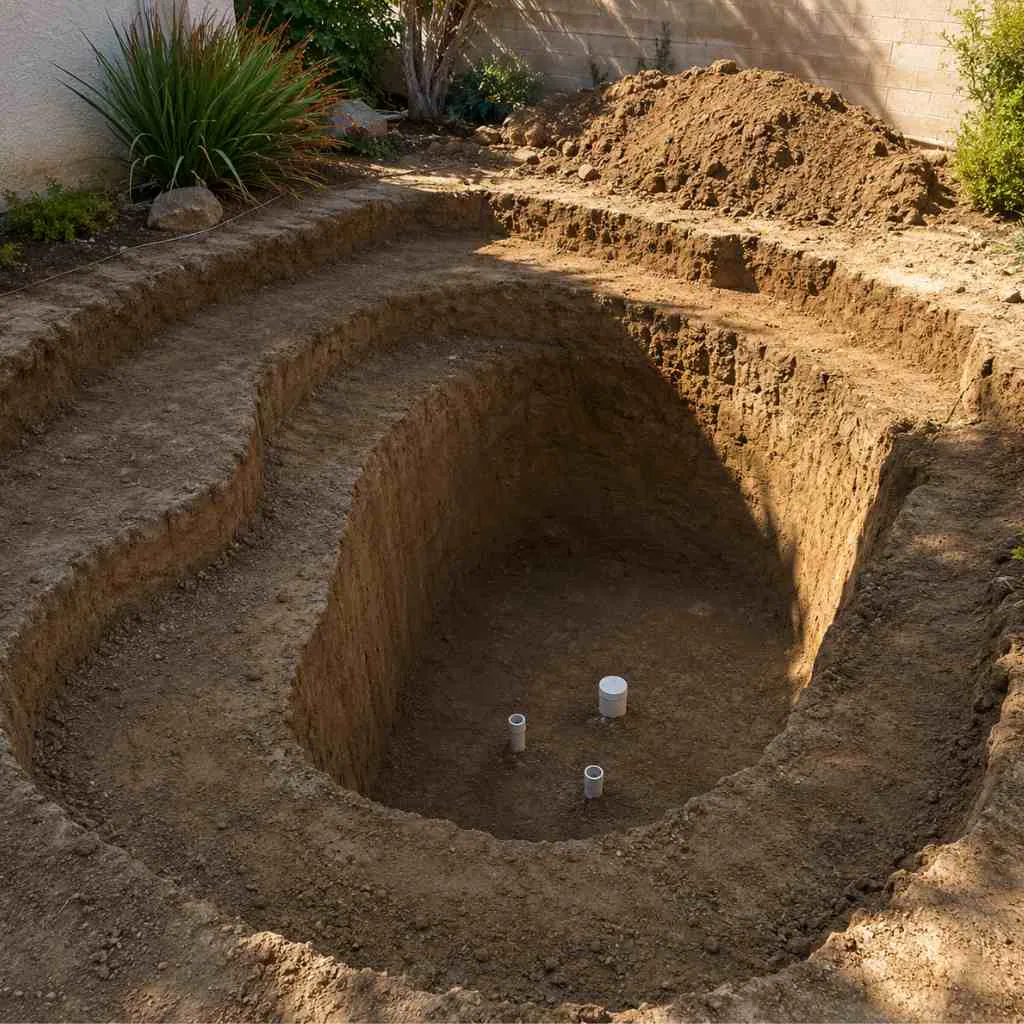
That dependency chain is the reason pond construction cannot be treated as a series of independent trade tasks. Koi Pros designs each project through a fixed construction sequence where every decision is evaluated against the decisions that precede it and the decisions that follow it. The sequence works like this.
Site evaluation and grading come first. Soil composition, drainage patterns, slope, elevation relative to the house and property line, sun exposure, and utility locations determine where the pond can sit, how deep it can go, and what structural preparation the ground requires. In parts of Orange County, expansive clay soils shift seasonally.
In coastal zones from Laguna Beach through Dana Point, sandy substrate drains differently than the compacted fill common in newer Irvine and Rancho Santa Margarita developments. These conditions change excavation methods, structural reinforcement requirements, and liner selection before a single shovel hits the ground.
Excavation follows site evaluation. Depth is not a single number. A properly excavated pond has multiple depth zones: shallow shelves for planting and edge access, intermediate zones for circulation flow, and deep zones for fish refuge during temperature extremes. Bottom drain locations are set during excavation, not after, because retrofit bottom drains require cutting through finished liner or shell and resealing under pressure, which introduces leak risk that did not need to exist.
The excavation profile also determines where return lines enter the pond, where skimmers sit relative to prevailing wind direction, and how water moves from the farthest point back to filtration intake.
Structural base preparation depends on what the excavation revealed. Compacted soil may need only a sand cushion and underlayment before the liner. Rocky substrate requires protective underlayment layers to prevent puncture under hydrostatic pressure. Concrete or gunite shells require rebar layout, form construction, and curing time before any plumbing is set. Hybrid builds, where a liner sits under a concrete veneer, require coordination between the liner installer and the concrete crew because the veneer must protect the liner without trapping moisture between layers.
Plumbing layout is designed before the liner or shell is installed, not routed afterward through finished surfaces. Supply lines, return lines, bottom drain plumbing, skimmer connections, overflow routing, and external filter feeds all need to penetrate the pond wall or floor at precise locations. Every penetration is a potential leak point. When plumbing is planned at the design stage, penetrations are minimized, sealed correctly during installation, and accessible for future service.
When plumbing is routed after construction, penetrations are added wherever they fit, which often means they are positioned in locations that are difficult to reach and difficult to reseal if a fitting fails.
Filtration integration happens in parallel with plumbing layout because the filtration system is not a standalone unit bolted onto the side of a finished pond. Biological media chambers, mechanical settlement tanks, pump vaults, and UV sterilizer housings all require plumbing connections, electrical supply, and physical space that must be allocated during construction.
Filtration that is sized correctly at the design stage accounts for the actual water volume, the projected fish load, the turnover rate required to maintain stable water chemistry, and the head pressure the pump must overcome given the plumbing run distances and elevation changes in that specific installation. Filtration that is added afterward is sized for the space that remains, which is rarely the same as the space the system needs.
Circulation and aeration design close the loop. Water must move through the full volume of the pond with no dead zones where waste accumulates and oxygen levels drop. Return line placement, waterfall or stream integration points, and aeration diffuser locations are selected to create a circulation pattern that pushes debris toward skimmers and drains rather than letting it settle on shelves and ledges.
In California’s warmer inland valleys, from Corona through Temecula, summer water temperatures accelerate biological oxygen demand. Ponds built without adequate circulation and aeration in these areas develop chronic oxygen stress that shows up as fish health problems and algae pressure months after installation.
Edge treatment, coping, and final grading are the last structural decisions. How the pond edge meets the surrounding grade determines whether surface runoff carries fertilizer, pesticide residue, and soil into the pond during rain events. In Southern California, where landscape irrigation is common and rainstorms are infrequent but intense, edge grading is the difference between a stable water chemistry baseline and a system that spikes in nutrient load every time the sprinklers run or a winter storm hits.
After construction is complete, the pond is filled and the biological cycle begins. Beneficial bacteria colonies establish over weeks, not hours. Water chemistry stabilizes as the biological filter matures. Fish are introduced gradually, not all at once, because stocking a full fish load into an immature biological system overwhelms the filtration capacity and produces ammonia and nitrite spikes that stress or kill fish.
This startup phase is part of the construction scope, not a separate service, because the decisions made during construction determine how quickly and reliably the biological cycle is established.
Pond Construction Methods and Material Selection in California
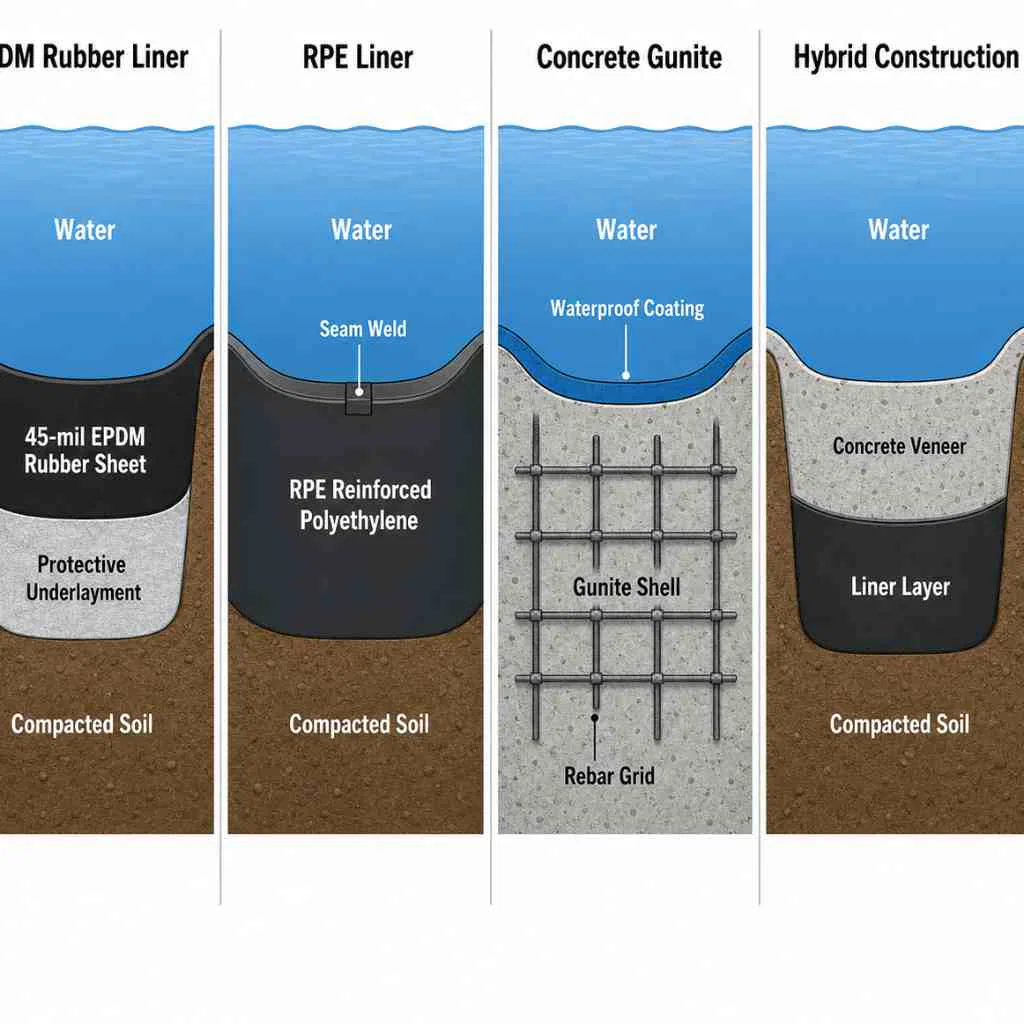
Four construction methods are used for pond building in California. Each has different performance characteristics, cost implications, and responses to California’s specific environmental conditions. The right method depends on the project, not on contractor preference.
EPDM Rubber Liner
EPDM is the most common pond liner material for residential construction. It is flexible, conforms to irregular excavation profiles, and tolerates ground movement without cracking. A properly installed 45-mil EPDM liner in California conditions has a functional lifespan of 20 to 30 years depending on UV exposure and installation quality.
The tradeoff is UV degradation. In inland valleys from Riverside through Temecula, where summer surface temperatures regularly exceed 100 degrees, exposed EPDM breaks down faster than in coastal installations where marine layer reduces direct UV hours. Any liner area not covered by water, rock, or gravel needs UV protection or it becomes the first failure point in an otherwise sound system. EPDM also requires careful underlayment on rocky substrate to prevent puncture under hydrostatic pressure, which adds preparation time and material cost to the excavation phase.
RPE (Reinforced Polyethylene) Liner
RPE is lighter, more puncture-resistant, and more UV-stable than EPDM. It is the stronger choice for larger ponds and commercial installations where liner panels must be welded on site to cover surface areas that exceed standard EPDM roll widths. RPE seams are heat-welded rather than taped, which produces a stronger joint under long-term stress.
The tradeoff is flexibility. RPE does not conform to tight contours as easily as EPDM, which means excavation profiles need to be smoother and transitions between depth zones more gradual. For smaller residential ponds with complex shapes, shelves, and planting pockets, EPDM is usually the better fit. For large-format installations where seam strength and UV resistance matter more than contour flexibility, RPE outperforms.
Concrete and Gunite
Concrete and gunite shells provide permanent structural enclosure. They do not shift, stretch, or puncture. For formal architectural ponds, raised ponds, and installations where the pond integrates with hardscape or structural elements, concrete is often the only method that achieves the required geometry.
The tradeoff in California is seismic risk. Concrete is rigid. Ground movement cracks rigid structures. In Seismic Zone 4, which covers the entire Southern California service area, concrete pond shells require properly specified rebar, control joints, and waterproof coating systems that can bridge hairline cracks without losing seal integrity. A concrete shell that is not engineered for seismic flex will develop cracks that leak slowly, and those leaks are expensive to locate and repair after the pond is finished and stocked. Concrete also carries higher material and labor cost than liner systems and longer construction timelines due to forming, pouring, and curing phases.
Hybrid Construction (Liner Under Concrete Veneer)
Hybrid construction places a waterproof liner beneath a concrete or mortar veneer. The liner provides the water seal. The concrete provides structural protection, aesthetic finish, and resistance to UV and physical damage. This method is used when the client wants the permanence and appearance of concrete without the seismic cracking risk that a structural concrete shell carries.
The tradeoff is coordination complexity. The liner must be installed and tested before the veneer is applied. The veneer must be detailed so that it protects the liner without trapping moisture between layers, which causes delamination over time. Drain and plumbing penetrations pass through both layers and must be sealed at each one independently. Hybrid builds require more installation time than liner-only projects and more precise crew coordination than concrete-only projects.
No single method is best for every project. Material selection is determined during the design phase based on pond size, depth, shape complexity, site conditions, fish load requirements, budget, and the specific environmental exposures at that property location.
Filtration System Design as a Construction Decision
Filtration is not equipment added to a finished pond. It is infrastructure built into the pond during construction, and the decisions that determine whether filtration works correctly are made before the liner goes in.
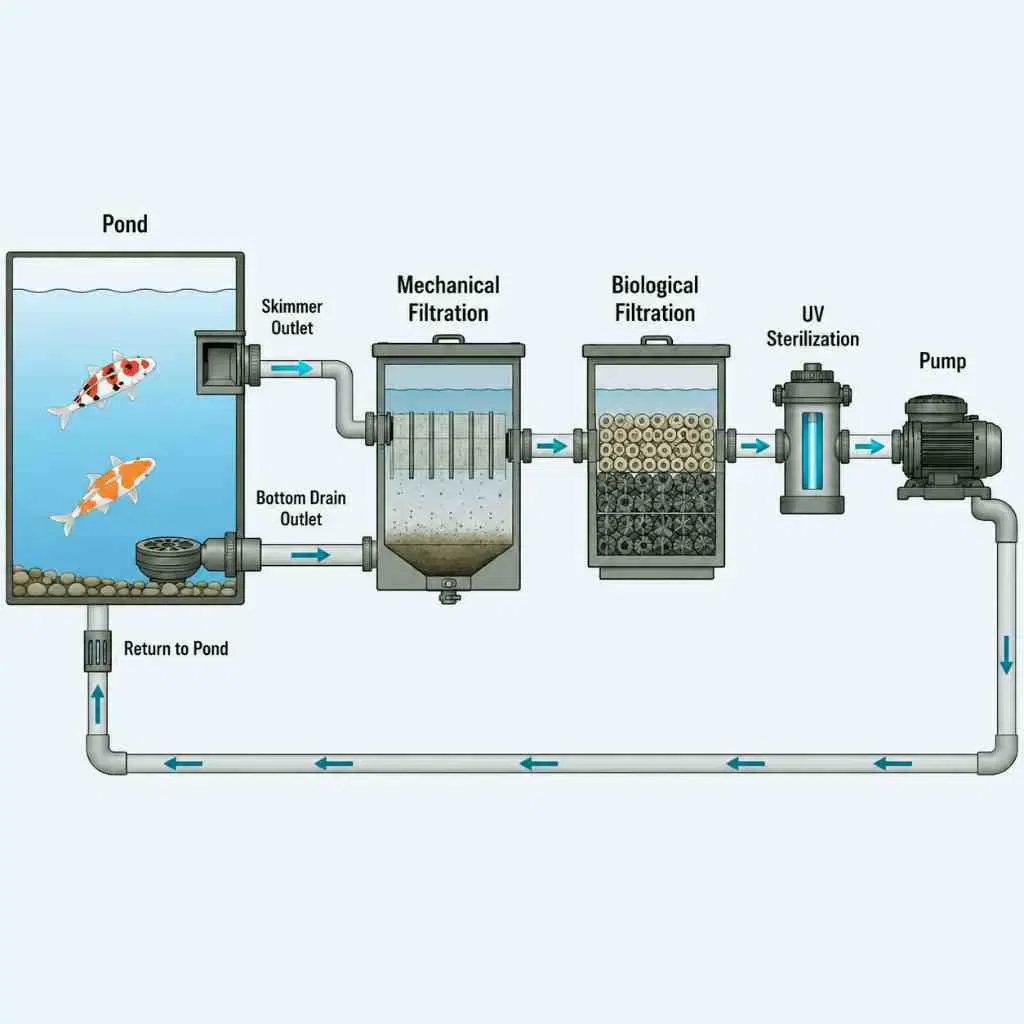
A pond filtration system has three functional layers. Mechanical filtration removes solid waste particles from the water column through settlement chambers, screen filters, or bead filters. Biological filtration converts dissolved ammonia and nitrite, both toxic to fish, into nitrate through bacterial colonies that colonize high-surface-area media inside dedicated chambers. UV sterilization controls suspended algae and waterborne pathogens by exposing circulating water to ultraviolet light before it returns to the pond.
All three layers must be sized for the specific installation. Sizing depends on water volume, projected fish load, turnover rate, and the head pressure created by plumbing distances and elevation changes between the pond and the filter system. A 5,000-gallon koi pond stocked with twenty fish requires a fundamentally different filtration configuration than a 15,000-gallon estate pond with sixty fish, even if both use the same brand of filter components. The difference is not the equipment. It is how the equipment is sized, sequenced, and plumbed into the circulation system.
This is why filtration must be designed during construction. Bottom drains, the primary intake points that pull settled waste off the pond floor, require plumbing runs that are set during excavation. Retrofitting a bottom drain into a finished pond means cutting through liner or shell, routing pipe under or through the pond structure, and resealing penetrations that were never planned for. It can be done, but it introduces risk and cost that proper construction planning eliminates.
Skimmer placement is a construction decision for the same reason. Skimmers pull floating debris from the surface, and their effectiveness depends on positioning relative to prevailing wind direction and return line flow patterns. A skimmer placed on the wrong side of the pond collects less debris because wind pushes floating material away from the intake rather than toward it. Moving a skimmer after construction means cutting into the finished pond edge, rerouting plumbing, and restoring the surrounding grade and coping.
Pump selection ties directly to the plumbing layout set during construction. The pump must overcome the total head pressure of the system, which is determined by pipe diameter, total run length, number of fittings, vertical lift from pond to filter, and flow restrictions created by UV housings and filter media. A pump selected before the plumbing is designed is either oversized, which wastes energy and creates excessive flow, or undersized, which starves the filtration system and allows waste to accumulate faster than the biological cycle can process it.
For koi ponds specifically, filtration design is the construction decision that separates a stable system from one that requires constant chemical intervention, frequent water changes, and recurring fish health problems. Serious koi keepers evaluate a builder’s filtration approach before anything else. Pond geometry, rock work, and landscaping matter, but none of it matters if the water cannot sustain the fish.
California-Specific Factors That Affect Pond Construction
Pond construction in California operates under environmental, regulatory, and climate conditions that do not apply in other states. These factors affect material selection, structural engineering, system design, and project timeline. A contractor who builds ponds in California without accounting for them is building to generic standards in a state that does not allow generic solutions.
Soil Conditions Across the Service Area
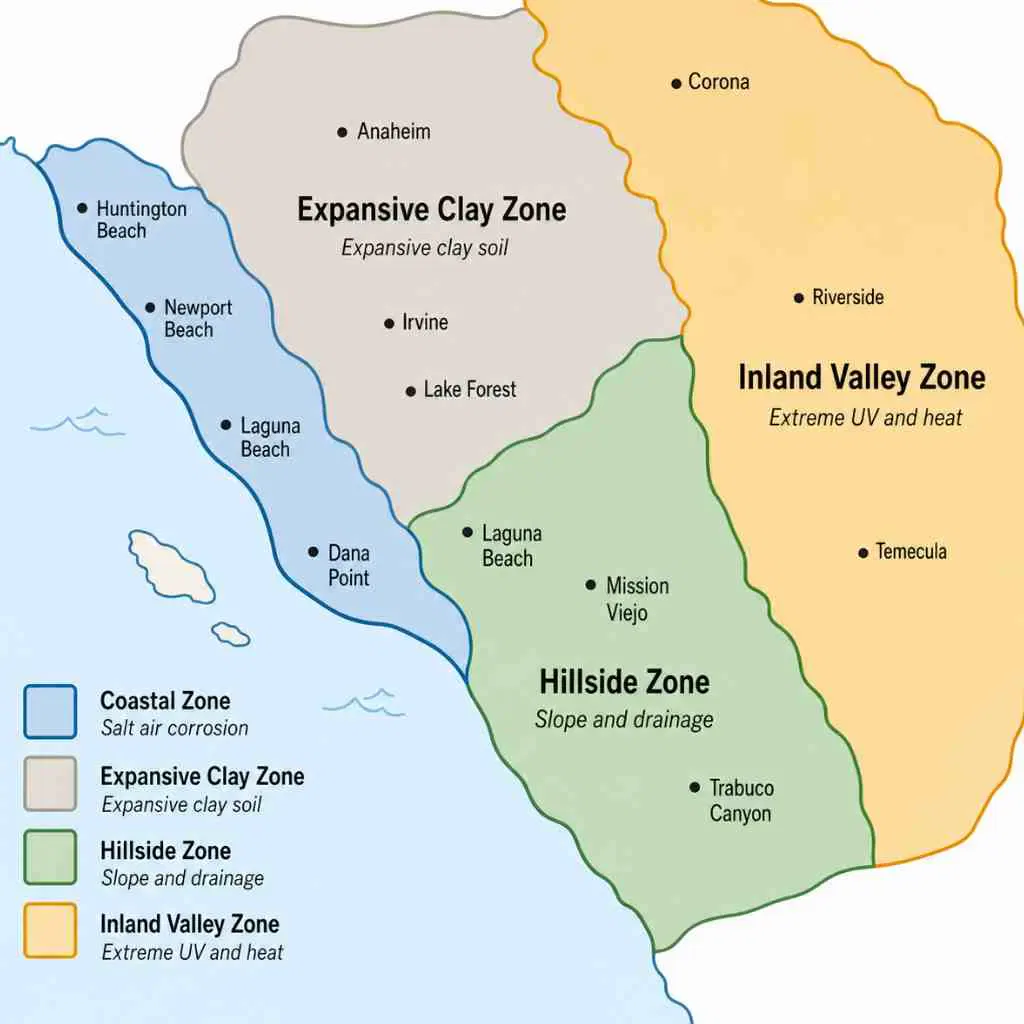
Soil type determines excavation method, structural reinforcement needs, and liner protection requirements. In central Orange County and parts of the Inland Empire, expansive clay soils swell when wet and contract when dry. This seasonal movement puts lateral pressure on pond walls and can shift plumbing runs over time if they are not bedded and backfilled correctly. Coastal properties from Huntington Beach through San Juan Capistrano often sit on sandy substrate that drains quickly and provides less lateral support for pond walls, requiring wider excavation profiles or structural reinforcement that inland clay sites may not need.
Hillside properties in Laguna Beach, Mission Viejo, and the canyon communities of Trabuco Canyon and Foothill Ranch introduce slope stability, drainage diversion, and retaining considerations before excavation begins. In all cases, soil conditions are evaluated during the site assessment, not assumed from a map. Two properties on the same street can have different substrate if one sits on cut ground and the other on fill from the original development grading.
Seismic Design Requirements
Southern California is Seismic Zone 4. Every pond structure must tolerate ground movement without losing water seal integrity. For liner systems, this means flexible plumbing connections at every penetration point so pipe movement does not tear the liner. For concrete and gunite shells, it means properly specified rebar, control joints at stress concentration points, and waterproof coatings that bridge hairline cracks rather than splitting with them. Rigid plumbing runs connected to rigid shells without flex couplings are a common failure point in California pond construction that does not exist in non-seismic regions.
Climate, UV Exposure, and Temperature Range
California’s climate varies significantly across the service area, and those variations affect equipment selection, material lifespan, and biological system behavior. Inland valleys from Corona through Temecula and Palm Springs experience summer air temperatures above 100 degrees regularly. Water temperatures in unshaded ponds in these areas can exceed safe ranges for koi, requiring shade structures, deeper refuge zones, and aeration systems sized for elevated biological oxygen demand.
Coastal installations benefit from marine layer moderation but face salt air corrosion on metal components, electrical connections, and pump housings. UV exposure degrades exposed EPDM liner faster in high-desert and inland valley installations than in coastal zones where cloud cover reduces cumulative UV hours.
Water Use, Drought Regulations, and Evaporation
California’s water regulatory environment affects pond construction in ways most states do not experience. Ponds are recirculating systems and do not consume water at the rate irrigation does, but they lose water to evaporation, and that loss must be managed. In inland valleys, a 5,000-gallon pond can lose 50 to 100 gallons per day to evaporation during peak summer. Auto-fill systems are standard on California pond installations to maintain water level without manual intervention.
Municipal water restrictions during drought periods can affect the initial fill and top-off supply. Pond construction projects planned during active drought restrictions need to account for fill source, fill rate limitations, and any local ordinances that address ornamental water features specifically. These vary by water district and are confirmed during the assessment phase.
Permits, Licensing, and Regulatory Requirements
Whether a pond requires a building permit depends on the jurisdiction, the pond size, the excavation depth, and whether the project involves grading, retaining structures, or electrical work. Small decorative ponds in many Orange County cities do not trigger permit requirements. Larger koi ponds, ponds with integrated structures, and any project that involves significant grading or changes to drainage patterns typically do.
HOA approval is a separate requirement in many Orange County communities, particularly in Irvine, Rancho Santa Margarita, Ladera Ranch, and the planned communities of South County. HOA review processes can add weeks to a project timeline and may impose restrictions on pond location, depth, fencing, and visibility from common areas.
Electrical work for pump circuits, lighting, and control systems requires a licensed electrician and electrical permit in California. This is not optional and is not a task that falls under the pond contractor’s license scope unless the contractor holds a separate C-10 Electrical classification.
Koi transport and stocking in California are subject to California Department of Fish and Wildlife regulations. Koi are classified as a restricted species in some contexts, and transport between properties or purchase from out-of-state breeders may require documentation. This is confirmed during the project planning phase so stocking does not create compliance issues after construction is complete.
What Drives Pond Construction Cost in California
Pond construction costs vary widely because the variables that drive cost vary widely. A small residential koi pond and a large estate water feature with integrated waterfalls and stream systems are not the same project, and they are not priced from the same set of inputs. Understanding what determines cost helps property owners evaluate proposals on substance rather than bottom-line price alone.
Water volume is the primary cost driver. Larger ponds require more excavation, more liner or shell material, more backfill, and larger filtration and circulation systems. But volume is not just surface area. Depth zones, shelf configurations, and bottom drain placement all affect how much material is removed, how the excavation is shaped, and how long the structural preparation takes. A 3,000-gallon pond with simple geometry costs less to excavate than a 3,000-gallon pond with multiple depth transitions, planting shelves, and integrated bottom drains.
Construction method affects cost at every stage. EPDM liner installations require less labor and material than concrete or gunite shells, but they require more careful site preparation and underlayment work. Concrete carries higher material cost, longer construction timelines due to forming and curing, and the additional engineering required for seismic performance in California. Hybrid builds fall between the two in material cost but require more coordination between trades.
Filtration system complexity scales with fish load and water volume. A pond designed for light ornamental use with a few goldfish needs basic mechanical and biological filtration. A koi pond stocked for serious collection requires bottom drains, dedicated settlement chambers, high-capacity biological media, UV sterilization, and pumps sized for the total head pressure of the system. The filtration package on a high-load koi pond can represent a significant portion of the total project cost.
Site conditions create cost variables that are not visible until the assessment. Rocky substrate increases excavation time and equipment requirements. Steep slopes require retaining work and drainage diversion before pond construction begins. Limited equipment access through narrow side yards or gated properties adds labor hours for manual material handling. Properties with high water tables may need dewatering during excavation. These are not unexpected costs when they are identified during the site assessment, but they are surprises when a contractor prices a project from a photo or a phone call.
Electrical scope adds cost that some proposals do not itemize. Pump circuits, lighting, control systems, and auto-fill valves all require dedicated electrical runs. In California, this work requires a licensed electrician and a separate electrical permit. A proposal that does not include electrical as a line item is either incomplete or assumes the property owner will arrange it separately.
Integrated features increase scope. Waterfalls, streams, lighting, planting, and edge landscaping each add materials, labor, and coordination time. These features are planned during design so their cost is known before construction starts, not discovered as add-ons during the build.
The most reliable way to understand what a specific project will cost is a site assessment where the actual conditions, system requirements, and scope are evaluated together. Proposals built from measurements, soil observation, and system design reflect the real project. Proposals built from assumptions reflect the estimator’s best guess.
The C-53 Swimming Pool Contractor License and What It Covers
In California, the contractor license classification determines what a contractor is legally authorized to build. Pond construction that involves excavation, plumbing, filtration systems, and structural work falls under the C-53 Swimming Pool Contractor classification issued by the California Contractors State License Board.
The C-53 covers construction of swimming pools, hot tubs, and their associated equipment, which includes ponds and water features that involve the same structural, plumbing, and mechanical scope. A contractor holding a C-27 Landscaping license can install surface-level landscape features but is not authorized to perform the structural excavation, plumbing, and mechanical system work that pond construction requires. The distinction matters because a pond built under the wrong license classification may not meet code requirements, may not be covered by the contractor’s insurance in the event of a structural or mechanical failure, and may create permit complications if the jurisdiction reviews the contractor’s license scope against the work performed.
Koi Pros holds a C-53 Swimming Pool Contractor license. The license number should be confirmed with the California Contractors State License Board before any contract is signed. This applies to any contractor, not just Koi Pros. CSLB license verification is free, takes less than a minute, and confirms license status, classification, bond, and insurance coverage. Property owners who skip this step have no way to verify that the contractor is authorized and insured for the work being proposed.
Commercial and Estate Pond Construction
Commercial and estate pond construction operates at a different scale, under different regulatory conditions, and with different stakeholder requirements than residential projects. The system design principles are the same. The scope, complexity, and coordination demands are not.
Commercial Properties
Commercial pond installations serve corporate campuses, hospitality properties, retail centers, medical office complexes, and multi-tenant developments. These projects differ from residential work in several ways that affect construction planning.
Water volumes are larger, which means filtration and circulation systems must be sized for higher biological loads and faster turnover rates. Equipment is typically commercial-grade, housed in dedicated mechanical rooms or enclosures rather than positioned adjacent to the pond. Plumbing runs are longer, which increases head pressure calculations and requires larger pipe diameters to maintain adequate flow.
Regulatory requirements are stricter. Commercial properties may require engineering review, structural calculations stamped by a licensed engineer, and compliance with ADA-adjacent site requirements depending on the pond’s proximity to pedestrian paths, entries, and common areas. Electrical scope on commercial installations is more complex, often involving integration with existing building management systems, timers, and dedicated circuit panels.
Stakeholder coordination adds timeline. Commercial projects involve property managers, building owners, landscape architects, general contractors, and sometimes municipal plan review. Construction scheduling must account for business operations, tenant disruption, and phased installation when the property cannot be fully shut down during construction. A residential koi pond project typically involves one decision-maker. A commercial installation may require approval from three to five stakeholders before work begins.
Private Estates and Large Residential Properties
Estate-scale pond construction falls between residential and commercial in system complexity. Water volumes range from 10,000 gallons to 50,000 gallons or more. Filtration systems require dedicated mechanical space, often concealed within landscape structures or outbuildings to maintain the property’s aesthetic. Plumbing, electrical, and filtration infrastructure must be designed for long-term serviceability without disrupting mature landscaping or hardscape that surrounds the installation.
Estate projects in Orange County and Los Angeles County frequently involve landscape architects and designers who specify the water feature’s appearance but may not design the mechanical, plumbing, and filtration systems required to support it. The mechanical and circulation systems must be integrated into the landscape architect’s plan during design, not resolved after construction begins. When filtration, circulation, and service access are not part of the original design coordination, the result is either a system that underperforms or a finished landscape that must be disturbed for maintenance access.
HOA Communities
Pond construction in HOA-governed communities requires a separate approval process that runs in parallel with project design. HOA architectural review committees evaluate pond location, visibility from common areas, fencing requirements, maximum depth, water source, and noise from pumps and water features. In planned communities across Irvine, Rancho Santa Margarita, Ladera Ranch, and South County, this review can add three to six weeks to the project timeline.
HOA restrictions are confirmed during the site assessment so design decisions account for them from the start. A pond designed without HOA input risks redesign after submission, which delays construction and increases cost.
Construction Assessment — What to Expect
Every pond construction project at Koi Pros begins with a site assessment. The assessment determines whether the property can support the type of pond the owner wants and identifies the specific conditions that will shape the construction plan. No design work, pricing, or construction scheduling happens before this step is complete.
The assessment is conducted on site because the variables that determine construction approach cannot be evaluated remotely. Soil composition is observed directly. Slope, drainage patterns, and elevation relative to the house and property boundaries are measured. Sun exposure is evaluated across the pond’s proposed location. Utility locations are confirmed. Equipment access paths are identified. If the property is in an HOA community, the assessment includes a review of any architectural restrictions that affect pond placement, depth, or visibility.
These site-level observations feed directly into the system-level decisions covered earlier on this page. Filtration requirements, plumbing routing, circulation design, and electrical scope are all evaluated against the specific conditions found at the property, not estimated from photos or general assumptions. The assessment also identifies variables that earlier sections do not cover: how far equipment and materials must travel from the access point to the build site, whether existing irrigation or drainage lines cross the proposed pond location, and whether the surrounding grade will need modification to prevent surface runoff from entering the pond.
After the assessment, the property owner receives a clear picture of what the project involves. If the site supports the intended pond, the next step is system design and a construction proposal built from measured conditions rather than assumptions. If the assessment identifies constraints that limit the project, those are communicated directly so the owner can make an informed decision about scope, location, or approach before any commitment is made.
Not every site is suitable for every type of pond. The purpose of the assessment is to determine that before construction begins, not after.
Pond Construction Questions California Property Owners Ask Before Building
It depends on the jurisdiction, the pond size, the excavation depth, and whether the project involves grading, retaining structures, or electrical work. Small decorative ponds in many Orange County and Los Angeles County cities do not trigger building permit requirements. Larger koi ponds, ponds requiring significant excavation or grading, and projects that alter drainage patterns typically do. Electrical work for pumps and lighting requires a separate electrical permit regardless of pond size. Permit requirements are confirmed during the site assessment so they are resolved before design decisions are finalized.
Most residential koi ponds take two to four weeks from excavation to biological startup. Timeline varies with pond size, construction method, site access, and whether the project requires grading permits or HOA approval. Concrete and gunite shells add curing time that liner installations do not require. Estate and commercial projects with larger scope, multi-stakeholder coordination, or phased installation schedules can extend to six weeks or more. The construction timeline is established during the proposal phase after the site assessment identifies the actual scope.
There is no single best method. EPDM liner, RPE liner, concrete, and hybrid construction each have different performance characteristics and respond differently to California’s soil, seismic, and climate conditions. Liner systems offer flexibility and lower cost. Concrete provides structural permanence but requires seismic engineering in Southern California. The right method is determined by pond size, shape complexity, fish load, site conditions, and budget. Section 3 on this page covers each method and its tradeoffs in detail.
Minimum depth for a koi pond in California is generally three feet, but most properly designed koi ponds include zones of four to five feet or deeper. Deeper zones provide thermal refuge during summer heat in inland valleys where water temperatures in shallow ponds can exceed safe ranges for koi. Depth also affects predator protection and fish stress behavior. The excavation profile is designed with multiple depth zones, not a single uniform depth, to support circulation, planting shelves, and fish refuge needs.
Cost depends on water volume, construction method, filtration complexity, site conditions, electrical scope, and integrated features. A small residential pond with basic filtration and a large estate koi pond with bottom drains, dedicated mechanical space, and integrated waterfalls are not comparable projects. Section 6 on this page explains what drives cost in detail. The most accurate way to understand cost for a specific project is a site assessment where the actual conditions and scope are evaluated together.
A professionally constructed koi pond or water feature can increase property value and curb appeal, particularly in Southern California where outdoor living spaces are a strong selling point. The impact depends on construction quality, system condition, and how well the pond integrates with the surrounding landscape. A well-built pond that operates with low maintenance and clear water is an asset. A poorly built pond with recurring water quality problems, visible equipment, or difficult maintenance access is a liability.
Maintenance burden is largely determined by construction decisions. A pond built with correctly sized filtration, bottom drains, properly positioned skimmers, adequate circulation, and planned service access requires less ongoing maintenance than a pond where any of those elements were undersized, misplaced, or omitted. Most well-constructed koi ponds require weekly checks on water chemistry and filter performance, periodic debris removal, and seasonal adjustments. The construction approach described on this page is designed to minimize reactive maintenance by building the right system capacity from the start.
Pond safety depends on design. Shallow shelf zones around the perimeter reduce depth at the edges. Fencing or barrier landscaping can restrict unsupervised access. Pondless water features, where water recirculates through an underground basin with no open standing water, are an alternative for properties where open-water safety is a primary concern. Local fencing requirements vary by jurisdiction and are confirmed during the site assessment.
No. A properly circulating pond with adequate water movement does not create the stagnant conditions mosquitoes require for breeding. Koi also consume mosquito larvae. Mosquito problems in ponds are a symptom of inadequate circulation or failed equipment, not an inherent characteristic of having a pond.
Confirm their California contractor license classification and verify it through the CSLB website. Ask whether filtration, plumbing, and circulation systems are designed before construction begins or selected during installation. Ask how they determine pump and filtration sizing for your specific water volume and fish load. Ask whether the proposal includes electrical work or assumes you will arrange it separately. Ask what warranty covers workmanship and what is covered by equipment manufacturer warranties. The answers to these questions reveal whether the contractor builds ponds as engineered systems or assembles components on site.
What Clients Say About Koi Pros Pond Construction Work
"Our pond was originally built poorly by another contractor and constantly had circulation problems. The reconstruction and repair work they did completely solved it. The water now flows properly and the koi look much happier in our Riverside property."

Pond Construction Assessment for California Properties
Pond construction decisions made before excavation determine how the system performs for years after installation. The site assessment evaluates whether your property can support the pond you want and identifies the specific conditions that will shape the construction plan.
Pond Construction Services Across California
Koi Pros provides system-based pond construction throughout California, supporting residential and commercial projects where long-term performance, regulatory awareness, and serviceability matter.
- California
- Los Angeles
- Beverly Hills
- Santa Monica
- Pasadena
- Long Beach
- Glendale
- West Hollywood
- Malibu
- Orange County
- Rancho Santa Margarita
- Seal Beach
- Riverside
- Corona
- Lake Elsinore
- Murrieta
- Norco
- Palm Desert
- Palm Springs
- San Jacinto
- Rancho Santa Margarita
- Seal Beach
- Riverside
- Corona
- Lake Elsinore
- Murrieta
- Norco
- Palm Desert
- Palm Springs
- San Jacinto
- Rancho Santa Margarita
- Seal Beach
- Riverside
- Corona
- Lake Elsinore
- Murrieta
- Norco
- Palm Desert