
Pond Repair Services in California
Most pond problems don’t start the day something breaks. They start weeks or months earlier, when a small shift in water chemistry, circulation, or equipment performance goes unnoticed. By the time a pump fails, a liner leaks, or fish show signs of stress, the root cause has usually been compounding through months of gradually declining flow rates, slow clarity loss, or water levels that drop a little more each week.
Koi Pros provides full-system pond repair based in Orange County, with on-site diagnosis and repair service through Los Angeles County, Riverside County, San Diego County, and the Inland Empire. Every repair starts with a system-level diagnosis because treating the visible symptom without identifying the underlying cause is how pond owners end up paying for the same repair twice.
We evaluate water chemistry, filtration performance, circulation, structural integrity, and biological load before recommending any work. That assessment determines whether the fix is a targeted component repair, a filtration retrofit, or a more involved rebuild.
- We assess your site conditions, system requirements, and long-term performance factors before recommending any next steps.
Common Pond Problems and What Causes Them
A pond that looks like it failed overnight has usually been failing for weeks. The visible symptoms are what finally get the owner’s attention, but the underlying causes started earlier and deeper in the system. Understanding what those causes are changes the conversation from “fix what broke” to “fix why it broke.”

Water loss without a visible leak is the most common complaint. The owner adds water every few days and assumes the liner is punctured. In many cases, the actual cause is settling along the pond edge or stream bank that has created a low point where water escapes over the liner. Ground movement, root pressure from nearby trees, and soil compaction over time all shift the liner position without leaving an obvious tear. In Southern California, expansive clay soils in parts of Orange County and the Inland Empire make settling more aggressive than in regions with stable sandy substrates.
Murky, green, or foul-smelling water points to a biological imbalance, not just an algae problem. Algae is the symptom. The cause is typically excess nutrient load from fish waste, decaying organic debris, and insufficient biological filtration to process the ammonia cycle. UV clarifiers can mask it temporarily by killing suspended algae, but they do nothing to address the dissolved nutrient load driving the bloom. Until the filtration system can process the biological demand, the algae returns every time the UV bulb weakens.
Pump failure or declining flow usually shows up as reduced waterfall output, poor surface circulation, or a pump that cycles on and off. Impeller wear is the most common mechanical cause. Debris that gets past the skimmer or pre-filter erodes the impeller over time, gradually reducing flow before the pump stops entirely. Cavitation from air intrusion at plumbing joints accelerates that wear. In older systems, the original pump is often oversized for the current pond configuration, pulling more amperage than necessary, generating excess heat, and forcing water through filtration faster than the media can process it.
Filter underperformance is harder to identify because the decline is gradual. Biological media loses surface area as it compacts and clogs. Bead filters that aren’t backwashed on schedule lose flow capacity. Waterfall box filters installed on ponds built ten to fifteen years ago were often sized for the pond’s original fish load, which may have doubled or tripled since then. The filter doesn’t fail in the dramatic sense. It just stops keeping up.
Structural cracking in concrete and gunite ponds results from ground movement, curing defects in the original pour, or years of thermal expansion and contraction. In California, seismic microactivity and the wide daily temperature swings in inland valleys create stress patterns that don’t exist in more temperate climates. A crack that hasn’t leaked in five years can open during a single heat event.
Fish stress, disease, or unexplained losses are almost never random. They follow a chain: degraded water quality stresses the immune system, parasites or bacterial infections take hold in weakened fish, and the owner sees symptoms that look sudden but had a weeks-long setup. Koi are particularly sensitive to ammonia spikes, pH swings, and dissolved oxygen drops. When a repair addresses the equipment failure but ignores the water chemistry reset, the fish remain at risk even after the hardware is fixed.
None of these problems exist in isolation. A settling liner causes water loss, which drops the water level below the skimmer intake, which starves the pump of flow, which reduces filtration turnover, which degrades water quality, which stresses fish. One root cause can cascade through the entire system. That is why diagnosis starts with the system, not the symptom.
Pump Repair and Replacement
The pump is the circulation engine of the pond. It moves water from the pond through filtration, up through the waterfall or stream, and back into the basin. When the pump underperforms or fails, every other system it feeds loses efficiency within hours. Filtration slows.
Surface agitation drops. Oxygen levels fall. In a koi pond, that timeline matters because fish stress begins before the owner notices the waterfall has gone quiet.

Mechanical wear is the most common pump failure. The impeller, the rotating component that generates flow, degrades over time as fine debris passes through the pump chamber. Sand, gravel particles, and organic grit that bypass the skimmer basket or pre-filter score the impeller surface and widen the tolerances between the impeller and the volute housing. Flow drops gradually. The pump still runs, still draws power, but moves less water per hour than the system requires.
Impeller replacement resolves the problem when the motor and housing are still sound. The diagnostic question is whether the impeller wear is isolated or whether it signals a broader intake protection failure. If debris is reaching the impeller consistently, replacing the impeller without addressing the skimmer, pre-filter, or intake screen means the new impeller follows the same wear path as the old one.
Electrical failures include tripped breakers, ground fault interruptions, corroded wiring connections, and burned motor windings. Intermittent cycling often traces to thermal overload protection activating because the motor is overheating. Overheating can result from restricted intake flow, a failing capacitor, or a motor bearing that has lost lubrication. In outdoor installations exposed to Southern California’s sustained summer heat, ambient temperature compounds internal motor heat, and pumps that run reliably through winter begin cycling in July and August.
Sizing mismatch is the problem most often inherited rather than created. Over the years, the pond gets replumbed, filtration gets added or upgraded, head height changes when a waterfall is modified, or the plumbing run gets extended. Each change alters the flow demand, but the pump stays the same. An oversized pump forces water through filtration media faster than biological processing can handle, reducing filter effectiveness and increasing backpressure. An undersized pump cannot turn over the pond volume frequently enough to maintain water quality, and stagnant zones develop where debris settles and anaerobic conditions build.
The repair-or-replace decision depends on what the diagnosis reveals. A pump with a worn impeller and a sound motor is a repair. A pump that is fundamentally wrong for the system is a replacement. Energy efficiency alone can justify the swap. A pond pump runs twenty-four hours a day, three hundred sixty-five days a year. The difference between a 350-watt legacy pump and a 150-watt variable-speed replacement compounds to hundreds of dollars annually in electricity.
Koi Pros diagnoses pump performance as part of the full system evaluation. Flow rate, amperage draw, operating temperature, and intake protection are assessed together before a recommendation is made. A pump replacement without a flow calculation matched to the current filtration, plumbing, and head height is not a diagnosis. It is guesswork. And guesswork is how pond owners end up replacing a pump that was never the real problem.






Filter and Filtration System Repair
Filtration is the biological and mechanical processing center of the pond. When filtration underperforms, the effects don’t appear immediately. Water clarity degrades over days or weeks, not hours. That slow decline is what makes filtration failure the most underdiagnosed problem in pond repair.
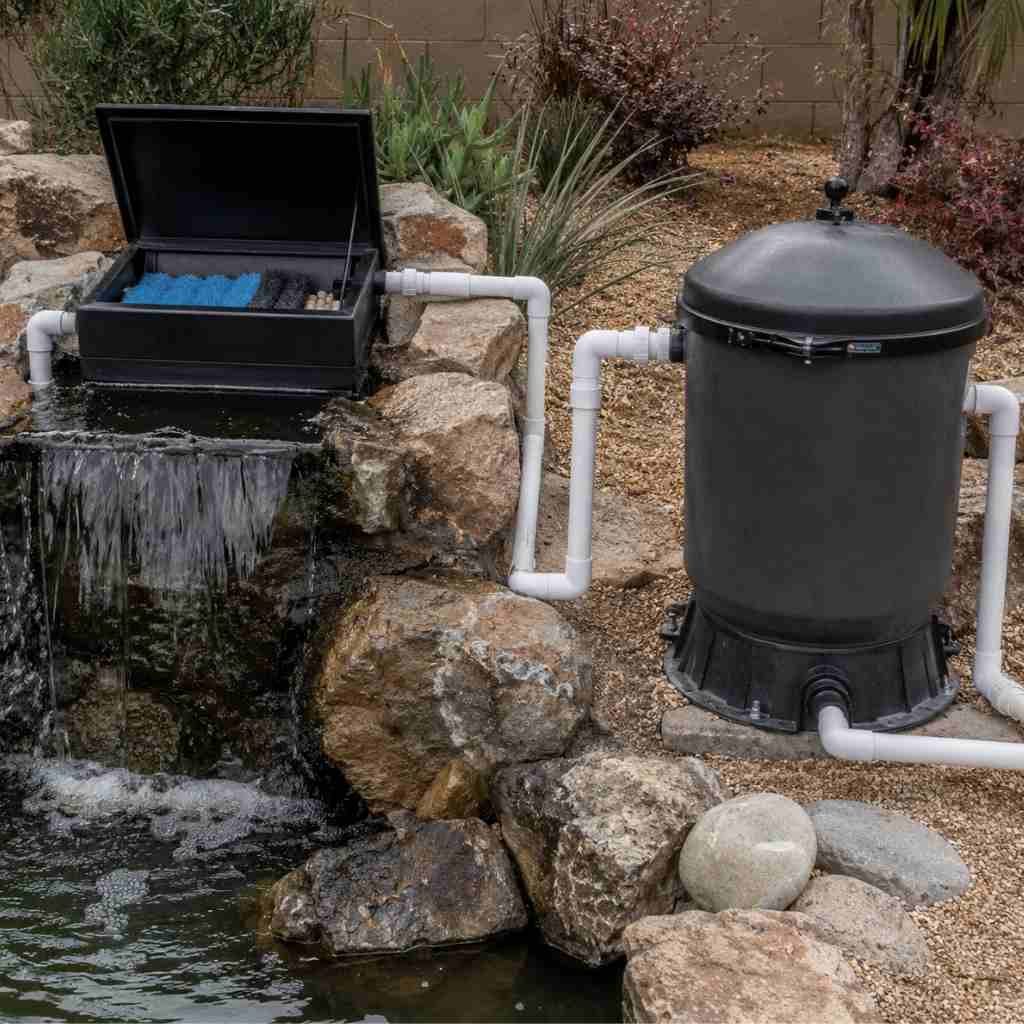
Mechanical filtration captures solid waste: fish waste, uneaten food, leaf debris, and suspended particulate. When mechanical filtration fails, the symptom is visible debris in the water column and sediment accumulating on the pond floor faster than normal. Filter pads compress and lose porosity over time. Skimmer baskets crack at the handle mounts. Pre-filter screens develop holes where debris pushes through repeatedly at the same contact point. Ignoring these failures creates a downstream problem: solids that pass through failed mechanical filtration reach the biological stage and clog the media, which causes the more serious failure.
Biological filtration is where most pond owners lose the thread. Biological media provides surface area for nitrifying bacteria colonies that convert ammonia to nitrite and nitrite to nitrate. This is the ammonia cycle, and it is the single most critical process in any pond that holds fish. When biological filtration fails, ammonia and nitrite levels rise, and fish begin showing stress before water clarity changes visibly.
Bead filters lose effectiveness when the beads compact and reduce the interstitial space where bacteria colonize. Backwashing restores flow, but if backwashing has been skipped for months, the bead bed can channel, meaning water finds the path of least resistance through the compacted media and bypasses most of the biological surface area. At that point, the filter is running but not processing. In severe cases, the filter housing itself may need inspection for internal baffle damage or seal failure that allows water to short-circuit the media entirely.
Waterfall box filters deserve specific attention because they are installed on thousands of ponds across Southern California and they are the single most common source of filtration inadequacy on systems built between 2005 and 2018. On koi ponds, the biological capacity is almost always insufficient. The media volume is too small, the contact time is too short, and the filter cannot be backwashed without complete disassembly. Pond owners with waterfall box filters who report persistent water quality problems despite regular cleaning are not doing anything wrong. The filter is simply undersized for the biological demand their pond generates.
The upgrade path from a waterfall box filter typically involves adding a standalone pressurized or bead filter plumbed into the return line. In some configurations, a bog filter or multi-chamber gravity-fed system is the better solution, particularly on larger ponds where flow volume exceeds what a single pressurized unit can handle.
UV clarifiers are filtration-adjacent equipment that often gets misunderstood as a filtration solution. A UV clarifier kills free-floating algae cells by exposing them to ultraviolet light as water passes through the unit. It does not remove the dead algae from the water. It does not process dissolved nutrients. It does not support the ammonia cycle. UV clarifier repair is straightforward: bulb replacement, quartz sleeve cleaning, and ballast testing. But if a pond owner is relying on a UV clarifier to do the work of biological filtration, replacing the bulb is treating the symptom, not the system.
Koi Pros evaluates filtration as an integrated system. Mechanical and biological stages, UV clarification, flow rates through each stage, media condition, and processing capacity relative to current fish load and pond volume are assessed together.
Leak Detection and Liner Repair
Waterfalls and streams are the most common source of water loss that gets misattributed to a liner leak. Water moves through these features at volume, under gravity, across surfaces that shift over time. When the flow path changes even slightly, water escapes the liner edge and saturates the surrounding soil before the owner notices a drop in pond level.

Step one is ruling out evaporation. A pond in full sun in Orange County or the Inland Empire with an active waterfall can lose one to two inches of water per week during summer months. Wind exposure accelerates it. Santa Ana wind events in fall can double a pond’s normal evaporation rate over 48 hours. Many pond owners add water for months before calling for service, convinced something is wrong, when the loss is entirely atmospheric.
Step two is the pump shutdown test. The pump is turned off, an aerator is placed in the pond to maintain oxygen for fish, and the water level is marked and monitored for 24 hours. If the level holds with the pump off, the leak is in the waterfall, stream, or plumbing. If the level continues to drop, the leak is in the basin, and the water will stabilize at the elevation of the breach. That stabilization point tells the technician exactly where to start looking.
Step three is edge and waterfall inspection. This is where the majority of non-evaporation water loss originates. Ground settling shifts the liner edge below the water line. Root pressure lifts or displaces liner sections. Rocks in the waterfall shift position over seasons, redirecting flow over the liner edge. In Southern California, expansive soils that swell during winter rains and contract during summer drought create cyclical movement that repositions liner edges year after year. A leak fixed in spring can reopen by fall if the underlying soil movement isn’t addressed with proper compaction and backfill.
Step four is plumbing and connection testing. Glued PVC joints can develop air channels when adhesive was not applied evenly during the original installation, and those channels may not leak until years later when thermal cycling widens the gap. Skimmer faceplate gaskets compress and lose their seal. Check valve connections develop slow drips invisible when the system is running because the water falls back into the pond, but create measurable loss over days. Pressure testing the plumbing run identifies these failures without excavation or liner removal.
Step five is liner inspection. When the first four steps confirm the leak is in the basin, the pond is drained to the stabilization point and the liner is inspected visually and by feel. Punctures from sharp substrate, rodent damage, root penetration, and UV degradation on exposed sections above the normal water line are the most common findings. EPDM liners in California face accelerated UV breakdown compared to less sun-intensive climates. A liner section exposed to direct sun for years becomes brittle and cracks where a shaded section of the same liner remains flexible.
Repair depends on the damage. Small punctures in EPDM or PVC liner are patched with manufacturer-matched adhesive and liner material. Concrete and gunite cracks require hydraulic cement for active leaks or epoxy injection for hairline cracks in structurally sound shells. When UV damage extends across a full exposed section or the material has lost flexibility throughout, patching does not hold. Liner replacement becomes the repair.
Koi Pros follows this diagnostic sequence on every water loss call. The process identifies the actual source before any repair begins, which prevents the most common mistake in pond leak work: patching a liner that was never leaking while the real loss continues from a shifted edge, a failed fitting, or evaporation that was never calculated.
Waterfall and Stream Repair
Waterfalls and streams are the most common source of water loss that gets misattributed to a liner leak. Water moves through these features at volume, under gravity, across surfaces that shift over time. When the flow path changes even slightly, water escapes the liner edge and saturates the surrounding soil before the owner notices a drop in pond level.

Rock displacement is the primary cause. Waterfall rocks are set in position during construction, often dry-stacked or foam-sealed against the liner. Over months and years, the weight of the rock, the force of water flowing across it, and ground movement beneath it combine to shift the rock’s position. A rock that moves half an inch can redirect a sheet of water from inside the liner channel to outside it. The leak is real, but the liner is intact. The fix is repositioning the rock, reshoring the base with compacted fill, and resealing the contact points with waterfall foam rated for fish-safe pond use.
Mortar and foam joint failure is the second most common waterfall repair. Mortar joints between stacked rocks crack as the structure settles or as thermal cycling expands and contracts the materials at different rates. In inland California valleys where daytime summer temperatures exceed 100 degrees and overnight lows drop into the 60s, the daily thermal swing puts repeated stress on rigid mortar joints that flexible foam would absorb. Failed joints create channels behind the rock face where water travels downward and exits below the visible waterfall surface. The leak appears to come from the pond because that is where the water level drops, but the actual exit point is behind the waterfall structure. Repairing these joints requires partial disassembly of the rock face to access the liner behind it, inspect for secondary damage, and reseal with appropriate materials.
Flow path obstruction causes water to back up and overflow the liner edge without any structural failure in the waterfall itself. Leaf debris, string algae buildup, and sediment accumulation in the stream channel restrict flow and raise the water level within the feature until it crests the liner. This is the easiest waterfall repair to prevent with regular maintenance, and the easiest to miss when it develops gradually. The stream looks normal from above. The water is simply running slightly deeper than the liner edge can contain, and the overflow exits into the soil on the opposite side from where the owner typically stands to observe the feature.
Splash loss is distinct from a leak but produces the same symptom. A waterfall designed with a steep drop or a sharp ledge throws water outward rather than channeling it downward into the next basin. Wind pushes the falling water sideways. Over time, the cumulative splash outside the liner adds up to measurable water loss that the owner cannot find because there is no single point of failure. Adjusting rock angles, adding deflector stones at key cascade points, and building up liner edges at splash-prone zones resolve the problem without major reconstruction.
Waterfall and stream repairs often reveal secondary issues that were invisible before the rocks were moved. Liner folds that trapped debris and created anaerobic pockets. Root penetration from plants that were installed too close to the stream edge. Foam sealant that was applied over dirty liner and never bonded properly. These findings don’t always require additional repair, but they inform whether the waterfall structure needs preventive reinforcement before the rocks go back in place.
California Climate and Pond System Stress
Most pond repair guides are written for temperate or humid climates where freeze-thaw cycling is the primary environmental stress. California ponds face a different set of conditions. The failure patterns here are driven by sustained UV exposure, extreme heat load, low humidity, expansive soils, and seasonal weather events that don’t appear in cold-climate repair literature.

UV degradation is the most persistent environmental factor. EPDM rubber liners lose elasticity under sustained ultraviolet exposure. The sections most affected are liner edges above the water line and beneath coping rocks where sun reaches the surface but water does not. Submerged liner remains flexible for decades. Exposed liner in a Southern California installation can become brittle within five to seven years. PVC liners degrade faster, typically showing chalking and surface cracking within three to four years of direct sun exposure. Pump housings, PVC plumbing fittings, and check valve bodies exposed to direct sun also become brittle over time, developing hairline cracks that leak only under operating pressure.
Heat load on equipment compounds UV damage. A pond pump in an equipment vault in the Inland Empire where ambient summer temperatures regularly exceed 105 degrees runs significantly hotter than the same pump in a ventilated, shaded enclosure near the coast. Motor windings degrade faster. Capacitors fail sooner. That is why pond owners in Riverside, Corona, and Temecula report more pump cycling problems in July and August than owners in Laguna Beach or Newport Beach running identical equipment.
Hard water and mineral scaling affect pond systems throughout the Inland Empire and parts of northern Los Angeles County. Scale builds on pump impellers, coats UV clarifier quartz sleeves, reduces flow through plumbing fittings, and deposits on pond surfaces. A UV clarifier running with a scaled quartz sleeve transmits less ultraviolet energy to the water, reducing algae kill effectiveness long before the bulb reaches its rated life.
Expansive clay soils are prevalent across Orange County, the Inland Empire, and the San Fernando Valley. These soils swell when wet and shrink when dry, creating cyclical ground movement that displaces liner edges, shifts waterfall structures, and can crack concrete pond shells. A pond built on expansive soil without proper site preparation and compacted base material will develop recurring leaks that no amount of patching resolves permanently. The repair in these cases is not the liner. It is the substrate beneath the liner.
Santa Ana winds accelerate evaporation dramatically, strip surface water from shallow streams, and deposit heavy loads of dust, ash, and organic debris into ponds over short periods. In wildfire years, ash deposition adds phosphates and particulate to the water that can trigger algae blooms and shift water chemistry within days.
These environmental factors are not independent. UV weakens the liner. Heat stresses the equipment. Hard water scales the components that heat already strains. Soil movement displaces the structures that UV has made less flexible. Santa Ana winds overwhelm the intake protection that keeps debris from reaching an already heat-stressed pump. In California, pond systems age as systems, and the repair approach has to account for that.
Repair, Retrofit, or Rebuild — How to Decide
Every pond repair consultation eventually reaches the same question: fix what’s broken, upgrade the system, or start over. The answer depends on what the diagnosis reveals about the pond’s structural condition, equipment viability, and how far the current design has drifted from what the pond actually needs.

Repair is the right response when the failure is isolated to a single component or a specific location. A worn pump impeller. A cracked skimmer faceplate gasket. A liner puncture at one identifiable point. A waterfall rock that has shifted and redirected flow over the edge. The rest of the system is sound, the original design still matches the pond’s current use, and the repair restores full function without altering anything else. Most pond problems fall into this category. The cost is limited to the failed component and the labor to access and replace it.
Retrofit is the right response when the system’s core structure is intact but one or more subsystems can no longer keep up with the pond’s current demands. The most common retrofit scenario is filtration. A pond built twelve years ago with a waterfall box filter and four koi now holds fifteen koi and the filter processes a fraction of the biological load the fish produce. The liner is fine. The plumbing is fine. The pump may be fine. But the filtration architecture is fundamentally undersized. Retrofitting a pressurized bead filter or multi-chamber gravity system into the existing plumbing run gives the pond the biological processing capacity it needs without tearing out the shell or the waterfall. Pump upgrades follow the same logic. A single-speed pump drawing 400 watts can be replaced with a variable-speed unit drawing 150 watts on the same plumbing, delivering equivalent or better flow at a fraction of the operating cost. Retrofits are system-level corrections that address design limitations the original build didn’t anticipate.
Rebuild is the right response when the diagnosis reveals failures that are structural, interconnected, or rooted in the original design itself. A concrete shell with multiple active cracks across the floor and walls. A liner that has lost flexibility across its entire surface, not at one point. A pond with no bottom drain, no adequate plumbing access, and a filtration setup that cannot be upgraded without excavating the perimeter. A system where every component has been patched or replaced individually over the years and the cumulative repair cost has exceeded what a properly designed replacement would have cost three repairs ago.
Rebuilds are the least common recommendation and the most consequential. They involve draining the pond, relocating fish to temporary holding, removing the existing structure, addressing site preparation and substrate conditions, and constructing a new system designed for the pond’s current and projected requirements. The cost is higher than any single repair or retrofit. The outcome is a system built with bottom drain access, correctly sized filtration from day one, plumbing runs designed for service access, and a shell constructed on properly prepared substrate.
The decision framework is not about age. A twenty-year-old pond with sound structure and one failed pump is a repair. A six-year-old pond with chronic water loss, undersized filtration, and a cracking concrete shell may be a rebuild. Age is a factor in material condition, but the diagnosis determines the category, not the calendar.
How a Koi Pros Repair Assessment Works
The assessment is an on-site evaluation, not a phone estimate. Every repair recommendation Koi Pros makes starts with a technician at the pond, observing the system under operating conditions before anything is disassembled, drained, or quoted.
The process follows a consistent sequence.
System observation under load comes first. The pump is running, the waterfall is flowing, and the filtration is operating. The technician observes flow rate, waterfall output, surface circulation patterns, and any visible anomalies: unusual noise from the pump, foam on the surface, reduced flow from returns, or water exiting the stream or waterfall edge. Problems that only appear while the system is running cannot be diagnosed from a static inspection.
Water chemistry testing follows. Ammonia, nitrite, nitrate, pH, and KH levels are tested on site. These readings establish whether the biological filtration is processing waste effectively or whether the chemistry has drifted into a range that stresses fish. A pond with clear water and dangerous ammonia levels looks healthy to the owner. The chemistry tells the real story.
Equipment inspection covers the pump, filtration system, UV clarifier, skimmer, plumbing connections, and any aeration equipment. The technician checks amperage draw on the pump motor, inspects the impeller and intake protection, evaluates filter media condition, and tests UV output. Each component is assessed individually and in relation to the system it serves. A pump performing within spec on a filtration system that cannot handle the pond’s biological load is not a pump problem. It is a design problem.
Structural and liner inspection evaluates the pond shell, liner condition, coping, edge grade, waterfall structure, and stream channel. The technician maps each finding to a cause: a settled edge is traced to the soil condition beneath it, a brittle liner section is evaluated for how far the degradation extends beyond the visible damage, and a waterfall crack is assessed for whether the failure is in the mortar joint or in the structure supporting it.
Fish assessment is conducted on koi ponds where the owner reports behavioral changes, visible disease, or unexplained losses. Flashing, clamped fins, lethargy, surface gasping, and lesions are observed and correlated with the water chemistry findings. Fish stress is almost always a secondary symptom of a system condition, not a standalone problem.
After the on-site evaluation, the technician presents findings and a recommendation. The recommendation identifies the root cause, classifies the repair as a component repair, retrofit, or rebuild, defines the scope of work, and provides a timeline. No work begins until the owner understands what was found, why it matters, and what the proposed repair addresses.
Fish handling during repair is planned in advance for any work that requires draining or significant system disruption. Koi are transferred to aerated temporary holding with water from the pond to minimize stress. Water chemistry in the holding vessel is monitored throughout the repair. After the system is restored, the pond is refilled and the chemistry is stabilized before fish are returned.
Commercial and Estate Pond Repair
Commercial water features and estate ponds operate under different conditions than residential backyard systems. The equipment is larger, the water volumes are higher, the usage patterns are more demanding, and the consequences of system failure are more visible. A residential koi pond with a pump problem affects one household. A commercial water feature with a pump problem sits in front of every client, tenant, or visitor who walks through the property.
Commercial water features and estate ponds operate under different conditions than residential backyard systems. The equipment is larger, the water volumes are higher, the usage patterns are more demanding, and the consequences of system failure are more visible. A residential koi pond with a pump problem affects one household. A commercial water feature with a pump problem sits in front of every client, tenant, or visitor who walks through the property.
Commercial water features include lobby fountains, courtyard ponds, resort water installations, and HOA common-area features. These systems typically run on commercial-grade pumps, multi-stage filtration, and automated chemical dosing or water level management. When they fail, the repair involves equipment that differs fundamentally from residential components. Three-phase pump motors, variable frequency drives, centralized control panels, and plumbing runs that serve multiple features from a single mechanical room all require diagnostic experience at a different scale.
Scheduling constraints add a layer that residential repair does not have. A resort feature cannot be drained during peak occupancy. A corporate lobby fountain cannot have equipment staged in the entryway during business hours. An HOA common-area pond requires board notification and sometimes resident communication before work begins. The repair scope may be identical to a residential job, but the logistics of access, timing, and coordination with property management extend the project timeline.
Estate ponds present a different set of requirements. These are typically large-format koi ponds or naturalistic water features on private properties, often designed by landscape architects and built by general contractors who may not specialize in aquatic systems. The construction quality varies widely. Some estate ponds are engineered with proper bottom drains, dedicated equipment rooms, and commercial-grade filtration. Others are built as landscape features first and aquatic systems second, with undersized filtration, limited service access, and plumbing that was never designed to be maintained.
Estate pond owners with serious koi collections have the highest expectations for fish safety during repair work. A collection worth tens of thousands of dollars requires handling protocols that go beyond transferring fish to a holding tub. Dedicated aerated holding tanks, temperature matching between holding water and pond water, individual fish identification for high-value specimens, and continuous water chemistry monitoring during the repair period are baseline requirements for this segment. Koi Pros’ participation in ZNA Koi Shows signals the level of species-specific knowledge this client segment evaluates before hiring a contractor.
The diagnostic process for commercial and estate systems follows the same sequence described in Section 8, but the equipment assessment and repair specification require familiarity with commercial-grade components. Sizing a replacement pump for a 15,000-gallon estate koi pond with a 25-foot head height and three separate return lines is a different calculation than replacing a submersible pump in a 2,000-gallon backyard pond. A filtration system processing waste from sixty koi in a 15,000-gallon pond requires multi-stage biological capacity that a single pressurized filter cannot provide, regardless of how well it performs on a smaller system. These systems fail for the same fundamental reasons as residential ponds. The difference is in the equipment scale, the project coordination, and the precision required in fish handling and water chemistry management throughout the repair.
Pond Repair Questions California Pond Owners Ask
Maintenance is scheduled, preventive care: cleaning debris, backwashing filters, testing water chemistry. Repair addresses something that has failed or is actively underperforming. If you are adding water more than once a week, if your pump sounds different than it did six months ago, if your fish are behaving abnormally, or if your water quality has changed despite regular maintenance, the problem has moved past what maintenance can resolve.
The assessment fee covers the on-site visit, water chemistry testing, equipment evaluation, and a documented findings report. The assessment is a diagnostic service, not a free estimate. It involves on-site testing, equipment evaluation, and structural inspection that produce specific findings and a documented recommendation. The cost of the assessment is applied toward the repair if the work is approved.
Single-component repairs such as pump replacement or liner patching are often completed in one visit. Filtration retrofits typically require one to two days depending on plumbing modifications. Full rebuilds can take one to two weeks depending on pond size, site access, and whether concrete or liner construction is involved. The assessment defines the scope and timeline before work begins.
Not always. Pump replacement, plumbing repairs, and some filtration work can be completed without draining. Leak detection may require a partial drain to the stabilization point. Liner replacement and structural shell repair require a full drain. When draining is necessary, fish are relocated to aerated temporary holding with pond water before any water is removed.
Koi are transferred to aerated holding tanks filled with water from the pond to minimize temperature and chemistry shock. Water chemistry in the holding vessel is monitored throughout the repair. For high-value collections, individual fish are identified and tracked. Fish are returned to the pond only after the system is restored and water chemistry has stabilized.
It depends on the extent and pattern of the cracking. Isolated hairline cracks in a structurally sound shell can be repaired with epoxy injection or hydraulic cement. Multiple active cracks across the floor and walls, especially on ponds built on expansive soil without proper site preparation, typically indicate structural failure that patching cannot resolve long term. The assessment determines whether the shell is a repair candidate or a rebuild.
The repair recommendation includes the root cause, not just the fix. If a pump failed because of impeller erosion from inadequate intake protection, the repair includes upgrading the skimmer or pre-filter. If a liner leaked because of soil settling, the repair includes compaction and backfill to stabilize the edge. Addressing the cause is what separates a lasting repair from a temporary patch.
What Our Clients Say About Koi Pros

Koi Pros provided an incredible pond restoration service for my garden pond in Santa Barbara. They took care of the algae and fixed a pump issue, leaving my pond with clear water quality.


Schedule a Pond Repair Assessment
Every repair starts with an on-site evaluation of your pond’s water chemistry, equipment performance, structural condition, and biological load. No phone estimates. No assumptions. The assessment identifies what failed, why it failed, and what the repair requires before any work is recommended.
Our Service Areas Include:
- California
- Los Angeles
- Beverly Hills
- Santa Monica
- Pasadena
- Long Beach
- Glendale
- West Hollywood
- Malibu
- Orange County
- Rancho Santa Margarita
- Seal Beach
- Riverside
- Corona
- Lake Elsinore
- Murrieta
- Norco
- Palm Desert
- Palm Springs
- San Jacinto
- Rancho Santa Margarita
- Seal Beach
- Riverside
- Corona
- Lake Elsinore
- Murrieta
- Norco
- Palm Desert
- Palm Springs
- San Jacinto
- Rancho Santa Margarita
- Seal Beach
- Riverside
- Corona
- Lake Elsinore
- Murrieta
- Norco
- Palm Desert