
Pond sludge and muck is the layer of decomposing organic and inorganic material that settles on the bottom of a pond over time. Leaf litter is typically the largest contributor by volume in outdoor ponds, followed by fish waste that adds ammonia-driven nutrient load, dead algae that decomposes faster than any other input and drives the sharpest oxygen demand at the pond bottom, uneaten food, and fine sediment carried in by runoff or erosion. As this material accumulates, bacteria consume dissolved oxygen to break it down. When the oxygen at the pond bottom runs out, decomposition shifts from aerobic to anaerobic, producing hydrogen sulfide gas and releasing nitrogen and phosphorus back into the water column. Those nutrients fuel algae blooms. The blooms die, sink, and add another layer of organic matter to the bottom, accelerating the cycle.
Left in place, sludge reduces usable water depth, degrades water clarity, and creates oxygen-depleted zones where most fish experience stress or mortality. Removing it requires matching the right method to the pond’s size, sludge depth, and biological conditions, and the method that fits a 500-gallon koi pond rarely applies to a half-acre lake.
What Causes Sludge and Muck to Build Up in a Pond?
Pond sludge accumulates when organic matter enters the water faster than aerobic bacteria can decompose it. Leaves, fish waste, dead algae, uneaten food, aquatic plant debris, and nutrient-rich runoff settle on the bottom and decompose anaerobically, forming progressively thicker layers of muck.
Leaf litter is the largest single organic input for most outdoor ponds. A mature tree overhanging a 1,500-gallon pond can deposit enough leaves in a single fall season to add a measurable layer of sediment by spring. Fish waste scales with stocking density: each koi produces ammonia continuously through gill respiration and solid waste, and a pond stocked beyond its filtration capacity generates organic load faster than the biological filter can process it. Uneaten fish food compounds the problem, particularly sinking pellets that reach the bottom intact and decompose in place rather than being consumed or captured by a skimmer.
Dead algae re-enters the sediment layer after every bloom collapse, decomposing at a faster rate than leaf litter and consuming more oxygen per gram as it breaks down. Aquatic plant material follows a similar path when stems, roots, and leaf matter die back seasonally and settle into the existing sludge layer. In most ponds, these inputs arrive concurrently. The combined oxygen demand of leaf litter, fish waste, and algae decomposing at the same time exceeds what any single source would produce on its own.

System and environmental failures control how fast organic matter accumulates. Inadequate mechanical filtration allows suspended solids to pass through and settle rather than being captured and removed. Poor water circulation creates dead zones, typically in corners, along shelves, or behind rock structures, where debris collects undisturbed. A pond without a skimmer or settling chamber has no mechanical interception point for surface debris before it sinks.
Nutrient-rich runoff from fertilized lawns or garden beds introduces nitrogen and phosphorus directly into the water, feeding biological activity that produces more organic waste. Animal waste from birds, raccoons, or domestic pets washing into the pond during rain adds concentrated nutrient loads. Soil erosion from exposed or unstabilized banks contributes inorganic sediment that mixes with organic matter and compresses into denser muck over time.
Oxygen availability determines whether accumulation stays manageable or compounds. Aerobic bacteria at the pond bottom consume dissolved oxygen as they break down settled organic matter. When the oxygen supply at the sediment layer is exhausted, anaerobic bacteria take over. Anaerobic decomposition produces hydrogen sulfide, the gas responsible for the rotten egg smell that pond owners notice when sediment is disturbed, and it releases trapped nitrogen and phosphorus back into the water column. Those nutrients feed algae growth at the surface. The algae bloom, die, and settle to the bottom, adding a fresh layer of fast-decomposing organic matter that drives another round of oxygen consumption.
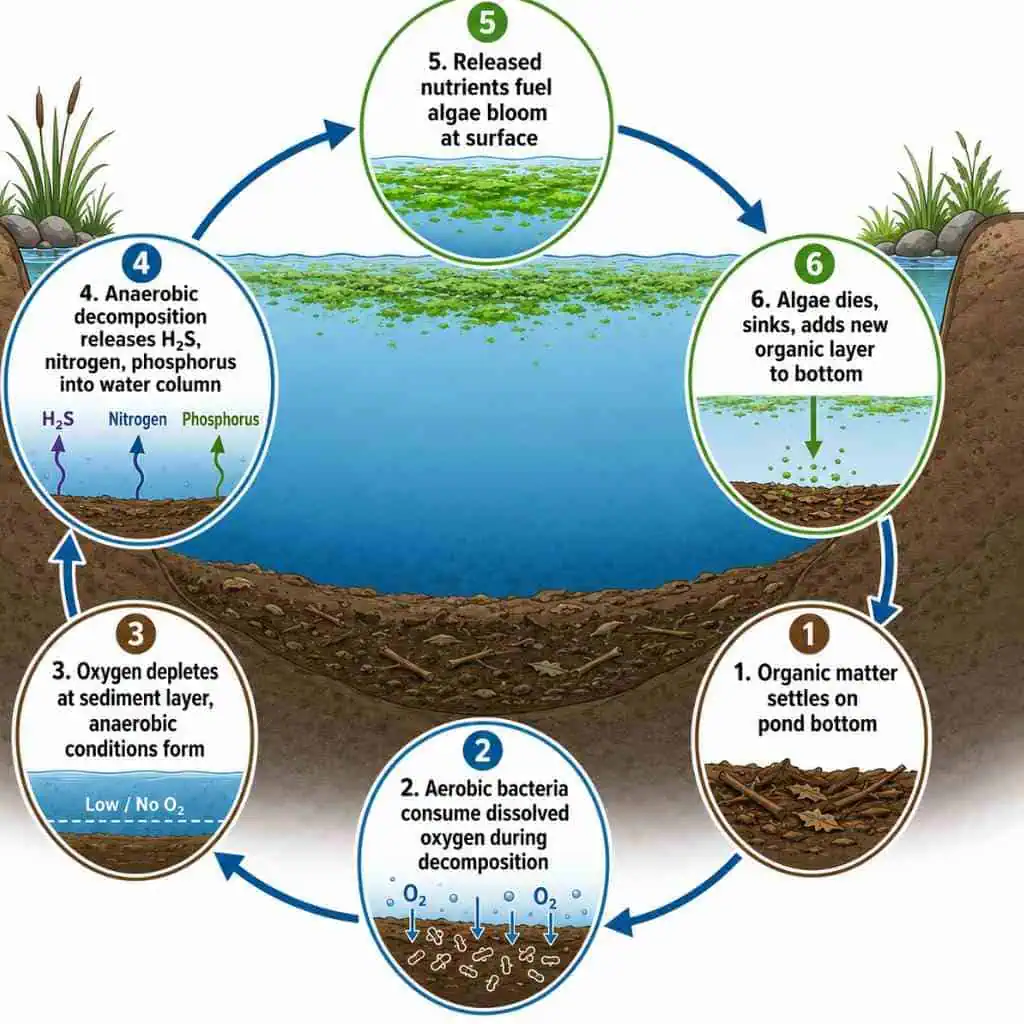
This is the self-reinforcing cycle that turns a manageable accumulation into a compounding problem. Not all sludge behaves the same way in this cycle. Labile organic sludge, material like fresh fish waste and algae residue, breaks down rapidly and creates the sharpest spikes in oxygen demand. Refractory organic sludge, primarily humic compounds from decomposed leaf litter and woody debris, resists bacterial breakdown and accumulates over years regardless of oxygen levels. The distinction matters for method selection: biological treatments like beneficial bacteria target labile material effectively, while refractory accumulation typically requires mechanical removal.
How Does Pond Sludge Affect Water Quality and Fish Health?
Excessive sludge depletes dissolved oxygen, releases toxic hydrogen sulfide, fuels algae blooms, and creates anaerobic zones that stress or kill fish. A pond with more than 2 to 3 inches of organic sludge is operating with measurably degraded water quality.
Decomposing sludge consumes dissolved oxygen from the water column, and the demand starts at the pond bottom where the sediment layer is thickest. As sludge depth increases, the oxygen-depleted zone expands upward into water that previously supported aerobic life. Most warm-water fish, including koi and goldfish, show stress behaviors when dissolved oxygen drops below 5 mg/L. Below 2 mg/L, fish kills become likely. The rate of depletion depends on water temperature, sludge composition, and whether the pond has any supplemental aeration, but a pond with no bottom aeration and more than 3 inches of organic sludge is almost always operating below safe oxygen levels at the sediment layer.
Once the bottom layer is fully oxygen-depleted, it becomes an anaerobic zone. Only bacteria that function without oxygen survive there, and their metabolic byproducts are hydrogen sulfide and methane rather than the carbon dioxide and water that aerobic decomposition produces.
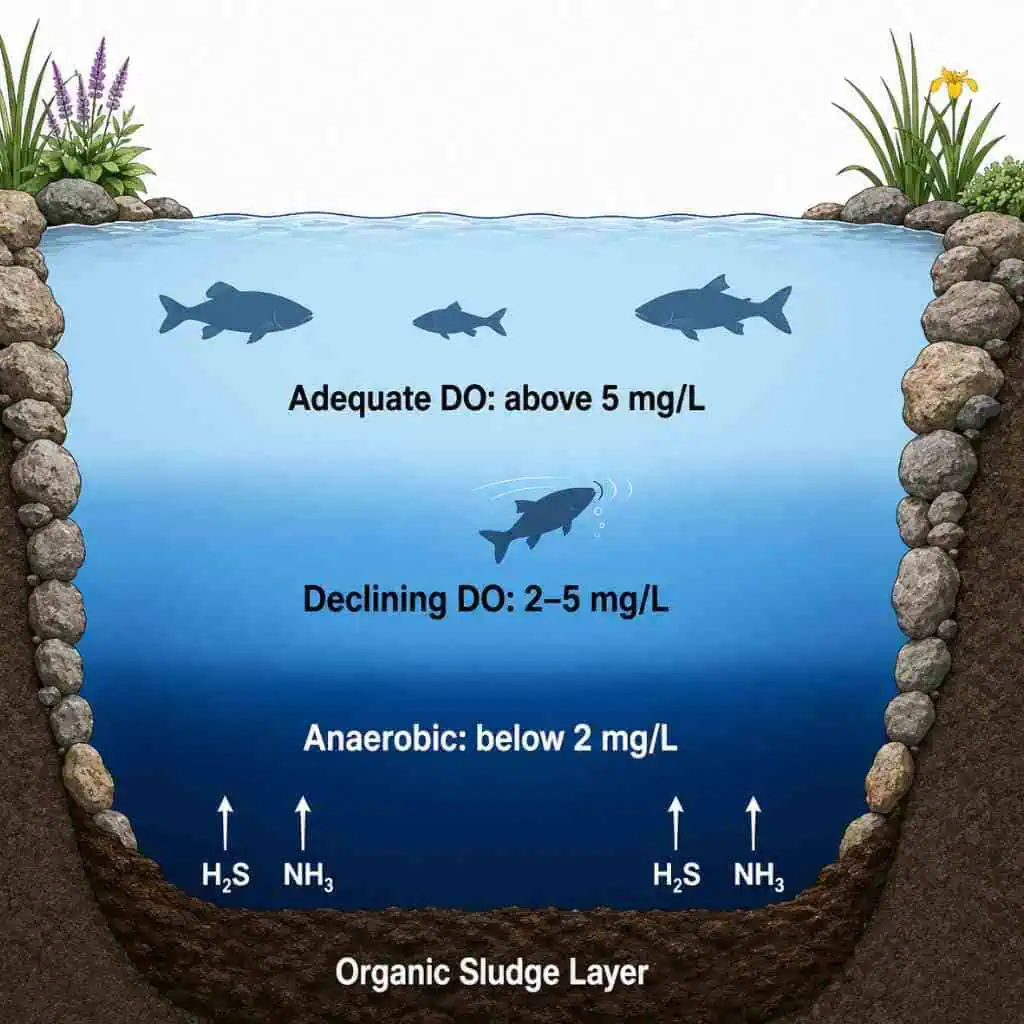
Hydrogen sulfide causes direct physiological damage to fish and is detectable by the rotten egg odor it produces when bottom sediment is disturbed. The same gas that creates the smell is toxic at concentrations most pond test kits cannot measure. H₂S interferes with oxygen uptake at the gill membrane by blocking the reoxidation of cytochrome a3 in the respiratory chain. A fish in water with adequate dissolved oxygen can still suffocate if H₂S is present at the gill surface.
The damage extends beyond direct toxicity. Anaerobic decomposition releases phosphorus and nitrogen that were bound in the sludge layer back into the water column, where they fuel algae growth. When those blooms collapse, the dead algae settle to the bottom as new organic material, increasing biological oxygen demand and producing another round of H₂S generation. In ponds with heavy nutrient loading, this cycle can also support cyanobacteria blooms, which introduce toxins that affect fish, pets, and wildlife.
The following indicators signal that sludge accumulation has reached a level where water quality and fish health are actively degrading:
- Persistent rotten egg odor when bottom sediment is disturbed during cleaning, feeding, or water changes
- Dark or black coloration of bottom sediment, indicating anaerobic conditions and sulfide presence in the substrate
- Murky or green water that does not clear despite adequate filtration and circulation, suggesting nutrient-driven suspended algae fed by sludge decomposition
- Sudden algae blooms following rain or warm spells, when runoff adds nutrients and rising water temperature accelerates decomposition in the sludge layer
- Fish gasping at the surface or clustering near waterfall returns and fountain outputs, which are the highest-oxygen zones in the pond
- Measurable reduction in pond depth over multiple seasons, indicating physical volume displacement by accumulated sediment
How Does Pond Vacuuming Remove Sludge?
A pond vacuum uses suction to pull sludge, debris, and fine sediment from the bottom of the pond into a collection chamber or directly through a discharge hose. This method works best for small to medium ponds under approximately 2,000 gallons with 1 to 3 inches of accumulated organic sludge.
The two main consumer vacuum types differ in how they handle the waste water cycle. Suction-and-discharge models fill an internal collection chamber, automatically stop suction to discharge the chamber contents through an outflow hose, then resume suction once the chamber empties. The operator works in intervals, not continuously. Continuous-discharge models use a pump that moves water and debris through the unit without stopping, which allows uninterrupted operation but typically produces a thinner slurry with more water volume per pass.
Suction-and-discharge units extract heavier sludge concentrations per cycle, which suits small ponds with localized deposits where the goal is removing a visible accumulation from a specific area. Continuous-discharge units cover more surface area in less time with lighter extraction per pass, which suits routine maintenance on ponds where sludge has not yet compacted into dense layers.

Most consumer pond vacuums handle solid debris up to approximately 3/8 inch in diameter. Suction performance degrades below 7 feet of water depth for standard consumer units, which limits effectiveness in deeper ponds or those with stepped shelves beyond that range. Substrate type also changes the approach: liner-bottom ponds allow full-contact suction where the vacuum head rests directly on the membrane, while gravel-bed ponds require positioning the vacuum head above the gravel line to avoid clogging the intake and displacing substrate that traps beneficial bacteria colonies.
Sectional removal is the governing protocol for fish-safe vacuuming. Disturbing the entire pond bottom at once releases stored ammonia and H₂S from anaerobic sediment layers simultaneously, which can spike water toxicity faster than the pond’s biological filtration can process it. Working in sections, typically one quarter to one third of the pond bottom per session, limits the volume of gas and nutrient release to levels the system can absorb. Running aeration before and during vacuuming increases dissolved oxygen in the water column, which buffers against the oxygen demand created by disturbed sediment. After each vacuuming session, testing ammonia and pH confirms whether the water has restabilized before the next section is addressed.
Raking and netting the surface before vacuuming prevents floating organic matter and large leaf clumps from reaching the intake and clogging it mid-session. Waste water discharged during vacuuming carries concentrated nitrogen and phosphorus, which makes it effective as fertilizer for garden beds and compost areas but harmful if it reaches storm drains or natural waterways where the nutrient load can trigger algae growth downstream.
What Role Does Beneficial Bacteria Play in Sludge Reduction?
Beneficial bacteria are aerobic microorganisms that consume organic matter in the sludge layer and convert it into carbon dioxide, water, and inorganic compounds that aquatic plants absorb. When applied consistently with adequate aeration, bacteria treatments can reduce 1 to 3 inches of organic sludge over a 3 to 6 month period.
Bio-augmentation introduces concentrated aerobic bacteria to the pond in pellet, tablet, or liquid form. Once applied, the bacteria colonize the sediment layer and accelerate decomposition of organic matter that natural bacterial populations cannot process at sufficient rates because anaerobic conditions at the sediment layer suppress the aerobic colonies needed for decomposition. The byproducts of aerobic decomposition are carbon dioxide and water, both odorless, which distinguishes the process from the anaerobic decomposition that produces hydrogen sulfide in untreated sludge. Effectiveness depends on dissolved oxygen concentration at the pond bottom, because these bacteria require oxygen to metabolize organic material.
Application timing matters. Morning or evening dosing avoids UV exposure that degrades live bacterial cultures before they reach the sediment layer.
Barley straw and barley extract function as supplemental treatments, not primary sludge removers. During decomposition, barley straw releases lignin-derived phenolic compounds that produce low concentrations of hydrogen peroxide, which inhibits new algae growth and supports organic matter breakdown at the surface layer. Barley works best as a complement to bacterial treatment rather than a standalone solution, and it has no measurable effect on compacted or refractory sludge that has accumulated over years.
Water temperature is the first variable that determines whether bacteria treatments will produce results. Bacterial activity begins above 50°F and reaches peak performance between 60 and 90°F. Below 50°F, most commercial formulations go dormant. Without supplemental aeration, dissolved oxygen at the sediment layer is rarely sufficient to sustain bacterial activity at treatment-effective concentrations.
Algaecides and chemical pond treatments kill beneficial bacteria on contact. A minimum 5 to 7 day pause between the last chemical application and the first bacteria dose is required for the bacterial cultures to survive colonization. Underdosing is the most common reason bacteria treatments fail to produce visible results, typically because the product label calculates dosage by surface area while sludge depth and organic load determine how much bacteria the pond actually needs.
Overdosing in warm water above 80°F carries the opposite risk: accelerated decomposition consumes dissolved oxygen faster than the pond can replenish it, triggering an oxygen crash that stresses or kills fish the same way untreated sludge does.
Results from biological treatment follow a graduated timeline. Weeks 1 through 4 typically bring improved water clarity and reduced odor as bacterial colonies establish and begin consuming the most accessible organic material at the sludge surface. Measurable muck reduction, usually 1 to 3 inches, occurs between months 3 and 6 in ponds with adequate aeration running continuously during treatment. Year 1 through 2 of consistent dosing produces cumulative reduction and shifts the pond toward a more self-sustaining biological balance where natural bacterial populations maintain decomposition rates closer to the organic input rate.
That shift is the actual goal. Bacteria treatments are a maintenance strategy that prevents future accumulation more effectively than they remove existing heavy deposits, and a pond with 6 or more inches of compacted refractory sludge will not reach acceptable levels through biological treatment alone.
How Does Aeration Help Break Down Pond Sludge?
Aeration increases dissolved oxygen concentration at the pond bottom, where sludge accumulates. Higher oxygen levels stimulate aerobic bacteria that decompose organic matter efficiently and without producing hydrogen sulfide. In ponds with existing sludge problems, aeration is the infrastructure addition with the broadest effect on sludge management because it enables every other biological treatment to function.
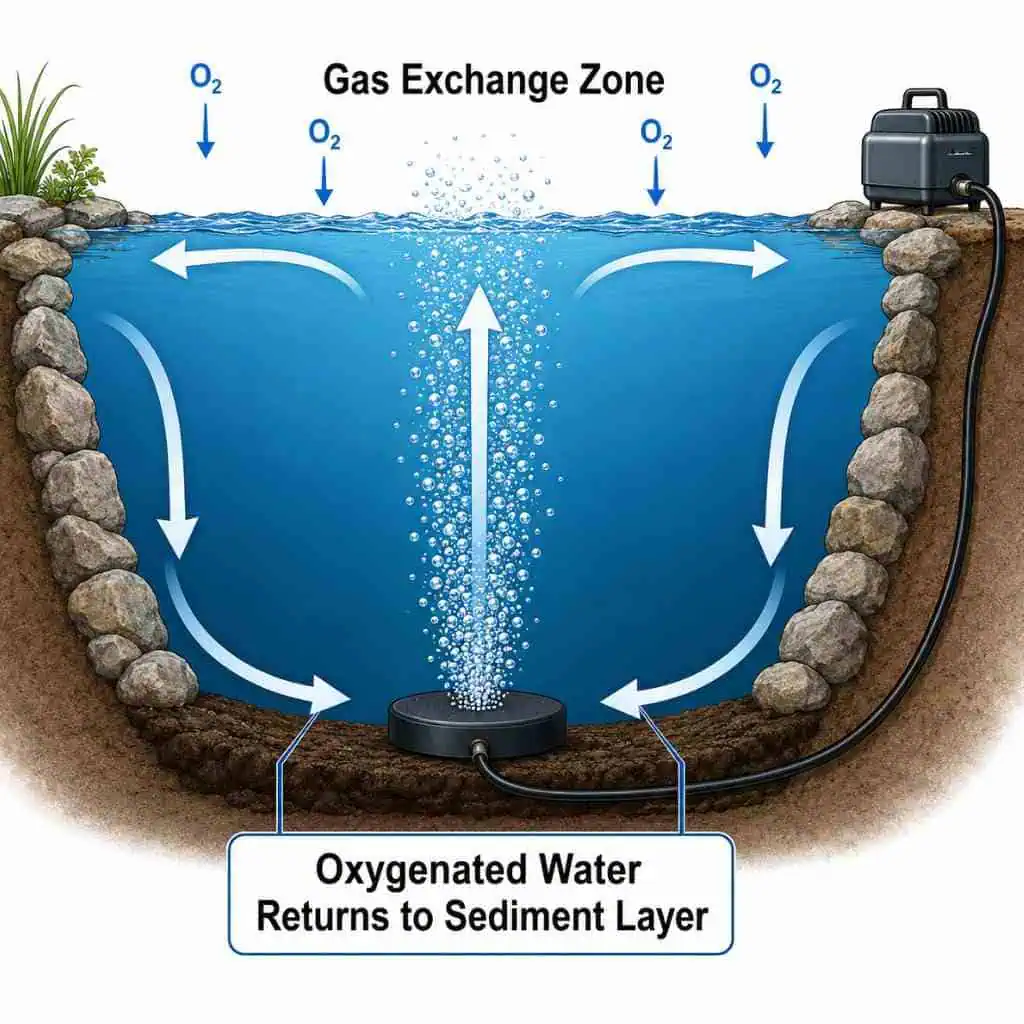
Diffused aeration uses bottom-mounted diffusers that release air directly at the sediment layer. The rising air column pulls oxygen-depleted bottom water to the surface, where it absorbs oxygen through gas exchange, then cycles back down. This vertical circulation pattern breaks thermal stratification, the layering effect where warm oxygen-rich water sits on top of cold oxygen-depleted water at the bottom, which is the condition that allows anaerobic zones to form and persist. The result is oxygen delivery where sludge decomposition actually occurs rather than at the surface where it contributes least to sediment breakdown.
Surface aerators and fountain aerators oxygenate the upper water column through agitation and spray. That process supports general water quality, fish health, and gas exchange at the surface. For sludge-specific results, surface aeration is less effective than diffused bottom aeration because it does not deliver oxygen to the sediment layer and does not break thermal stratification in ponds deeper than 3 to 4 feet.
Aeration amplifies every other sludge management method. Beneficial bacteria require dissolved oxygen to metabolize organic matter, and a pond running diffused aeration sustains the oxygen concentrations that keep bacterial colonies active at the sediment layer where the sludge is. Without it, bacterial colonies stall. Pre-aerating for 24 to 48 hours before vacuuming or dredging stabilizes the water column by raising dissolved oxygen levels high enough to buffer the ammonia and H₂S release that mechanical disturbance causes. Destratification from continuous aeration prevents the seasonal oxygen crashes that occur when thermally stratified ponds turn over in fall, mixing oxygen-depleted bottom water throughout the entire water column at once. Sizing matters: an undersized aeration system moves air without delivering enough oxygen to change conditions at the sediment layer, which is why diffuser capacity should be matched to pond volume and maximum depth rather than surface area alone.
A pond with consistent aeration accumulates sludge at a fraction of the rate of a stagnant pond with the same organic load. Aeration does not remove existing sludge. It changes the conditions that allow sludge to persist and compound.
When Is Dredging Necessary for Pond Muck Removal?
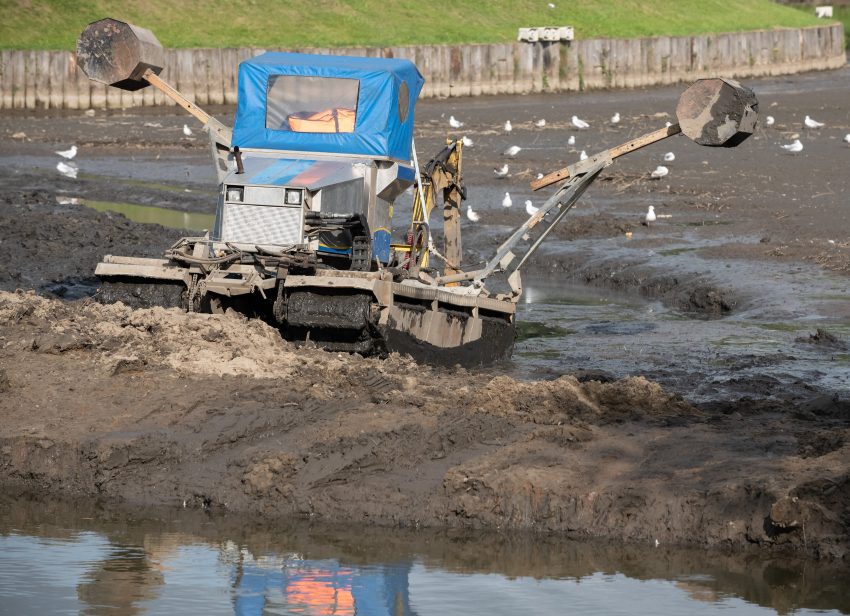
Dredging is necessary when sludge depth exceeds what vacuuming and biological treatments can manage, typically more than 6 inches of accumulated sediment, or when the pond has lost significant water depth and biological interventions cannot restore it within a reasonable timeframe.
Cost ranges from $20 to $90 per cubic yard, driven primarily by disposal method and project volume, with access conditions and regional labor rates as secondary factors.
| Mechanical Dredging | Hydraulic Dredging | |
|---|---|---|
| Method | Excavators physically scoop sediment from the pond bottom and load it for removal | Suction pumps create a slurry of water and sediment pumped through a pipeline to a dewatering area |
| Best fit | Larger ponds with accessible banks and stable ground for heavy equipment staging | Deeper ponds, access-restricted sites, or projects where bank and shoreline disturbance must be minimized |
| Removal speed | 20 to 50 cubic yards per hour depending on reach and staging; fastest option for high-volume removal | Slower per cubic yard; continuous operation but lower volume per pass |
| Ecosystem disruption | Higher; physical contact with the pond bottom, banks, and shoreline displaces substrate, plants, and organisms | Lower; suction disturbs the sediment layer without direct contact with banks or surrounding landscape |
| Access requirements | Stable perimeter access for equipment staging; minimum 10 to 12 feet of clearance for standard excavators | Pipeline routing from pond to dewatering area; equipment footprint is smaller but requires a suitable discharge location |

Disposal drives the cost. On-site spreading on adjacent land or dewatering bags keeps costs lowest when the property has space and the sediment passes environmental testing, while off-site trucking to a landfill or disposal facility can double or triple the per-cubic-yard cost.
Property owners with ponds connected to natural waterways, drainage channels, or wetlands may need permits before dredging. Any discharge of dredged or fill material into navigable waters of the United States requires a permit from the U.S. Army Corps of Engineers under CWA Section 404 (33 U.S.C. §1344). In California, discharges affecting waters of the state also fall under the Porter-Cologne Water Quality Control Act (Cal. Water Code §13000 et seq.), which gives the Regional Water Quality Control Board permitting authority. Sediment testing may be required before disposal when the dredged material comes from a pond connected to regulated waterways, and contaminated sediment that fails screening for heavy metals or hydrocarbons must be trucked to a licensed facility rather than spread on-site. The permit process adds weeks to months to the project timeline depending on the agency and the scope of the discharge.
Most residential koi ponds and water gardens on private property with no outfall to a natural waterway fall outside these permit requirements. For these ponds, dredging is a maintenance activity, not a regulated discharge. Property owners should confirm whether their pond connects to waters of the state before scheduling dredging work, because the connection is not always obvious when drainage channels or underground culverts route water off the property.
Which Sludge Removal Method Works Best for Each Pond Size?
Small koi ponds and water gardens under 2,000 gallons respond best to vacuuming combined with ongoing beneficial bacteria. Mid-size ponds between 2,000 and 10,000 gallons require aeration as the foundation, supplemented by bacteria and periodic vacuuming. Large ponds and lakes with severe accumulation typically require professional dredging followed by aeration and biological maintenance.
The method that fits depends on three variables: pond volume, sludge depth, and whether the owner can manage the work or needs professional service.
| Small (Under 2,000 Gallons) | Medium (2,000–10,000 Gallons) | Large (10,000+ Gallons or 4+ Inches of Sludge) | |
|---|---|---|---|
| Sludge depth range | Light to moderate: 1 to 3 inches | Moderate: 2 to 4 inches | Heavy: 4+ inches, or any depth where biological treatment alone cannot restore water depth within 6 months |
| Primary removal method | Pond vacuum (sectional removal protocol) | Periodic professional vacuuming or partial cleanout | Professional dredging: mechanical if banks are accessible, hydraulic if access is restricted |
| Biological maintenance | Beneficial bacteria dosed weekly during warm months (60–90°F) | Beneficial bacteria program with dosing matched to organic load, not label surface-area calculations | Ongoing biological maintenance program calibrated to post-dredging organic input rate |
| Aeration role | Optional; recommended if sludge recurs within one season despite vacuuming and bacteria | Required; diffused bottom aeration installed as foundation before bacteria program begins | Required; diffused aeration installed immediately after dredging to prevent reaccumulation |
| Owner capability | DIY-feasible with consumer-grade equipment | Professional assessment recommended; aeration installation and periodic cleanout typically require contractor | Professional-only for dredging; ongoing maintenance may transition to owner-managed after system stabilizes |
| Time to results | Immediate removal per session; 3 to 6 months for biological maintenance to reduce recurrence | 1 to 3 months for aeration to shift oxygen conditions; 3 to 6 months for measurable biological reduction | Dredging produces immediate volume removal; 6 to 12 months for biological system to stabilize post-dredging |
Every method in the table addresses one part of the problem. No single-method approach resolves sludge permanently. Vacuuming and dredging remove existing accumulation but do nothing to slow the organic inputs that rebuild the sludge layer. Beneficial bacteria prevent future buildup by accelerating decomposition, but they cannot break down heavy existing deposits or compacted refractory material. Aeration does not remove sludge at all, but without it, bacteria lack the oxygen to function at the sediment layer and mechanical disturbance releases ammonia and H₂S into an oxygen-depleted water column.
The most effective long-term outcome sequences all three. Remove existing accumulation mechanically, whether by vacuum or dredge depending on volume. Install diffused aeration to establish oxygen conditions that sustain biological activity at the pond bottom. Maintain with scheduled bacteria dosing calibrated to the pond’s actual organic load, not surface-area defaults from product labels.
How Do You Prevent Sludge From Building Up Again After Removal?
Preventing sludge recurrence requires controlling the organic inputs that cause it and maintaining the biological systems that decompose what remains. A pond with consistent aeration, scheduled bacteria dosing, regular debris removal, and controlled fish feeding accumulates sludge at a fraction of the rate of an unmanaged pond.
Prevention works by intercepting organic matter at every stage between entry and decomposition.
- Install leaf netting over the pond before fall and remove it after leaf drop ends, blocking the single largest organic input before it reaches the water.
- Maintain skimmers, filters, settling chambers, bottom drains, and UV clarifiers on a weekly or biweekly schedule to capture and process debris before it decomposes.
- Feed fish floating pellets rather than sinking food, in quantities consumed within 5 minutes, and evaluate whether total fish count exceeds what the pond’s filtration can support.
- Dose beneficial bacteria on a scheduled maintenance cycle, weekly or biweekly during warm months above 60°F and monthly in cooler months above 50°F, with aeration running continuously during treatment.
- Schedule professional pond cleaning when sludge depth reaches 2 inches despite consistent biological treatment, rather than waiting for accumulation to pass the threshold where bacteria alone cannot reverse it.
Water testing on a monthly schedule ties the protocol together. Tracking pH, ammonia, and dissolved oxygen over time reveals whether the prevention steps are keeping pace with organic inputs or whether accumulation is outrunning the system. A rising ammonia trend or a declining DO reading at the pond bottom signals that one or more steps need adjustment before the sludge layer reaches the threshold where mechanical removal becomes necessary again.
Need a hand with your pond?
Koi Pros designs, builds, maintains and repairs ponds, waterfalls, fountains and lakes across Southern California and Arizona. Start with an on-site assessment.