
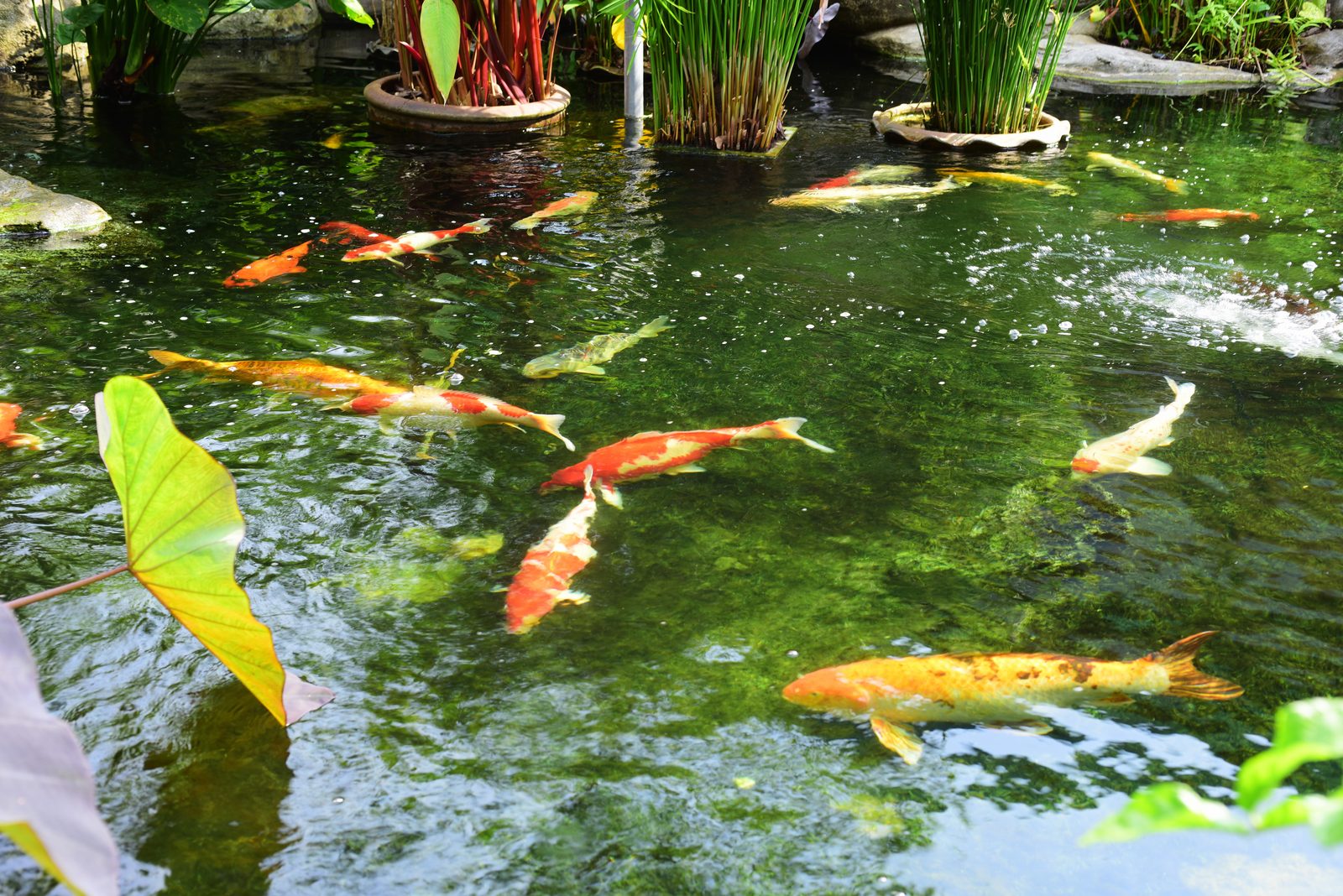
Pond water quality parameters are the measurable chemical and biological indicators that determine whether a pond can sustain fish health, support biological filtration, and maintain water clarity. Eight parameters form a complete testing profile: pH, ammonia, nitrite, nitrate, KH (carbonate hardness), GH (general hardness), dissolved oxygen, and temperature.
These eight readings function as an interactive system, not as independent values. A total ammonia reading of 0.5 ppm can be safe at low pH and cool water or lethal at high pH and warm water, because pH and temperature together control how much of that ammonia exists in its toxic free form.
Isolating any single parameter from the others produces an incomplete picture.
In Southern California, warm-season pond temperatures routinely reach 82–88°F. At that range, the toxic free ammonia fraction runs roughly ten times higher than it would at 68°F, turning a reading that looked safe in March into a gill-burn risk by July. Dissolved oxygen saturation drops toward the 6 mg/L floor fish need to sustain normal respiration. Testing all eight parameters together on a schedule matched to seasonal and event-driven risk is how pond owners catch a falling KH buffer, a rising nitrite spike, or an ammonia reading that crossed from safe to lethal between one weekly test and the next.
What Are Pond Water Quality Parameters?
Pond water quality parameters are the measurable chemical indicators that together determine whether a pond can sustain fish health and biological filtration. No single parameter is diagnostic in isolation; they interact as a system where one out-of-range value shifts the toxicity or stability of the others.
pH measures hydrogen ion concentration on a logarithmic scale, so a one-point drop from 8.0 to 7.0 represents a tenfold increase in acidity. That shift directly controls how much total ammonia exists as toxic free ammonia (NH₃) versus the less harmful ionized form (NH₄⁺). Ammonia is the primary metabolic waste fish excrete through their gills, and it also builds from decomposing food, leaves, and organic sludge. Higher pH means more toxic ammonia.
Nitrite (NO₂⁻) appears when Nitrosomonas bacteria begin converting ammonia inside the biological filter. Nitrate (NO₃⁻) is what remains after Nitrobacter bacteria finish the second conversion stage, and it accumulates until water changes or plant uptake remove it. KH (carbonate hardness) measures carbonate and bicarbonate ions that buffer pH against swings.
GH (general hardness) measures calcium and magnesium that koi need for osmoregulation, maintaining stable internal salt and fluid balance across gill membranes. Dissolved oxygen (DO) sustains both fish respiration and the aerobic bacteria powering the nitrogen cycle, and when summer temperatures push DO below 6 mg/L, fish and filter bacteria compete for the same shrinking oxygen supply. Temperature governs that competition along with metabolic rate, feeding behavior, and ammonia toxicity at any given pH.
The most critical interaction is the pH-temperature-ammonia triangle. At pH 8.0 and 86°F, conditions common in Southern California summer ponds, the fraction of toxic free ammonia (NH₃) runs roughly ten times higher than at pH 7.0 and 68°F per EPA aquatic life criteria. A pond reading 0.5 ppm total ammonia at pH 7.2 and 70°F sits well below the acute toxicity threshold, but the same 0.5 ppm at pH 8.2 and 84°F pushes free ammonia past the concentration where gill tissue damage begins within hours.
One number without the others tells you nothing.
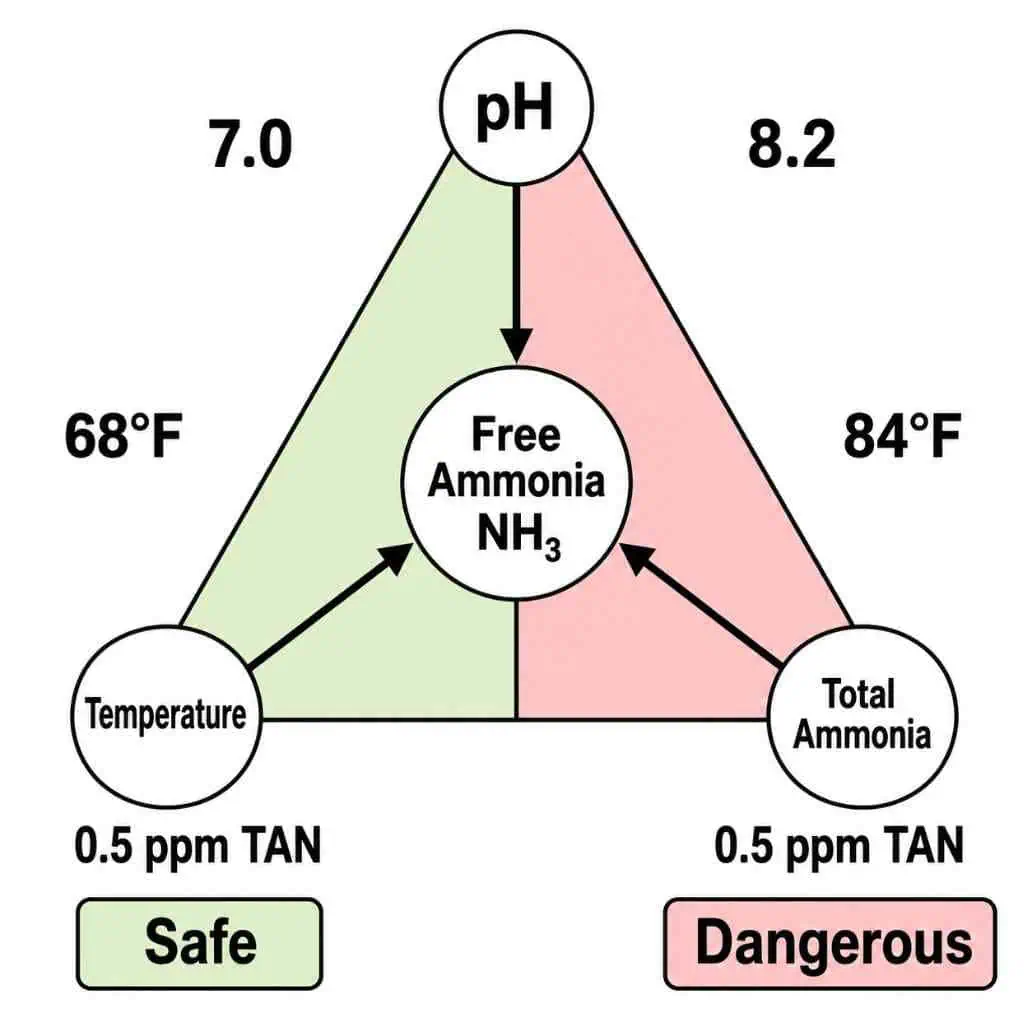
KH depletion compounds this because falling carbonate hardness removes the buffer holding pH stable, and unstable pH destabilizes every other parameter that depends on it. A pond testing zero ammonia, zero nitrite, and acceptable nitrate can still crash fish within 48 hours if KH has dropped below 40 ppm and pH swings two full points between dawn and mid-afternoon.
What Should Pond Water Test Results Be?
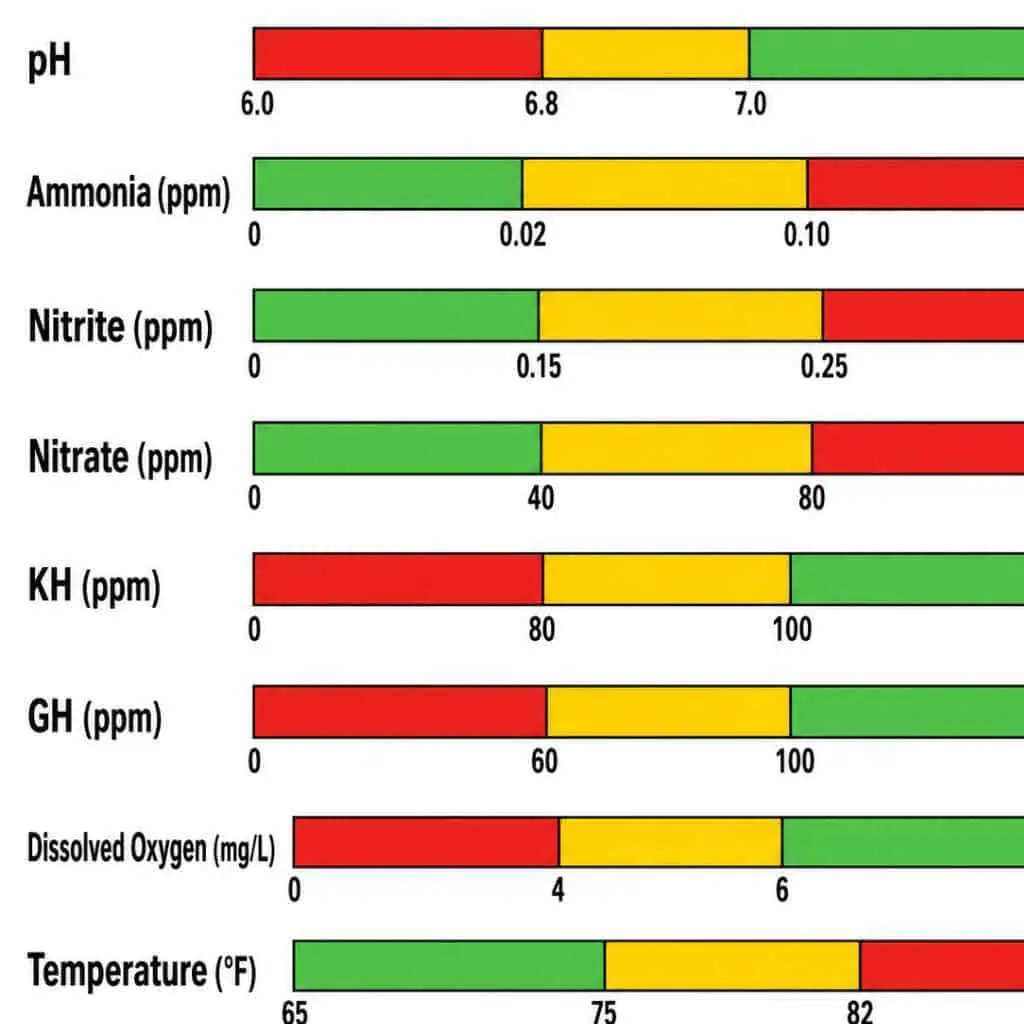
For koi ponds in Southern California, target ranges are: pH 7.0–8.4, ammonia 0 ppm, nitrite 0 ppm, nitrate below 40 ppm, KH 80–120 ppm (4–6 dKH), GH 60–200 ppm, dissolved oxygen above 6 mg/L, and temperature 65–75°F for optimal koi metabolism. Any ammonia or nitrite reading above zero requires immediate corrective action.
The table below reflects warm-climate koi pond thresholds, not generic freshwater aquarium or cold-water fisheries ranges, because California summer pond temperatures compress safe ammonia and dissolved oxygen windows well beyond what published temperate-climate standards account for.
| Parameter | Acceptable | Caution | Danger | First Action |
|---|---|---|---|---|
| pH | 7.0–8.4 | 6.5–6.9 or 8.5–8.8 | Below 6.5 or above 9.0 | Test KH immediately; do not adjust pH directly |
| Ammonia (NH₃/NH₄⁺) | 0 ppm | 0.25 ppm | 0.5 ppm or above | 25–30% water change with dechlorinated water; stop feeding |
| Nitrite (NO₂⁻) | 0 ppm | 0.25 ppm | 1.0 ppm or above | 25–30% water change; add pond salt at 1 lb per 100 gallons to block nitrite uptake through gills |
| Nitrate (NO₃⁻) | Below 20 ppm | 20–40 ppm | Above 40 ppm | Increase water change volume and frequency |
| KH (carbonate hardness) | 80–120 ppm (4–6 dKH) | 40–79 ppm | Below 40 ppm | Add sodium bicarbonate at 1 tbsp per 100 gallons; retest in 24 hours |
| GH (general hardness) | 60–200 ppm | 30–59 ppm | Below 30 ppm | Add calcium chloride or mineral supplement; retest in 48 hours |
| Dissolved oxygen | Above 7 mg/L | 6–7 mg/L | Below 6 mg/L | Increase aeration or surface agitation immediately |
| Temperature | 65–75°F | 55–64°F or 76–82°F | Below 50°F or above 86°F | Reduce feeding below 55°F; increase aeration and shade above 82°F |
Acceptable parameter ranges shift with season. During winter lows of 55–60°F, the nitrogen cycle slows and ammonia toxicity drops because cold water holds a lower fraction of free ammonia at any given pH. But that same slowdown suppresses Nitrosomonas and Nitrobacter activity in the filter, which means bacterial colonies thin out over winter months. Filter startup after winter is a high-risk period because rising spring temperatures increase fish metabolism and feeding before the bacterial population has recovered enough to process the resulting ammonia load.
The mirror problem hits in summer.
Summer highs of 82–88°F increase fish metabolism, feeding rates, and ammonia excretion while simultaneously increasing the toxic fraction of total ammonia and reducing dissolved oxygen saturation capacity. A reading of 0.25 ppm total ammonia in January at pH 7.4 and 58°F water carries a free ammonia concentration of approximately 0.004 ppm, well within safe range. The same 0.25 ppm in August at pH 8.0 and 84°F water carries approximately 0.03 ppm free ammonia, nearly eight times higher and approaching the threshold where chronic gill stress begins per EPA aquatic life criteria.
How Does the Nitrogen Cycle Work in a Pond?
The nitrogen cycle converts toxic ammonia from fish waste into less harmful nitrate through two bacterial stages: Nitrosomonas bacteria oxidize ammonia (NH₃) into nitrite (NO₂⁻), and Nitrobacter bacteria oxidize nitrite into nitrate (NO₃⁻). The cycle requires established bacterial colonies in the filter media, adequate dissolved oxygen, and water temperatures above 50°F to function. A new or disrupted cycle produces ammonia and nitrite spikes that are the leading cause of fish mortality in maintained ponds.
The conversion follows a fixed sequence where each stage depends on the one before it and each stage requires oxygen and colonized surface area in the filter media to proceed.
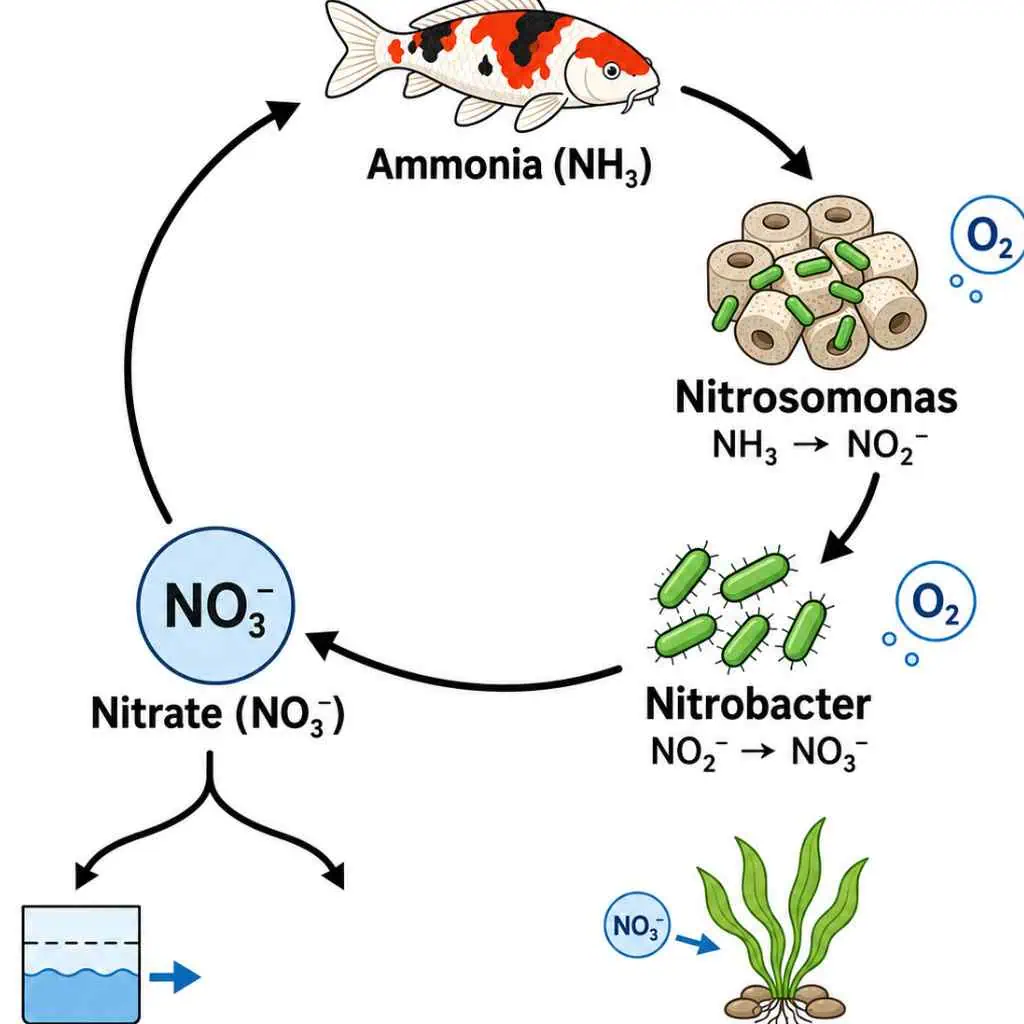
- Ammonia production. Fish excrete ammonia continuously through their gills and urine. Uneaten food, fallen leaves, and organic sludge decompose into additional ammonia. This is the cycle’s input and it never stops as long as fish are alive and organic matter is present.
- Ammonia-to-nitrite conversion. Nitrosomonas bacteria colonized on biological filter media oxidize ammonia into nitrite (NO₂⁻). Nitrite is less toxic than ammonia but still dangerous to fish, causing methemoglobinemia (brown blood disease) by binding to hemoglobin and blocking oxygen transport.
- Nitrite-to-nitrate conversion. Nitrobacter bacteria oxidize nitrite into nitrate (NO₃⁻). Nitrate is the least toxic nitrogen compound in the chain and accumulates in the pond water until removed by water changes or absorbed by aquatic plants.
- Nitrate export. Nitrate has no bacterial conversion stage in a standard pond system. It builds continuously and is removed only through partial water changes or plant uptake, which is why regular water changes remain necessary even when the cycle is fully established.
A complete cycle takes 4–8 weeks to establish in a new pond. This period is commonly called new pond syndrome. Nitrosomonas colonies must reach sufficient population density before Nitrobacter colonies can begin establishing on the nitrite those bacteria produce. Any event that kills or displaces bacterial colonies resets part or all of the establishment period.
Nitrosomonas recover faster than Nitrobacter after a disruption, which means ammonia drops first and creates a false sense of recovery while nitrite climbs silently behind it.
Test results reveal exactly where the cycle has broken and which bacterial population is affected.
- Ammonia elevated, nitrite zero, nitrate zero. Nitrosomonas bacteria have not colonized or have been killed. Common after medicating a pond with antibiotics, cleaning filter media with chlorinated tap water, or replacing all media at once.
- Ammonia falling, nitrite elevated, nitrate rising. Nitrosomonas are active and converting ammonia, but Nitrobacter have not established sufficient population to keep pace. Typical at weeks 2–4 of a new cycle or after a partial filter disruption.
- Ammonia zero, nitrite zero, nitrate rising. The cycle is complete and functioning. Nitrate accumulation is the expected steady-state outcome. Rising nitrate indicates the need for increased water change volume or frequency, not a cycle failure.
In Southern California, the cycle slows significantly when pond water drops below 55°F because Nitrosomonas and Nitrobacter metabolism is temperature-dependent. Bacterial colonies thin over winter, and when spring temperatures climb back above 55°F, fish resume feeding and excreting ammonia before the bacterial population has recovered processing capacity. March and April are the predictable risk window, and test results during those weeks frequently show the ammonia-only or ammonia-plus-nitrite failure pattern even in ponds that cycled successfully the previous year.
The spring restart is not a new pond problem. It is a recurring seasonal vulnerability.
How Often Should You Test Pond Water?
Test pond water weekly during summer (May through October in Southern California) and biweekly during winter (November through April). Test daily during new pond cycling, after adding fish, after heavy rain, after medication, or when fish show stress behavior. Ammonia and nitrite require the highest testing frequency because they can reach lethal concentrations within 24–48 hours of a triggering event.
The schedule below accounts for Southern California’s seasonal temperature patterns and the nitrogen cycle’s temperature-dependent bacterial activity, which is why testing frequency tracks water temperature rather than calendar dates.
| Season / Condition | Parameters | Frequency | Why This Frequency |
|---|---|---|---|
| Summer (May–October) | pH, ammonia, nitrite, nitrate, temperature | Weekly | Fish metabolism, feeding rates, and ammonia output peak. Free ammonia toxicity highest at summer pH and temperature. |
| Summer (May–October) | KH | Monthly (weekly if pH unstable) | KH consumption accelerates in warm water. Monthly catches drift. Weekly required if pH swings more than 0.4 between morning and afternoon. |
| Winter (November–April) | All parameters | Biweekly | Reduced feeding, lower metabolism, lower ammonia toxicity at cool temperatures. Cycle slows but does not stop. |
| Spring transition (March–April) | pH, ammonia, nitrite, temperature | Weekly when water rises above 55°F | Nitrogen cycle restarts unevenly. Fish resume feeding before bacterial colonies recover processing capacity. Highest seasonal risk window. |
| Fall transition (October–November) | All parameters | Weekly until water drops below 60°F | Maintain weekly frequency through feeding reduction period. Shift to biweekly only after feeding stops and water temperature stabilizes below 60°F. |
| New pond cycling | Ammonia, nitrite, pH | Daily for 4–8 weeks | Ammonia and nitrite can spike to lethal levels within 24 hours during cycling. Daily testing catches spikes before fish are harmed. |
Five events override the routine schedule and trigger daily testing for seven consecutive days regardless of season: adding new fish to the pond, heavy rainfall, medicating the pond with antibiotics or anti-parasitic treatments, replacing biological filter media, and any visible fish stress including flashing, gasping at the surface, clamped fins, or lethargy. Each event carries a different primary parameter risk, and knowing which parameter to watch first prevents wasted time testing everything at maximum urgency.
The trigger tells you where to look first.
Rain primarily affects pH and KH because acidic runoff dilutes the pond’s carbonate buffer and can drop pH by a full point within hours. New fish primarily affect ammonia because the added bioload exceeds the biological filter’s current processing capacity. Medication primarily affects the entire nitrogen cycle because antibiotics suppress Nitrosomonas and Nitrobacter alongside the target pathogen, which is why the ammonia-only or ammonia-plus-nitrite failure pattern from a cycle disruption frequently follows antibiotic treatment by 48–72 hours.
Which Pond Water Test Kit Should You Use?
Liquid reagent test kits are the minimum standard for reliable pond water testing. Test strips are faster but lack the precision to detect the low-level ammonia and nitrite readings that matter most for fish safety. Digital meters offer the highest accuracy for pH and temperature but require calibration and do not replace chemical tests for ammonia, nitrite, and nitrate.
The comparison below evaluates each kit type on the criteria that determine whether test results are reliable enough to make treatment decisions from, not just convenient enough to run.
| Kit Type | Accuracy | Resolution | Speed | Cost | Parameter Coverage | Limitation |
|---|---|---|---|---|---|---|
| Liquid reagent kit | Highest for ammonia and nitrite | 0.25 ppm for ammonia and nitrite | 5–10 minutes per full test | $25–$45 per kit | pH, ammonia, nitrite, nitrate, and high-range pH. Separate drop test for KH/GH. | Reagents expire 12–18 months after opening. Color reading is subjective under artificial light. |
| Test strips | Low to moderate | 0–0.5–1.0 ppm for ammonia (a dangerous 0.25 ppm reads as “safe”) | 60 seconds | Lowest cost per test | pH, ammonia, nitrite, nitrate, KH, GH on multi-parameter strips | Cannot detect the sub-0.5 ppm readings where early intervention prevents fish harm. Resolution gap is the critical failure. |
| Digital pH meter | Highest for pH | 0.01 pH units | Instant | $15–$80 | pH and temperature only | Requires monthly calibration with buffer solutions (pH 4.0 and 7.0). Does not test ammonia, nitrite, nitrate, KH, or GH. |
The practical combination for most pond owners is a liquid reagent kit for nitrogen parameters and KH/GH plus a digital thermometer for continuous temperature monitoring.
Expired reagents are the most common source of false-safe readings. Ammonia and nitrite reagents degrade after opening, and degraded reagents read low, meaning a pond with dangerous ammonia levels can test as zero. Testing only in the morning misses the period when pH and temperature both peak in late afternoon, which is exactly when the free ammonia fraction is highest. A morning test can show a safe ammonia-to-pH ratio while the same pond reaches dangerous free ammonia levels four hours later.
Technique matters more than kit quality.
Reading color results under artificial light shifts hue perception compared to the daylight-calibrated color cards included with reagent kits, which is why test instructions specify natural daylight for color matching. The Nessler ammonia reagent (yellow-to-amber color scale) produces falsely elevated readings when the pond water contains sodium thiosulfate from dechlorinators; the salicylate method (green-to-blue color scale) avoids this interference, which matters for any pond filled or topped off with municipal water. Shaking the nitrate #2 reagent bottle vigorously for a full 30 seconds is required because the reagent contains a suspended powder that must be fully dispersed. Insufficient shaking is the single most common source of false-low nitrate results.
What Causes Ammonia Spikes in a Pond?
Ammonia spikes are caused by bioload exceeding biological filtration capacity. The five most common triggers are overfeeding, overstocking, filter media disruption, dead fish or organic debris decomposition, and new pond syndrome where the nitrogen cycle has not yet established. In Southern California summer conditions, the same ammonia concentration is more toxic at higher temperatures and pH, making summer spikes more dangerous than identical readings in winter.
The triggers below are ranked by frequency in maintained ponds, not neglected ones, because ammonia emergencies in ponds that receive regular care almost always trace back to one of these five sources.
- Overfeeding. Uneaten food decomposes into ammonia within hours. Koi should consume all food within three to five minutes. Any food remaining on the surface or settling to the bottom is excess bioload the filter must process.
- Overstocking. The general guideline of one inch of koi per ten gallons is a starting reference, not a rule. Biological filtration capacity is the actual limit, and a pond with undersized filtration hits ammonia problems at stocking densities well below that ratio.
- Filter media disruption. Replacing all media at once, cleaning media with chlorinated tap water, or running antibiotics kills the Nitrosomonas and Nitrobacter colonies that convert ammonia. Partial media replacement in rotation preserves enough bacterial population to maintain conversion capacity.
- Debris accumulation. Dead fish, fallen leaves, and accumulated sludge decompose into ammonia continuously. A single dead koi in a small pond can produce a measurable ammonia spike within 12 hours.
- New pond syndrome. The 4–8 week cycling period before bacterial colonies establish sufficient processing capacity. Ammonia spikes during this window are expected, not a sign of equipment failure.
Every trigger on this list shares the same root mechanism: ammonia input exceeded the biological filtration capacity available to process it. The diagnostic question is which input overwhelmed the filter and whether the filter itself was compromised.
Diagnosis before treatment prevents the wrong corrective action.
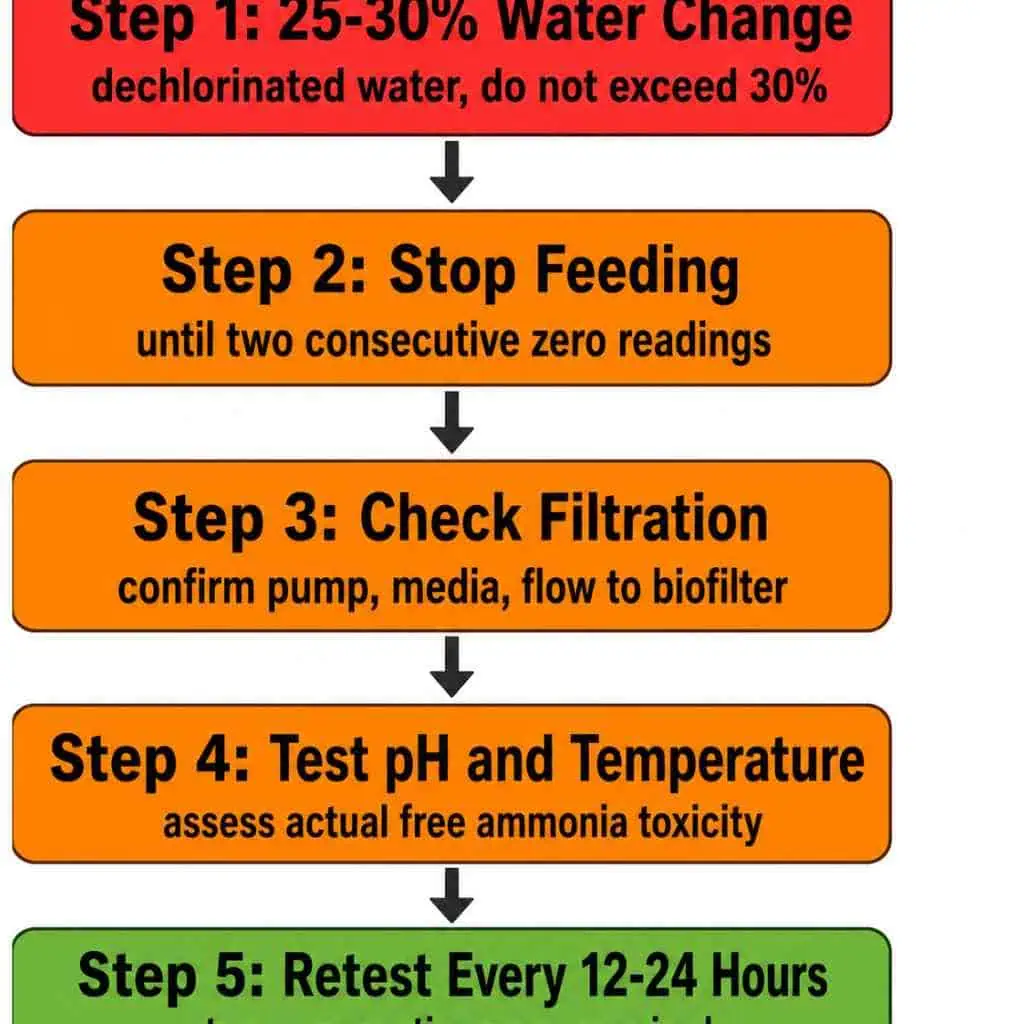
When ammonia tests above zero, the response follows a fixed sequence where each step must happen in order because skipping ahead can worsen the situation.
- Immediate 25–30% water change using dechlorinated water to dilute the ammonia concentration. Do not exceed 30% in a single change to avoid shocking fish with rapid temperature or pH shifts from the replacement water.
- Stop feeding entirely until ammonia returns to zero on two consecutive tests spaced 12–24 hours apart. Every feeding adds ammonia input to a system already unable to process what it has.
- Check and restart filtration. Confirm the pump is running, media is in place, and flow is reaching the biological filter chamber. A filter running at reduced flow processes less ammonia per hour.
- Test pH and temperature to assess the actual free ammonia toxicity of the reading. A TAN reading of 0.5 ppm at pH 7.2 and 68°F produces a fraction of the gill damage that the same 0.5 ppm produces at pH 8.2 and 84°F.
- Retest every 12–24 hours until two consecutive readings return to zero. A single zero reading does not confirm the spike has resolved because ammonia can fluctuate within a 24-hour period as feeding, decomposition, and bacterial processing rates shift.
Ammonia-binding products convert toxic free ammonia (NH₃) to less toxic ammonium (NH₄⁺) temporarily, but they do not remove ammonia from the system. The total ammonia nitrogen remains in the water, and when the binding agent dissipates, free ammonia returns. Water changes physically remove ammonia. Binders delay it.
The binder is not a substitute. It is a bridge while water changes do the actual work.
How Do You Stabilize Pond pH?
Pond pH stability depends on KH (carbonate hardness), not on pH adjusters. The fix is raising and maintaining KH with sodium bicarbonate, not adding pH-up or pH-down products that create temporary corrections followed by rebound swings.
KH represents the concentration of carbonate and bicarbonate ions in the water that absorb hydrogen ions and prevent pH from shifting. A pond with KH above 80 ppm resists pH movement even as photosynthesis consumes CO₂ during the day and respiration releases it overnight. A pond with KH below 40 ppm has effectively no buffering and will pH-crash, often overnight when respiration-driven CO₂ accumulation produces carbonic acid with no carbonates available to neutralize it.
pH instability is a KH problem, not a pH problem.
In Southern California, much of the municipal water supply draws from low-mineral sources that naturally trend toward low KH, which means most ponds in the region require periodic KH supplementation rather than relying on source water to maintain the buffer. Testing KH monthly is the minimum frequency. Test weekly if morning-to-afternoon pH variation exceeds 0.4 points, which signals the buffer is depleting faster than the source water replenishes it.
Sodium bicarbonate (baking soda) at one tablespoon per 100 gallons raises KH approximately 10–15 ppm. Add no more than 20 ppm of KH increase per 24-hour period to avoid osmotic stress on fish, and dissolve the dose in a bucket of pond water before distributing it across the surface. Crushed coral or oyster shell placed in the filter chamber provides slow-release KH supplementation that buffers continuously between manual doses, reducing the frequency of sodium bicarbonate additions.
Stability matters more than precision.
pH-up and pH-down products create rapid temporary pH changes without addressing the underlying KH deficit, and the pH rebounds within hours once the chemical dissipates, producing swings that stress fish more than a stable but slightly out-of-range pH would. A stable pH of 7.8 is safer for koi than a pH that swings between 7.2 and 8.4 daily, because the swing itself triggers osmoregulatory stress as the fish’s body constantly adjusts internal chemistry to match the shifting external environment.
How Do You Read Pond Water Test Results Together?
Read pond water test results as a system, not as individual numbers. The corrective action for any single out-of-range parameter depends on what the other parameters read. Priority order for corrective action is always: ammonia and nitrite first (acute lethality), then pH/KH stability, then nitrate and DO, then GH.
Ammonia and nitrite can kill fish within 24–48 hours at dangerous levels, which is why they occupy the top of every corrective sequence regardless of what other parameters show. pH and KH issues cause chronic stress over days to weeks. Nitrate accumulation degrades fish health over weeks to months. When multiple parameters are out of range simultaneously, address them in lethality order: immediate water change for ammonia and nitrite, then KH adjustment to stabilize pH, then increased water change volume for nitrate reduction.
Fixing pH while ammonia is elevated makes the situation worse because raising pH converts more total ammonia into the toxic free ammonia fraction.
The three scenarios below represent the most common multi-parameter combinations and the diagnostic interpretation each one requires.
- Ammonia 1.0 ppm, nitrite 0, nitrate 0. The nitrogen cycle has not established. No Nitrosomonas activity is converting ammonia, so no nitrite is being produced. This is new pond syndrome or a complete post-disruption reset where all bacterial colonies were killed.
- Ammonia 0, nitrite 2.0 ppm, nitrate rising. Nitrosomonas are active and processing ammonia, but Nitrobacter have not built enough population to convert the resulting nitrite. The cycle is mid-establishment. Ammonia has cleared but the nitrite bottleneck has not resolved, which is the most common pattern at weeks two through four of a new cycle.
- Ammonia 0, nitrite 0, nitrate 80+ ppm, pH dropping. The cycle is complete and functioning. The problem is downstream: water changes are insufficient to export nitrate, and the acid produced by nitrification is consuming KH faster than the source water replenishes it. The falling pH is a KH depletion signal, not a standalone pH problem.
The pattern tells the story.
Each scenario produces a different corrective path, but none of the three is diagnosable from any single parameter reading. The ammonia-only pattern looks like overfeeding until nitrite and nitrate confirm it is a cycle failure. The nitrate-plus-falling-pH pattern looks like a pH problem until KH testing reveals it is a buffer depletion problem.
Some test result combinations indicate the problem exceeds what water changes, feeding adjustments, and KH supplementation can resolve. Multiple parameters simultaneously in danger zones, ammonia or nitrite above 1.0 ppm with fish showing acute distress such as gasping, erratic swimming, or lying on the bottom, and pH below 6.5 or above 9.0 all require immediate professional assessment. Any parameter that does not respond to two consecutive corrective actions signals a root cause that surface-level treatment cannot reach.
Chemical treatment cannot fix a structural problem.
The root cause in those cases is usually structural: undersized filtration, inadequate circulation, or a pond design limitation that no amount of chemical adjustment resolves.
How Do You Keep a Pond Water Quality Log?
A pond water quality log records every test date, all parameter readings, water temperature, any actions taken, and weather conditions. The log’s value is trend identification: a single test result is a snapshot, but weekly readings over 8–12 weeks reveal patterns like gradual KH depletion, seasonal pH drift, or slow nitrate accumulation that individual tests miss.
Minimum fields per entry are date, time of day, water temperature, pH, ammonia, nitrite, nitrate, KH, any action taken, and a weather or event note. Time of day matters because pH varies between morning and afternoon as CO₂ levels shift, so a log entry without the time cannot distinguish a normal diurnal swing from a genuine drift. The action field turns the log into a diagnostic tool, because correlating a parameter shift to an action taken days earlier reveals cause-and-effect that memory cannot reconstruct.
Trends matter more than individual readings.
After 8–12 weeks of consistent entries, the log establishes a seasonal baseline for each parameter, and any deviation from that baseline triggers investigation before the parameter reaches a danger threshold. A single test shows where a parameter is. The log shows how fast it is moving, which is the difference between knowing KH reads 70 ppm today and knowing it has dropped 10 ppm per month for three months and will hit crash threshold next month.
Need a hand with your pond?
Koi Pros designs, builds, maintains and repairs ponds, waterfalls, fountains and lakes across Southern California and Arizona. Start with an on-site assessment.