
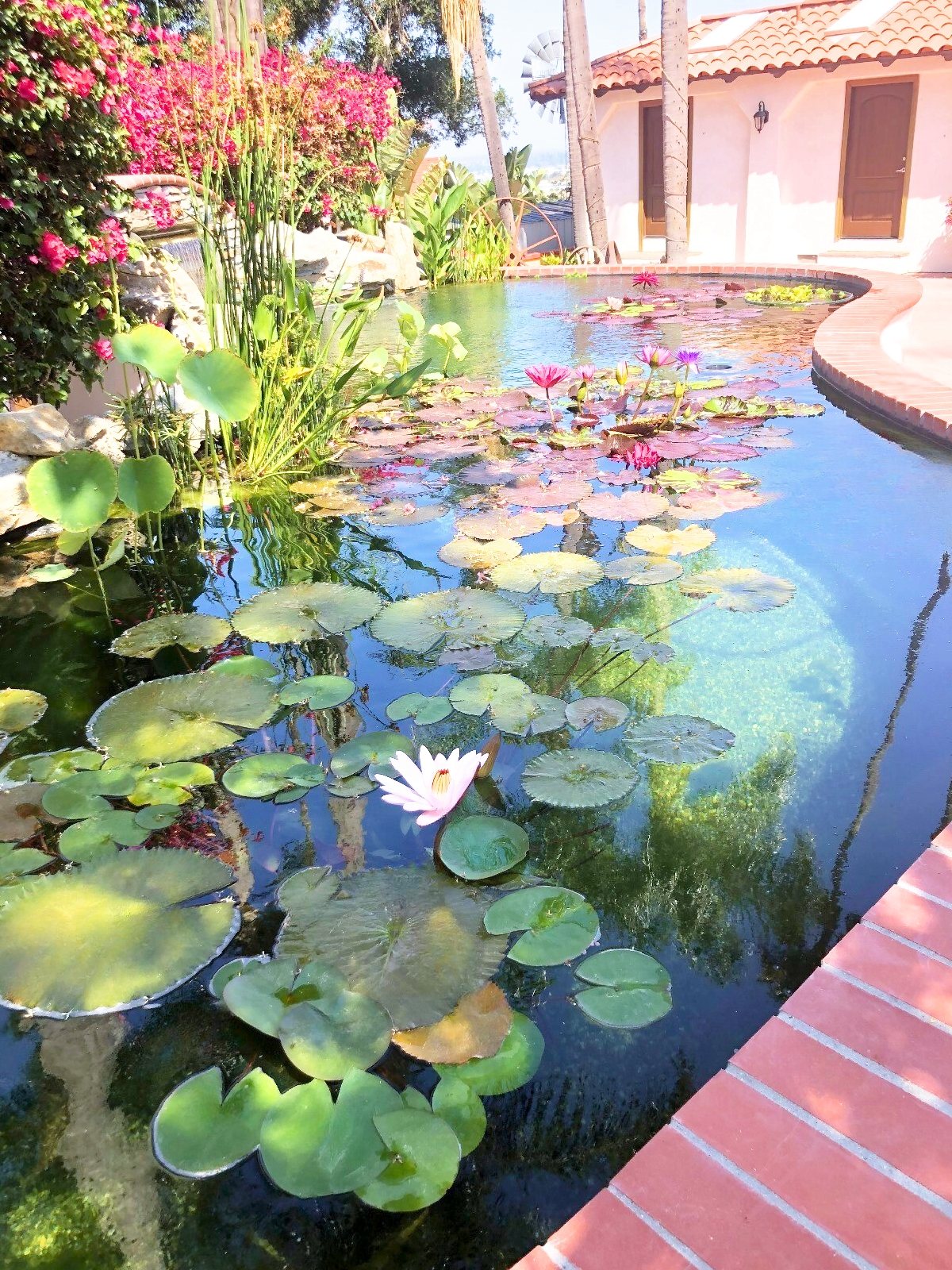
Seasonal pond maintenance is the year-round cycle of water chemistry management, biological filtration support, equipment inspection, and fish care adjustment that sustains a koi pond. In California, that cycle centers on managing heat, evaporation, and dissolved oxygen rather than the freeze protection that most cold-climate maintenance guides assume. Ponds here rarely freeze.
The differences come from climate zone. Coastal ponds across Orange County and Los Angeles rarely see water temperatures high enough to stress fish, but the marine layer holds temperatures in the range where algae grows continuously from March through November without a seasonal break. Inland ponds in Riverside and San Bernardino face summer water temperatures above 85°F, evaporation that can pull two to three inches of water per week, and Santa Ana wind events that spike water loss overnight. Desert ponds in the Coachella Valley add extreme dissolved oxygen depletion and accelerated UV degradation of liner materials to the stress load. Every seasonal task in the maintenance cycle either prevents a condition the next season would create or corrects one the previous season left behind.
What Does Seasonal Pond Maintenance Include?
Seasonal pond maintenance is the year-round cycle of weekly, monthly, and season-specific tasks that sustain water quality, biological filtration, fish health, and equipment performance in a koi pond. In California, where pond water rarely freezes, maintenance focuses on managing algae pressure, evaporation, storm runoff, and dissolved oxygen rather than winterization.
The cycle operates across four task categories: water chemistry management, biological filtration support, equipment inspection, and fish care adjustment. Water chemistry management means testing pH, ammonia, nitrite, phosphate, KH, and dissolved oxygen on weekly and monthly testing schedules and correcting parameters before they cascade into visible problems. Biological filtration support keeps the nitrogen cycle functioning, the process where beneficial bacteria colonies convert toxic ammonia from fish waste into nitrite and then into less harmful nitrate.
That conversion requires oxygen. Bacteria colonies begin dying after three hours without oxygenated water flow, and the full colony takes two to eight weeks to recover. When any of the four categories is neglected in one season, the next season inherits the failure. A spring where beneficial bacteria colonies were never re-established after a winter cleanout becomes a summer where ammonia spikes and algae blooms arrive weeks earlier than they should.
California pond maintenance diverges from cold-climate care on three fronts. Pumps run year-round because water temperatures in coastal and most inland zones never drop low enough to justify shutdown. Heat-driven evaporation during summer and Santa Ana wind events during fall create water loss that exceeds what pond owners in freeze-prone climates typically manage. Winter storm runoff carries landscape fertilizer, roof debris, and soil nutrients into the pond, loading phosphate levels that fuel the following spring’s algae bloom.
Those three variables mean California pond owners face a longer active maintenance window than pond owners in freeze-prone states. There is no off-season. The cycle runs twelve months.
How California’s Climate Zones Affect Pond Care Schedules
Coastal Southern California ponds face mild winters and moderate summer heat, making year-round pump operation and algae management the primary concerns. Inland ponds experience wider temperature swings and higher evaporation rates. Desert ponds endure extreme summer heat above 110°F, accelerated evaporation of three or more inches per week, and minimal winter rainfall.
Three variables separate the zones: water temperature range, evaporation rate, and primary seasonal risk.
| Zone | Water Temperature Range | Evaporation Rate | Primary Seasonal Risk | Maintenance Frequency Adjustment |
|---|---|---|---|---|
| Coastal (Orange County, Long Beach, coastal LA) | 55°F to 80°F year-round | Minimal; marine layer limits surface evaporation | Algae grows continuously March through November with no seasonal break | Standard weekly schedule year-round; increase bacteria dosing and plant coverage in spring before the nine-month algae window opens |
| Inland (Riverside, San Bernardino, Temecula) | Summer water temps above 85°F; winter lows near 50°F | 2 to 3 inches per week during sustained heat | Evaporation-driven water loss and dissolved oxygen drop during summer; Santa Ana wind events spike water loss within 24 to 48 hours | Add twice-weekly water level checks May through October; verify auto-fill valve function weekly; increase aeration during heat events |
| Desert (Palm Desert, Palm Springs, Coachella Valley) | Summer water temps above 90°F; can exceed 95°F in July and August | 3 or more inches per week; peaks during dry wind events | Dissolved oxygen depletion at sustained high temperatures; accelerated UV degradation of EPDM liner and exposed equipment | Supplemental aeration required May through September; auto-fill valve checks multiple times per week; shade coverage approaching 50% of surface area |
Desert ponds operate under the most compressed maintenance window in California. When water temperatures exceed 90°F, dissolved oxygen drops below the threshold where koi can sustain normal metabolic function, and supplemental aeration becomes a requirement rather than an improvement. That threshold arrives fast. The aeration system must run continuously alongside the pump and waterfall from May through September. Shade structures or floating plant coverage approaching 50% of the pond surface reduce direct solar heating of the water column, which slows both evaporation and oxygen loss simultaneously. Auto-fill valves in desert installations require verification multiple times per week because a single missed refill day during peak evaporation can drop water levels far enough to expose the pump intake, causing cavitation damage.
Desert pond owners carry roughly twice the weekly task load of coastal pond owners across that five-month window. The zone determines the schedule.
What Should You Do for Your Pond in Spring?
Spring pond maintenance in California starts with a full equipment inspection, debris removal of accumulated organic matter from winter rains, and a beneficial bacteria dosing restart to re-establish the nitrogen cycle before the first algae bloom arrives with warming water. The window is February through April in Southern California, earlier in inland and desert zones where water warms faster.
The equipment inspection covers every mechanical and structural component that may have degraded over winter. Work through the following sequence before restarting seasonal dosing or adding plants:
- Test pump flow rate against the manufacturer’s rated GPH to confirm the impeller has not lost efficiency from mineral buildup or debris wear.
- Remove and inspect the skimmer basket for cracks, warping, or mesh failure that would allow debris to bypass the basket and reach the pump intake.
- Check valve seals for backflow leakage by listening for water draining backward through the plumbing when the pump cycles off.
- Replace the UV clarifier bulb if it has been running for twelve months or longer, regardless of whether the bulb still illuminates, because UV output drops below effective algae-control wavelength well before the bulb burns out visually.
- Adjust the auto-fill valve float to confirm it triggers refill at the correct water level and shuts off cleanly without sticking or overshooting.
- Inspect EPDM liner seams at the waterline, where UV exposure concentrates degradation, looking for separation, brittleness, or lifting at the seam edges.

The UV bulb is the most commonly skipped item because the bulb appears functional. It is not. A bulb that still glows but no longer emits effective UV wavelength output allows suspended algae to pass through the clarifier unchecked, and the pond turns green within weeks despite every other system operating correctly.
Spring algae prevention starts before algae appears. Three tasks establish the biological and physical conditions that suppress the first bloom:
- Restart beneficial bacteria dosing within the first week of consistent water temperatures above 55°F; colonies take two to eight weeks to fully establish, and every week of delay shortens the window between colonization and the first warm-weather algae pressure.
- Introduce or divide aquatic plants (water lilies, water lettuce, water hyacinth) to reach 30% to 40% surface shade coverage before summer, blocking the sunlight that drives algae photosynthesis.
- Conduct a baseline water chemistry test for pH, ammonia, nitrite, nitrate, phosphate, and KH to establish the seasonal reference point against which all subsequent readings are compared.
The baseline test is what separates reactive maintenance from preventive maintenance. Without a spring reference point, a reading of 0.15 ppm phosphate in June means nothing because there is no comparison value. With one, the same reading either confirms stability or signals the early stage of nutrient loading before it reaches the level that triggers a visible bloom. That distinction determines whether the pond owner adjusts bacteria dosing in June or fights a full algae event in July.
How Do You Maintain a Pond Through California’s Summer?
Summer is the highest-risk season for California koi ponds because warm water holds less dissolved oxygen while fish metabolism and algae growth both accelerate. Pumps, waterfalls, and aeration systems must run 24/7, and water levels require monitoring at least twice per week in inland and desert zones.
Evaporation is the most visible summer problem, but it masks a more dangerous one. Water loss drops the pond level, but it also concentrates dissolved waste, raises ammonia density per gallon, and reduces the volume available to buffer temperature swings. Four priorities govern summer evaporation management:
- Verify auto-fill valve function weekly, confirming the float triggers at the correct level and shuts off without sticking or overshooting.
- Track water loss rate against the expected 2 to 3 inches per week for inland zones per LA County IPM data derived from CIMIS station measurements.
- Run the pump, waterfall, and aeration system continuously with no overnight shutoff.
- Test dissolved oxygen during the first week of sustained heat above 85°F; the minimum threshold for koi is 5 mg/L per Koi Organization International and Merck Veterinary Manual guidelines.
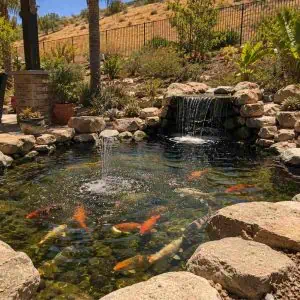
Water loss that exceeds the expected rate is the critical signal. A pond requiring daily manual top-offs beyond 2 to 3 inches per week likely has a liner leak, not an evaporation problem, and needs a pressure test diagnostic rather than more refill water. Overnight shutoff is equally dangerous: dissolved oxygen drops fastest between midnight and dawn, when photosynthesis stops but fish respiration continues. Readings below 5 mg/L require supplemental aeration before fish show stress signs like surface gasping.
Summer feeding is where most nutrient loading problems originate. Koi metabolism peaks in warm water, and the instinct is to feed more. Four rules prevent overfeeding from becoming an algae trigger:
- Follow the 5-minute consumption rule: offer only the amount koi consume within five minutes, then remove uneaten food.
- Feed one to three times daily using a high-protein warm-weather formula matched to water temperature per Hikari Sales USA feeding protocols.
- Reduce feeding frequency when water temperature exceeds 90°F, even if koi appear active at the surface.
- Stop feeding entirely during heat events above 95°F lasting more than 48 hours.
The protein formula matters because carbohydrate filler breaks down into dissolved nutrients faster than bacteria can process them, feeding the nutrient cycle that drives algae. The 90°F and 95°F thresholds reflect how koi digestion slows at those temperatures despite continued surface activity that resembles hunger. Feeding a fish that cannot digest the food causes gut decay, which creates more systemic damage than a skipped meal. Every gram of uneaten food that sinks adds phosphate and ammonia to the water column. The pond owner who masters the 5-minute rule eliminates the largest controllable variable in summer algae prevention.
What Fall Tasks Prepare Your Pond for Winter?
Fall is the annual cleanout window for California koi ponds, ideally scheduled between November and February when cooler water temperatures below 60°F reduce fish stress during handling. The cleanout involves a full drain, rock and liner rinse, sludge removal, equipment inspection, dechlorinated refill, and a 7-day daily bacteria restart.
The cleanout follows a fixed sequence. Skipping steps or reordering them creates problems that surface weeks later when the biological system fails to re-establish:
- Relocate fish to aerated holding tanks filled with pond water, not fresh tap water, to avoid temperature and chemistry shock during the cleanout.
- Drain the pond completely and remove accumulated sludge and sediment from the bottom before rinsing any rock or gravel.
- Rinse rocks individually without pressure washing closer than 12 inches to the EPDM liner surface; high-pressure spray at close range causes micro-punctures that become slow leaks over the following months. [NEEDS SOURCE — verify 12-inch minimum distance against Firestone PondGard or equivalent EPDM liner care documentation.]
- Inspect the liner at every seam, at the waterline where UV degradation concentrates, and at any point where rocks sit directly on the membrane.
- Inspect skimmer baskets, biofilter media, check valves, and the pump impeller for wear accumulated over the year.
- Refill with dechlorinated water, matching the holding tank temperature within 3°F before reintroducing fish.
- Dose beneficial bacteria daily for the first 7 days, then transition to weekly dosing; full colony establishment takes 2 to 8 weeks, and the pond remains vulnerable to ammonia spikes throughout that window.
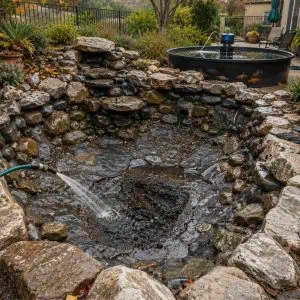
The bacteria restart is the step most often rushed. Seven days of daily dosing is not optional. Skipping to weekly dosing immediately leaves the biofilter under-colonized, and the first ammonia spike typically arrives within two to three weeks when fish waste output exceeds what the incomplete colony can convert.
Fall leaf management runs parallel to cleanout scheduling and carries consequences that reach into the following spring. Three tasks prevent organic debris from becoming the nutrient source for the next algae season:
- Increase skimmer basket emptying to twice per week or more in ponds under heavy deciduous tree canopy; a full basket stops catching debris entirely and allows leaves to sink to the bottom.
- Install a pond net over the surface before peak leaf drop if the canopy density makes daily skimming impractical; the net catches leaves before they reach the water.
- Transition fish feeding to a cold-water wheat germ formula below 60°F and reduce feeding frequency to once daily or every other day as metabolism slows.
Leaves that sink and decompose on the pond bottom release phosphate and ammonia directly into the water column. That nutrient load sits through winter, and when spring temperatures rise, it fuels the first algae bloom weeks before the pond owner connects the cause to the previous fall. Fall debris removal is the single most effective preventive action for spring water clarity. Most pond owners miss this connection. The problem repeats every year in ponds where fall skimming is treated as cosmetic rather than biological.
Does a California Pond Need Winterization?
Most California koi ponds do not require winterization because water temperatures in coastal and inland Southern California rarely drop below 40°F. Pumps run year-round, and the primary winter tasks are managing storm runoff, maintaining weekly bacteria dosing at reduced rates, and reducing or stopping fish feeding when water drops below 55°F.
Storm runoff is the winter task most California pond owners underestimate. During the rainy season, typically November through March, rain carries rooftop debris, landscape fertilizer, and dissolved soil nutrients into the pond. The damage is chemical. That inflow lowers pH through dilution, overwhelms existing water treatments, and deposits phosphate and nitrogen compounds that fuel early spring algae blooms. One heavy storm can shift pH by a full point and load enough phosphate to produce weeks of green water once March temperatures arrive.
Routing roof downspouts through a wetland filter or settling basin before the water reaches the pond removes the heaviest nutrient load from runoff. Where rerouting is not possible, a dedicated overflow drain prevents storm surges from flooding the pond with unfiltered water and washing out bacteria colonies that took weeks to establish.
Fish feeding transitions to a cold-water wheat germ formula below 60°F per Hikari and Ultra Balance feeding protocols. Below 50°F to 55°F, feeding stops entirely. Koi metabolism slows to the point where food sits in the gut undigested, and decaying food inside the fish causes more damage than the missed nutrition would. The wheat germ transition is not optional. Standard summer pellets contain protein and fat levels that the fish cannot process in cold water, and the undigested material becomes an internal infection risk rather than a growth input.
Pumps must continue running through winter regardless of water temperature. Three functions depend on continuous flow: dissolved oxygen maintenance, biological filtration support for the bacteria colonies that remain active at reduced rates, and mosquito prevention. Standing water in a California winter is a breeding habitat. A pump shutdown lasting more than three hours begins killing the bacteria colonies in the biofilter, restarting the colonization cycle that takes two to eight weeks to complete.
Which Weekly Tasks Stay the Same Regardless of Season?
Five weekly tasks remain constant regardless of season: emptying the skimmer basket, rinsing filter pads in pond water only, testing pH and KH with dip strips, dosing beneficial bacteria, and inspecting the pump, auto-fill valve, and UV clarifier for early signs of wear. A full liquid test for ammonia, nitrite, nitrate, phosphate, and dissolved oxygen should run monthly.
These five tasks are the biological baseline. Every seasonal adjustment across spring, summer, fall, and winter assumes this weekly routine is already running:
- Empty the skimmer basket before debris compacts and blocks flow to the pump intake.
- Rinse mechanical filter pads in a bucket of pond water, squeezing until the water runs mostly clear.
- Test pH and KH with dip strips and log the results to track week-over-week drift.
- Dose beneficial bacteria at the manufacturer’s recommended weekly rate, adjusting seasonally per dosing instructions.
- Inspect the pump for vibration or reduced flow, the auto-fill valve for sticking or overshoot, and the UV clarifier for condensation inside the quartz sleeve.
The filter pad rinse is where the most damage happens. Rinsing pads in tap water instead of pond water destroys the beneficial bacteria colonies living on the media. Those colonies are the biological engine converting ammonia to nitrite to nitrate. Tap water kills them on contact. The nitrogen cycle resets as if the pond had just been cleaned out, and ammonia spikes with water clarity failure follow within 48 to 72 hours. One tap water rinse undoes weeks of colonization, and the pond owner who does not understand why their water turned cloudy two days after cleaning the filter will repeat the mistake every time.
Monthly full liquid testing catches what weekly dip strips cannot. Dip strips measure pH and KH with reasonable accuracy, but they lack the precision for the parameters that drive management decisions:
- Ammonia above 0.25 ppm on a liquid test indicates biofilter underperformance that a dip strip may not register at all.
- Nitrite above 0.25 ppm signals an incomplete nitrogen cycle or a recent disruption, such as a tap water filter rinse.
- Phosphate above 0.5 ppm indicates nutrient loading; the corrective response is reducing feeding volume, increasing bacteria dosing, and identifying the organic debris source.
- Dissolved oxygen below 5 mg/L per K.O.I. and Merck Veterinary Manual guidelines requires immediate aeration intervention regardless of season.
The monthly test is what tells the pond owner whether something is actually going wrong or whether the system is holding. Without liquid readings for ammonia and phosphate, bacteria dosing, feeding schedules, and partial water changes are guesswork. A partial water change protocol of 25% maximum volume corrects parameter drift when liquid testing identifies a specific imbalance. Changing water without testing first risks diluting treatments and resetting chemistry in the wrong direction.
How Do You Control Algae Without Harming the Pond Ecosystem?
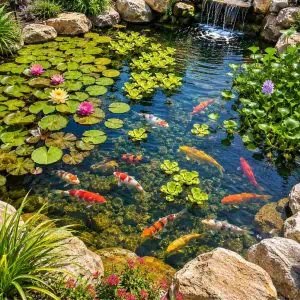
Algae control in a koi pond follows a three-step response hierarchy: first, increase shade through aquatic plant coverage to 30% to 40% of the water surface; second, manually remove string algae and dose beneficial bacteria to outcompete algae for nutrients; third, apply a targeted algaecide only after manual removal, never as a standalone first response. Chlorine, bromine, copper sulfate, silver, and ozone kill biofilter colonies and are not pond-safe.
The first step is prevention, and it runs year-round. Aquatic plants do two things simultaneously that no chemical treatment replicates:
- Water lilies, water lettuce, and water hyacinth covering 30% to 40% of the pond surface block the sunlight that drives algae photosynthesis.
- Those same plants absorb dissolved phosphate and nitrogen from the water column, consuming the same nutrients algae need to grow.
- The combined effect is competitive exclusion: plants outcompete algae for both light and nutrients without chemical input, manual labor, or biofilter risk.
Competitive exclusion is the only algae control that operates continuously. Every other method requires repeated intervention. A pond that reaches 30% to 40% plant coverage before summer has already deployed its most effective long-term defense, and the plants improve as they grow. This is why spring plant establishment matters: the coverage must be in place before algae pressure peaks, not installed as a response after the first bloom.
When a bloom occurs despite prevention, the response sequence matters as much as the response itself. Reversing the order wastes product and delays recovery:
- Remove visible string algae manually by hand or with a brush before applying any treatment; algaecide spent on biomass that could have been physically removed is algaecide not reaching the remaining growth.
- Apply a single targeted algaecide dose to finish remaining algae that manual removal cannot reach, following manufacturer concentration instructions exactly.
- Dose beneficial bacteria immediately after treatment to recolonize the nutrient space the dying algae releases; skipping this step leaves dissolved nutrients available for the next bloom to start within days.
The chemical distinction most pond owners get wrong is copper sulfate versus copper ion technology. Copper sulfate is a chemical killer that does not discriminate: it destroys algae, beneficial bacteria, and potentially fish at pond concentrations per Pond Solutions toxicity documentation. Copper ion systems like IonGen release controlled doses of copper ions that suppress algae without reaching concentrations toxic to fish or bacteria per Aquascape Inc. product documentation and EPA registration. The two are not interchangeable. A pond owner who hears “copper works for algae” and buys copper sulfate from a garden supply store can destroy the biofilter in a single application.
What Is the Most Costly Seasonal Pond Maintenance Mistake?
The most costly seasonal pond mistake is shutting off the pump to save energy during mild winter months or overnight. Beneficial bacteria in the biofilter begin dying after 3 hours without oxygenated water flow, and the full colony takes 2 to 8 weeks to re-establish, leaving the pond vulnerable to ammonia spikes, fish stress, and algae blooms during the entire recovery window. The second most costly mistake is ignoring evaporation until the water level drops below the pump intake, which burns out the impeller and kills the same bacteria colonies through interrupted flow.
The cost is not the electricity saved. A pond pump rated at 100 to 300 watts costs roughly $15 to $45 per month to run continuously. What the shutdown actually costs is the biological collapse that follows. After 3 hours without oxygenated flow, bacteria colonies on the filter media begin to die. Most of the colony is gone within 24 hours. The pond owner restarts the pump and sees water flowing, but the biofilter is now empty biological infrastructure. Ammonia from fish waste accumulates with nothing to convert it, and the first visible sign is cloudy water within days. The full consequence is a 2-to-8-week recovery window during which the pond cannot process waste at the rate fish produce it.
The same collapse happens when evaporation drops the water level below the pump intake. The impeller overheats, the seal fails, and the flow stops. The bacteria colonies die through the same oxygen starvation mechanism, whether the owner shut the pump off deliberately or let the water level fall.
When Should You Call a Pond Maintenance Contractor?
A pond maintenance contractor is warranted when ammonia or nitrite readings exceed 0.5 ppm on consecutive tests, when water loss exceeds normal evaporation rates, when fish show behavioral stress signs that do not resolve within 24 hours of aeration adjustment, or when the annual cleanout involves fish handling in a pond with more than 500 gallons of volume. Not every pond problem requires a professional, but some cross a threshold where DIY correction risks making the condition worse.
Each trigger marks the point where weekly maintenance, bacteria dosing, and partial water changes have already failed. These are diagnostic boundaries, not reasons to call a contractor preemptively:
- Ammonia or nitrite above 0.5 ppm on two consecutive weekly liquid tests indicates biofilter failure that a single bacteria dose will not correct.
- Water loss exceeding expected evaporation by more than half an inch per day points to a structural leak requiring pressure testing and liner inspection.
- Fish behavioral changes lasting longer than 24 hours after aeration correction, including gasping, listing, or isolation, suggest parasitic or bacterial infection requiring quarantine protocol.
- Any cleanout on a pond over 500 gallons where fish handling, water volume, and equipment weight create safety risks beyond typical homeowner capability.
The pattern connecting all four triggers is identical. The homeowner has already tried the standard correction, and the problem did not resolve. Ammonia stayed high after dosing. Water kept dropping despite daily refills, and the loss exceeded what evaporation alone explains. Fish kept gasping after adding aeration. That failure is what separates a DIY problem from a contractor call.
Before hiring any contractor, verify CSLB licensing before discussing scope. California pond construction and maintenance fall under CSLB license classifications C-27 (Landscaping) and C-53 (Swimming Pool), depending on the scope of work. A contractor who cannot provide a valid CSLB license number verifiable on the Contractors State License Board website is not legally authorized to perform the work. Ask for proof of liability insurance, confirm the license covers the specific classification the project requires, and request a water chemistry log from a recent maintenance client to confirm the contractor tests rather than guesses.
Need a hand with your pond?
Koi Pros designs, builds, maintains and repairs ponds, waterfalls, fountains and lakes across Southern California and Arizona. Start with an on-site assessment.