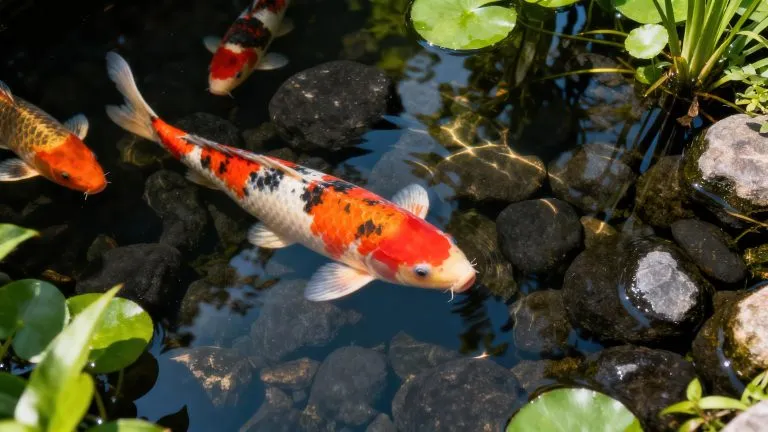
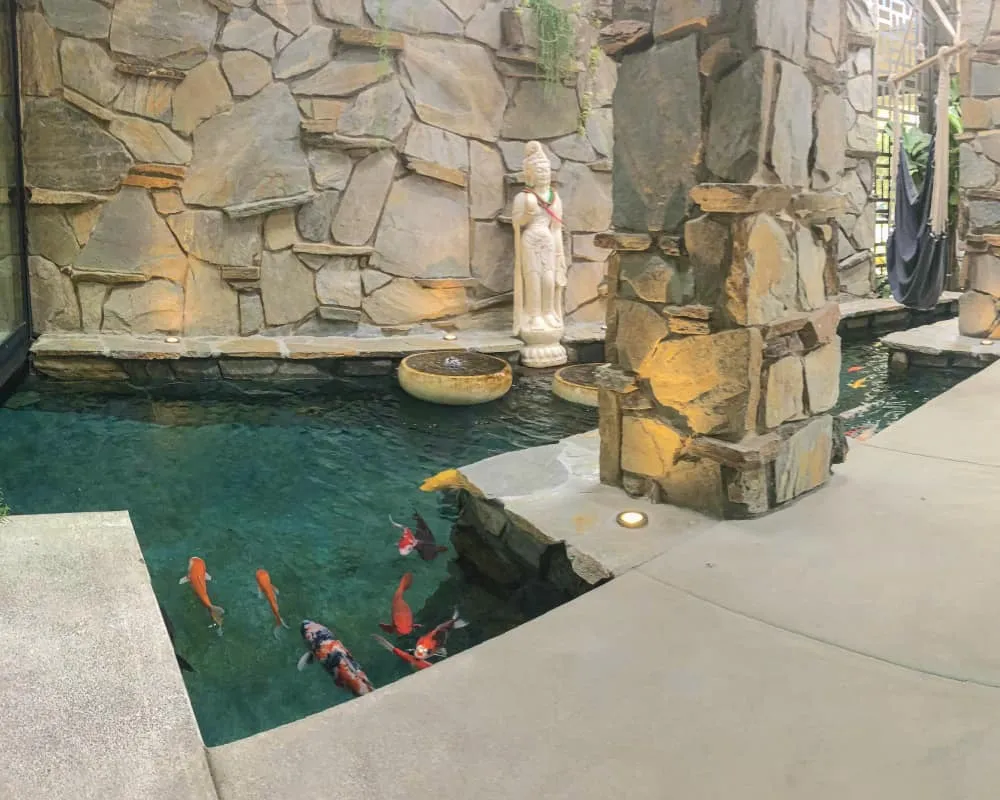

Pond Cleaning Services Across California
System-level pond cleaning designed to restore water quality, filtration performance, and biological balance under real operating conditions.
We evaluate water quality, filtration performance, and system condition before recommending next steps.
- We assess your pond’s condition, system design, and location before recommending any next steps.
System Driven Pond Cleaning
How We Evaluate and Clean Ponds Without Creating Repeat Problems
Pond cleaning is only effective when it is driven by system behavior, not visual condition. Before removing debris, our technicians assess water clarity trends, filtration efficiency, circulation dynamics, and biological load to determine what disrupted balance in the first place.
Cleaning without this diagnostic step often produces clear water briefly, then reintroduces the same failures. Algae returns. Fish stress increases. Filters clog again. The appearance improves, but the system remains unstable.
Our approach focuses on controlled removal of organic accumulation, precision filtration cleaning, and measured water stabilization. Each action is tied to system recovery, not cosmetic improvement, so the pond regains function without creating new imbalances.
What you see here is not a reset for appearance. It is a condition-based cleaning process designed to restore system stability, protect equipment, and establish a foundation for predictable, long-term maintenance.
Best for ponds showing recurring algae, filtration issues, or performance decline after prior cleanings.
What Koi Pros’ Pond Cleaning Service Actually Covers
Koi Pros’ pond cleaning service is designed to restore system function, not just visual clarity.
Every pond we clean is evaluated as a working ecosystem, where water quality, filtration capacity, circulation behavior, and biological load all determine how and why the system fell out of balance.
Before any debris is removed, our technicians assess how the pond is actually operating. That includes how solids are accumulating, how efficiently filtration is processing waste, and whether circulation patterns are supporting or undermining biological stability.
Cleaning without this context often creates temporary clarity followed by recurring algae, stressed fish, and repeated equipment issues. Our approach avoids that cycle by prioritizing controlled debris removal, targeted filtration cleaning, and water stabilization that supports recovery instead of triggering new imbalance.
This is not a surface reset or a one-time cleanup. It is a condition-based pond cleaning process built to restore function, protect equipment, and prepare the system for reliable ongoing care.
- Ponds with recurring algae, cloudy water, or organic buildup that returns after past cleanings
- Systems where fish health, filtration performance, or circulation stability is a concern
- Property owners who want the underlying cause addressed, not repeated cosmetic cleanups
- Ponds that require careful debris removal without disrupting biological balance or equipment
- Clients who value long-term system performance over short-term visual fixes
Best suited for ponds with recurring water quality or performance issues.
CONDITION-BASED POND CLEANING
Pond Cleaning Focused on System Recovery, Not Cosmetic Reset
Pond cleaning is most effective when it’s guided by system conditions, not surface appearance. When clarity drops, algae returns, or filtration performance declines, the cause is usually circulation, filtration efficiency, and accumulated organic load interacting over time. Our pond cleaning service corrects those drivers through a controlled, system-first reset that restores function and stability, without creating short-term clarity that quickly fades.
Custom Pond Design & Construction
Building a pond that performs long term is an engineering problem, not a cosmetic one. Layout, excavation depth, structural integrity, filtration capacity, circulation paths, and biological load must work together from day one. Shortcuts taken during design often surface later as leaks, unstable water quality, or costly rebuilds. Design decisions determine whether a pond remains stable or requires ongoing corrective work. Each system is planned as a closed, balanced environment sized for real-world conditions so long-term performance is driven by design, not constant intervention.
Bi-Weekly Maintenance
Ponds rarely fail suddenly. They drift out of balance as filtration efficiency declines, biological load increases, and seasonal conditions change. Bi-weekly maintenance provides structured oversight before small imbalances escalate into algae blooms, fish stress, or equipment failure. Each visit evaluates water quality, filtration performance, circulation behavior, and biological conditions so adjustments are made early. This service is designed for owners who want predictable system stability, not reactive cleanups after problems surface.
Pump & Filtration Repair
When pumps or filtration systems begin to fail, the issue is rarely isolated. Flow imbalance, undersized components, clogged media, or layout limitations often contribute to recurring breakdowns. Replacing parts without understanding system behavior leads to repeat failures. Evaluation focuses on why performance declined, including hydraulic imbalance, loading mismatch, and circulation limitations, before corrective work is recommended. Repairs are approached as system corrections so restored performance holds under continuous operation.
LEAK DETECTION & STRUCTURAL REPAIR
Water loss is rarely caused by a single visible failure. Leaks often result from liner fatigue, settlement movement, plumbing stress, or structural transitions that only reveal themselves under operating conditions. Treating symptoms without isolating the failure point leads to repeat loss and unnecessary repairs. Leak detection is handled as a structural diagnostic process, evaluating liner integrity, penetrations, plumbing runs, and system behavior under load to identify the true source of loss and correct it at the structural level.

Lake & Large-Pond Aeration Systems
As pond size, depth, and biological load increase, oxygen management becomes critical. Poor circulation and stratification lead to oxygen depletion, nutrient trapping, and long-term water quality decline that surface treatments cannot resolve. Aeration alone is not always the answer unless circulation patterns, turnover rate, and nutrient loading are evaluated together. Aeration systems are designed and placed based on depth profiles, biological demand, and system behavior so oxygen support aligns with long-term ecosystem function.
POND WEED & ALGAE MANAGEMENT
Excess algae and invasive plant growth signal nutrient imbalance, circulation limitations, or biological overload. Treating algae in isolation often produces short-term clarity while underlying conditions continue to degrade system stability. Weed and algae management is approached as whole-pond system control. Growth patterns are evaluated relative to filtration capacity, flow behavior, seasonal loading, and oxygen availability so corrective actions reduce recurrence rather than mask symptoms.
SHORELINE STABILITY & EROSION CONTROL
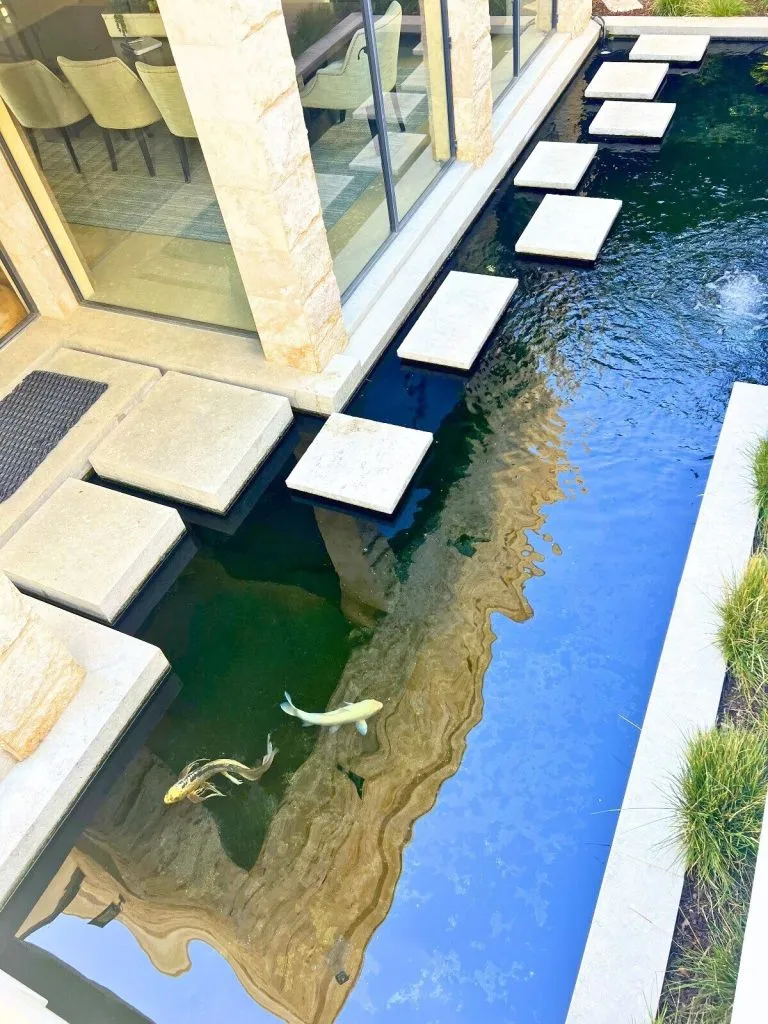
Shoreline conditions directly affect pond water quality. Soil erosion, failing edges, and uncontrolled runoff introduce sediment and nutrients that accelerate algae growth and overload filtration systems. These issues often develop slowly and are misdiagnosed as routine water problems. Shoreline restoration is evaluated as part of overall pond system health. Stabilization focuses on reducing ongoing contamination, managing runoff behavior, and protecting long-term biological balance rather than cosmetic changes.
FOUNTAIN & STREAM SYSTEM INTEGRATION
Fountains and streams influence circulation patterns, oxygen distribution, and debris movement throughout a pond. When flow rates, elevation changes, or return paths are misaligned, these features can create dead zones, uneven filtration loading, and recurring clarity problems. Fountain and stream systems are evaluated for hydraulic performance and integration with existing filtration and circulation. The goal is functional support of water quality and biological stability, not decorative flow alone.
WATERFALL FLOW & AERATION SYSTEMS
Waterfalls influence oxygen exchange, circulation velocity, and biological activity. When flow is undersized, misrouted, or deteriorating, waterfalls can become visual features that actively undermine system performance. Koi Pros constructs and repairs waterfalls with hydraulic performance in mind. Each structure is evaluated for flow consistency, oxygen contribution, and integration with filtration and return systems to support long-term pond balance.
Why Pond Systems Across California Require a System-First Approach
Pond systems across California operate under a wide range of conditions, from coastal environments to inland heat, elevation changes, and seasonal water restrictions. Despite these differences, most ponds fail for the same underlying reason: system components drift out of alignment over time.
Water clarity alone does not indicate system health. Filtration capacity, circulation behavior, oxygen availability, biological load, and equipment sizing operate as a single system. When one element falls out of balance, stress accumulates elsewhere until symptoms surface as algae growth, fish stress, equipment failure, or water loss.
Effective pond care starts by evaluating how the system is functioning as a whole. Cleaning, repairs, or upgrades applied without this context often create short-term improvement followed by recurring problems. A system-first approach identifies why performance declined and determines what level of intervention will remain stable under real operating conditions across California environments.
This approach is designed for pond owners who want predictable performance, not recurring fixes.
Questions About Professional Pond Cleaning Services in California
Professional pond cleaning costs in California vary because ponds do not fail in the same way. Pricing is influenced by pond size, depth, biological load, filtration design, access conditions, and how far the system has drifted out of balance.
A lightly maintained koi pond with stable filtration requires a very different level of intervention than a pond with accumulated sludge, declining circulation, or stressed fish. For that reason, professional cleaning is typically scoped after evaluating system conditions rather than priced as a flat service.
This approach helps ensure cleaning work addresses root causes instead of creating short-term clarity followed by repeat problems.
Koi ponds are not cleaned on a fixed schedule. They are maintained based on system performance.
Well-designed ponds with proper filtration, circulation, and biological balance often require less aggressive cleaning and more consistent monitoring. Ponds with undersized filtration, seasonal debris load, or changing fish populations may need more frequent intervention.
The goal of professional pond cleaning is not repeated disruption, but reducing the need for corrective cleanups by keeping the system stable over time.
The most effective way to clean a dirty koi pond is to understand why it became dirty.
Surface debris, algae, and sludge are symptoms. Removing them without evaluating filtration performance, circulation behavior, oxygen levels, and biological load often results in short-term clarity followed by rapid recurrence.
Professional pond cleaning focuses on controlled debris removal, targeted filtration cleaning, and stabilizing water conditions so the system can recover without triggering additional stress.
Fish removal is not automatically required and is avoided whenever possible.
In many cases, koi can remain in the pond during cleaning when water levels, temperature, and oxygen are managed correctly. Temporary relocation may be necessary if the system is severely imbalanced, filtration is being rebuilt, or structural work is required.
The decision is based on fish safety and system stability, not speed or convenience.
Bottom muck forms when organic material accumulates faster than the system can process it.
Vacuuming alone may remove visible sludge but does not address the conditions that caused buildup in the first place. Effective removal depends on filtration efficiency, circulation patterns, oxygen availability, and biological activity within the pond.
Professional cleaning addresses muck as part of a broader system correction so buildup does not immediately return.
Professional pond cleaning is best suited for pond owners who want long-term system stability, not quick cosmetic fixes.
If the goal is short-term clarity without addressing filtration limits, circulation issues, or biological balance, results are often temporary. System-based cleaning is designed for ponds that require reliable performance, healthy fish conditions, and fewer recurring problems over time.
This service is typically chosen by owners who want their pond managed as an integrated system rather than treated as a one-time cleanup.
What happens after a professional pond cleaning is completed?
After cleaning, the pond is monitored for recovery rather than immediately disturbed again.
Water clarity, biological activity, filtration behavior, and fish response are observed to ensure the system stabilizes properly. In many cases, pond owners transition into structured maintenance to prevent the same conditions from redeveloping.
The objective is not repeated cleaning, but reducing the need for corrective intervention altogether.
What Pond Owners Experience After System-Based Cleaning
These are not one-time cleanups. They reflect what happens when pond systems are evaluated and corrected at the root level.
Koi Pros provided an incredible pond restoration service for my garden pond in Santa Barbara. “They identified the underlying causes of algae buildup and a pump performance issue, corrected the system imbalance, and restored stable water clarity.”

Start With a Pond System Assessment
Effective pond care starts with understanding how the system is actually performing.
A pond system assessment evaluates water quality, filtration capacity, circulation behavior, biological load, and structural conditions to determine why issues are occurring and what level of intervention will remain stable over time.
This process is intended for pond owners who want long-term reliability, not temporary visual improvement. Recommendations are based on system conditions, not assumptions or one-size-fits-all treatments.
Assessments are designed for ponds requiring corrective cleaning, maintenance planning, or system-level repairs.
Pond Cleaning & System Services Across California
Pond systems across California operate under widely different conditions, from coastal environments to inland heat, elevation changes, and regional water restrictions. Service coverage is structured to support these variations without relying on one-size-fits-all solutions.
Site conditions, system design, and operating stress are evaluated locally to ensure cleaning, maintenance, or repair recommendations remain stable under real regional conditions.
- Statewide California
- Los Angeles County
- Beverly Hills
- Santa Monica
- Pasadena
- Long Beach
- Glendale
- West Hollywood
- Malibu
- Orange County
- Riverside
- Lake Elsinore
- Murrieta
- Norco
- Fairhaven
- Corona
- Norco
- Palm Springs
- San Jacinto
- Rancho Santa Margarita
- Seal Beach
- Palm Desert
- Fair Hills