
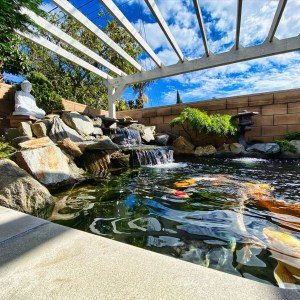
Pond maintenance cost is the total annual expense required to keep a residential or commercial pond operating in biological balance, structural integrity, and visible clarity. Most pond owners spend $450 to $5,000 per year depending on four primary variables: pond size, pond type, service frequency, and geographic location. Those variables interact. A small garden pond cleaned twice a year falls at the low end. A large koi pond on a monthly professional plan with multiple water features reaches the upper range.
Southern California adds its own cost pressure. Water temperatures stay warm enough year-round to sustain continuous algae growth, ammonia output from fish feeding and respiration, and filter demand with no seasonal dormancy period. California residential electricity rates average $0.30 to $0.35 per kWh, roughly double the national average, which adds $150 to $300 per year to pump operating cost alone compared to most other states. Whether a pond owner handles maintenance independently or hires a professional contractor further shifts the annual total in ways the cost breakdown below quantifies section by section.
What Does Pond Maintenance Cost Per Year?
Professional pond maintenance costs $450 to $5,000 per year for most homeowners, with a national average around $1,750 annually for a mid-sized backyard pond receiving two to four service visits. That range spans two distinct service models, and the cost difference between them comes down to how many days the pond runs unobserved between professional checks.
A pond owner scheduling two to four professional visits per year pays $450 to $2,625 for those visits alone. This is the most common model for ponds with low to moderate fish stocking and simple filtration. Monthly maintenance plans that include weekly or biweekly visits run $170 to $450 per month, totaling $2,040 to $5,400 annually. Monthly plans are typical for koi ponds with higher biological load, multi-feature systems, or commercial properties where water quality failures carry liability exposure.
The wide range between $450 and $5,400 reflects pond size, fish stocking density, and feature complexity rather than service quality alone. A 50-square-foot garden pond with no fish and a single skimmer falls at the low end. A 300-square-foot koi pond with a waterfall, bog filter, and 20 fish falls at the upper end. Same contractor. Same service standards. Different system demand.
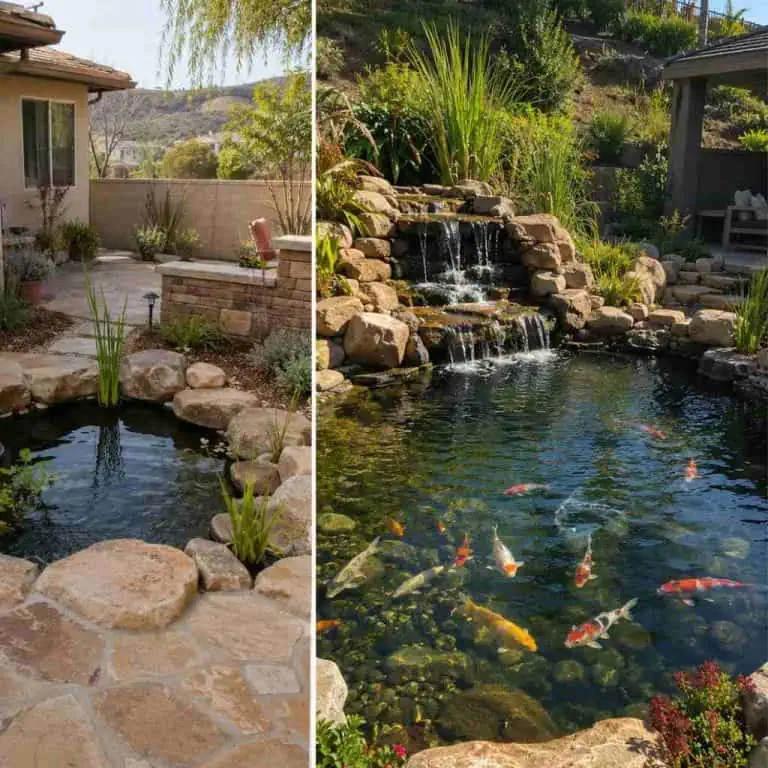
A single professional maintenance visit costs $250 to $450. Scope typically covers skimmer basket and net cleaning, water quality testing for pH, ammonia, nitrite, and dissolved oxygen, mechanical and biological filter inspection, aquatic plant trimming, and beneficial bacteria dosing. The visit scope stays consistent. What changes the price is time on site. Per-visit pricing runs $140 to $225 per man-hour in Southern California, so a pond with easy equipment access and light debris load finishes in 90 minutes at the lower end, while a pond with buried pumps, heavy sludge, or algae-covered rock surfaces takes three hours and bills near the ceiling. Condition at arrival, not service list, drives the invoice.
How Does Pond Size Affect Maintenance Cost?
Small ponds under 100 square feet cost $450 to $950 per year to maintain, mid-sized ponds of 100 to 200 square feet cost $950 to $1,500, and large ponds above 200 square feet cost $1,550 to $5,000 or more depending on feature complexity. The table below maps pond size to approximate volume and annual cost range so owners can locate their system in the correct tier.
| Pond Size (sq ft) | Approximate Volume (gallons) | Annual Maintenance Cost Range |
|---|---|---|
| Small — under 100 | Under 700 | $450–$950 |
| Medium — 100 to 200 | 700–2,500 | $950–$1,500 |
| Large — 200 to 350 | 2,500–5,000 | $1,550–$2,750 |
| Very Large — 350+ | 5,000+ | $2,750–$5,000+ |
Cost scales with size because labor time scales with volume. A filter-only maintenance visit on a small pond takes one to three man-hours. The technician clears the skimmer, tests water parameters, inspects the pump, and doses bacteria in a single pass. A drain-and-clean on a large pond takes six to eight man-hours at $140 to $225 per man-hour because every gallon must be pumped out, every rock surface pressure washed, and every piece of equipment pulled and inspected before refill and fish reintroduction. Double the volume does not double the time. It often triples it, because sludge settles into rock crevices and plumbing joints that small ponds do not have.
Very large ponds with heavy sludge accumulation or complex rock structures cross into exploratory drain-and-clean territory at 10+ man-hours. At that threshold, the technician is no longer following a standard cleanout sequence. They are diagnosing buried problems: liner tears hidden under gravel, pump impellers clogged with calcium deposits, check valves failed inside rockwork that has to be partially disassembled to access. The labor bill alone reaches $1,400 to $2,250 for a single visit, which is why annual costs for the very large tier start at $2,750 and have no hard ceiling.
How Much Does Maintenance Cost by Pond Type?
Koi ponds cost $1,000 to $3,000 per year because of high biological load and water quality sensitivity. Garden ponds cost $450 to $1,000, pondless waterfalls run $250 to $735, natural swim ponds cost $500 to $1,500, and retention or detention ponds range from $300 to $4,000+ depending on acreage. The cost gap between pond types is driven by what each system demands biologically, mechanically, and in some cases regulatory.
| Pond Type | Annual Maintenance Cost Range |
|---|---|
| Koi Pond | $1,000–$3,000 |
| Garden / Decorative Pond | $450–$1,000 |
| Natural / Swim Pond | $500–$1,500 |
| Pondless Waterfall | $250–$735 |
| Retention / Detention Pond | $300–$4,000+ |
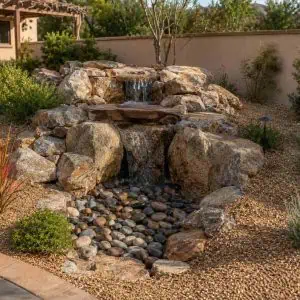
Koi ponds sit at the top of the cost range because koi generate continuous ammonia load through feeding and respiration, and that load must be processed around the clock by biological filtration that never shut down. Weekly water quality testing for pH, ammonia, nitrite, and dissolved oxygen is standard, not optional. Feed costs alone add $50 to $200+ per fish per year, and a well-stocked pond with 15 to 20 koi carries $750 to $4,000+ in annual feed expense before a single service visit is scheduled. The real cost driver is failure consequence. A single ammonia spike or pH crash can kill koi valued at $50 to $500+ each, meaning one preventable water quality event can exceed the entire annual maintenance contract in fish loss alone. The $1,000 to $3,000 annual range is risk management, not discretionary spending.
Garden ponds with minimal fish stocking and simple plantings cost $450 to $1,000 per year and typically need only one to two professional cleanings annually. Filtration is simpler, biological load is lower, and the margin for error is wider because there is less at financial risk in the water. Pondless waterfalls are the lowest-maintenance water feature at $250 to $735 per year. No standing water volume means no algae management, no fish health monitoring, and no biological filtration to service. Maintenance scope is mechanical: pump inspection, basin debris removal, and flow rate verification.
Natural swim ponds cost $500 to $1,500 per year and replace chemical water treatment with biological filtration through planted regeneration zones. Consumable costs drop because the system does not rely on commercial bacteria cultures, algaecides, or pH buffers. Plant management time increases instead. Regeneration zone plants require seasonal division, thinning, and replanting to maintain filtration capacity, and that labor replaces the chemical line items rather than eliminating maintenance altogether.
Retention and detention ponds operate under a fundamentally different maintenance model than ornamental water features. Annual costs range from $300 to $4,000+ depending on acreage, depth, inlet and outlet configuration, and local stormwater management requirements. Maintenance scope includes sediment removal from basin floors, inlet and outlet structure inspection, bank erosion control, vegetation management along shorelines, and trash or debris clearance from grate structures. The labor type is closer to earthwork and site management than to pond servicing.
What Does a Seasonal Pond Cleanout Cost?
A spring cleanout costs $850 to $1,000 for a mid-sized pond and is the most labor-intensive single service of the year, covering full draining, pressure washing, equipment inspection, and fish reintroduction. Fall closing runs $850+, and winterizing adds $150 to $500.
These are standalone event costs, separate from ongoing maintenance visits. A pond owner on a monthly plan still pays for seasonal cleanouts unless the plan explicitly includes them.
Spring cleanout is the largest single line item on most pond maintenance budgets. The scope for a mid-sized pond includes:
- Draining the pond fully while relocating fish to a holding tank filled with existing pond water to preserve the bacterial environment the fish are acclimated to
- Pressure washing all gravel beds, rock surfaces, and shelf areas to remove accumulated biofilm and algae
- Cleaning the skimmer basket, biofalls unit, and any mechanical pre-filter media
- Pulling and inspecting the pump, checking impeller condition, and testing flow rate against manufacturer baseline
- Inspecting plumbing connections, check valves, and bulkhead fittings for leaks or degradation
- Refilling with dechlorinated water and dosing with beneficial bacteria to restart the nitrogen cycle
- Reintroducing fish through a temperature acclimation process that equalizes holding tank water with new pond water over 20 to 45 minutes to prevent thermal shock
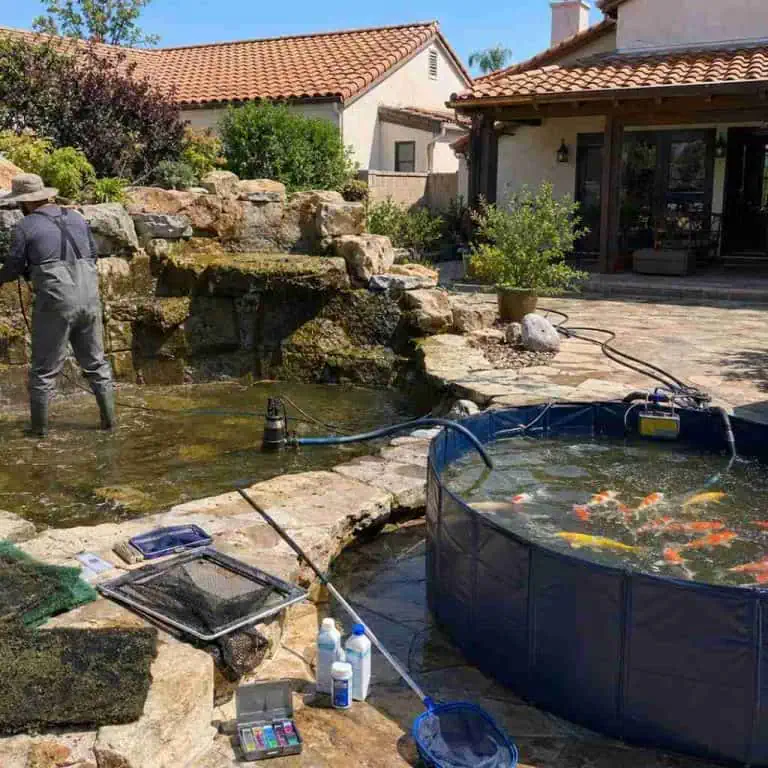
Ponds not cleaned in two or more years do not follow this standard sequence. The technician cannot pressure wash or inspect equipment until the extent of buried problems is known. An exploratory drain-and-clean costs $1,000 to $1,500 because the scope expands to include assessing hidden liner damage beneath compacted sludge, removing debris that has settled into plumbing joints, and evaluating whether degraded equipment can be serviced or needs replacement. The price gap between $850 and $1,500 is the cost of deferred maintenance compounding into diagnostic labor.
Fall closing starts at $850 and prepares the pond for reduced biological activity and increased debris load. The scope includes:
- Removing accumulated sediment from the pond floor and skimmer basin
- Inspecting and cleaning biological and mechanical filter media
- Testing equipment function before seasonal load changes
- Installing protective pond netting over the water surface to intercept falling leaves before they decompose and spike nutrient levels
Winterizing adds $150 to $500 on top of the fall closing and applies only to ponds with fish that need protection through cold months. Scope includes pump removal and dry storage, cold-water bacteria treatment to sustain biological filtration at reduced metabolic rates, and installing an aerator and floating pond heater to maintain a gas exchange opening in the surface. In Southern California, where water temperatures rarely stay below 50°F for more than a few consecutive days, full winterization is less intensive than in cold-climate regions. Most SoCal ponds skip pump removal entirely and reduce winterizing to heater installation and bacteria adjustment, which pulls the cost toward the lower end of the $150 to $500 range.
What Factors Drive Pond Maintenance Costs Up?
Water feature complexity, pond condition, fish stocking density, filtration system type, liner material, equipment access, and tree canopy are the primary variables that push pond maintenance costs above the median for a given pond size. Two ponds with identical surface area can carry annual maintenance bills $1,000 or more apart based on these factors alone.
Three variables act as direct cost multipliers that scale maintenance expense faster than pond size does.
- A waterfall, fountain, or stream adds $300 to $600 per year in maintenance cost because each feature carries its own pump, its own plumbing connections, and its own debris accumulation surfaces that require separate cleaning and inspection during every visit
- Fish stocking density scales cost on three axes simultaneously: each additional koi adds $50 to $200+ in annual feed expense, increases ammonia load requiring more frequent filter servicing, and raises total financial exposure from a single water quality failure to levels that can exceed the annual maintenance contract
- Deferred maintenance history converts routine cleanouts into exploratory diagnostic work, where the technician is no longer cleaning but assessing what broke while no one was looking
The stocking density variable deserves specific attention because it compounds. A pond with 5 koi at $50 each carries $250 in fish loss exposure from one ammonia spike. A pond with 15 koi at $100+ each carries $1,500+ in exposure from the same event. The maintenance cost is not just higher because of feed and filter load. It is higher because the financial consequence of a single failure scales with the population. Deferred maintenance compounds the same way: a pond left uncleaned for two to three years typically reveals failed UV clarifiers, liner tears beneath compacted sludge, or burned-out pump motors, and those repair costs stack on top of the exploratory cleanout fee.
Four equipment and site factors create baseline cost differentials independent of pond size or stocking level.
- Pressurized bead filters require periodic backwashing and media replacement every 3 to 5 years at $200 to $500 per replacement, while gravity-fed bog filters need seasonal plant division and gravel cleaning on a different labor schedule
- Mechanical-only skimmer systems with no biological filtration stage demand the most frequent manual debris removal, increasing visit frequency or visit duration
- EPDM rubber liners last longer and resist UV degradation better than PVC, but cheap PVC liners installed without underlayment tear more frequently and add recurring patch or reline costs to the annual maintenance budget
- Ponds under heavy tree canopy accumulate organic debris faster, requiring more frequent skimming, netting replacement, and fall cleanout scope expansion

Equipment access is the cost factor pond owners most often underestimate. Pumps buried under decorative rockwork, inline filters installed behind retaining walls, and plumbing routed through tight crawl spaces all increase labor time per visit. A technician who can reach the pump in two minutes bills differently than one who spends 30 minutes moving rock to access the same component. The access constraint does not change what the visit includes. It changes how long every task takes.
How Much Does It Cost to Run a Pond Pump in California?
Running a 200-watt pond pump 24/7 in California costs approximately $300 to $525 per year, with the low end reflecting national average electricity rates and the high end reflecting California’s average residential rate of $0.30 to $0.35 per kWh. Pump electricity is not a line item most pond owners budget for, but in California’s rate environment it is often the largest single ongoing cost outside of professional service visits.
The formula is the same for every pump: wattage multiplied by 24 hours, multiplied by 365 days, divided by 1,000 to convert to kWh, then multiplied by the local rate per kWh. At the national average of approximately $0.16 per kWh, a 200-watt pump running continuously draws 1,752 kWh per year and costs roughly $280. At California rates in SCE, LADWP, or Riverside Public Utilities territory, the same pump costs $525 to $613. That $245 to $333 gap is the California rate premium applied to a single piece of equipment running around the clock.
A 300-watt pump reaches $788 to $920 per year at California rates. Ponds running 400-watt or 500-watt external pressure pumps cross $1,000 annually in electricity alone before any auxiliary equipment is powered.
The pump is rarely the only electrical load on a pond system. An aerator drawing 50 to 100 watts adds $130 to $305 per year at California rates. A UV clarifier drawing 18 to 40 watts adds $47 to $122. A pond running a 300-watt pump, a 75-watt aerator, and a 25-watt UV clarifier carries a combined electrical load of 400 watts and an annual electricity bill of $1,051 to $1,226 before the system produces a single gallon of clean water.
A variable-speed pump running at 70% capacity can cut total pond electricity cost by 30 to 50%. On a system drawing $1,000+ per year in electricity, the savings offset the pump’s price premium within 12 to 18 months. For ponds running 300W+ pump systems with auxiliary loads, the variable-speed upgrade is one of the few maintenance cost reductions that recovers its upfront cost without reducing filtration performance, flow rate, or service quality.
How Does DIY Pond Maintenance Cost Compare to Professional
DIY pond maintenance costs roughly 50% less in direct expenses, running $180 to $500 per year in consumables after an initial equipment purchase of $500 to $750. That 50% savings is real in direct dollars, but the comparison breaks down when labor time, diagnostic accuracy, and the cost of mistakes enter the calculation.
| Cost Category | DIY | Professional Service |
|---|---|---|
| Startup Equipment | $500–$750 (one-time) | Included in service |
| Annual Consumables / Visit Fees | $180–$500 | $450–$2,625 |
| Labor | Owner’s time (full day per drain-and-clean) | Included in visit fee |
| Diagnostic Accuracy | Limited to visual and test kit | Professional-grade testing and pattern recognition |
| Fish Loss Exposure | Full owner risk | Reduced by early detection |
| Hybrid Model (DIY weekly + 2 pro visits) | $400–$1,200/year total | N/A |
The startup equipment list for DIY maintenance includes a submersible pump or pond vacuum, a pressure washer, waders, long-handled nets, and water test kits running $15 to $40 each. That $500 to $750 outlay is a one-time cost. After that, consumables drive the annual budget: beneficial bacteria at $20 to $50 per month, dechlorinator, pH buffers, and algaecide cost $45 to $125 per cleaning, totaling $180 to $500 per year across four cleanings. The direct dollar savings against professional service is roughly half. What the savings calculation omits is time and accuracy. A drain-and-clean that takes a two-person professional crew three to four hours takes a homeowner a full day working alone, and the homeowner is less likely to catch early-stage pump degradation, slow liner seepage, or the ammonia pattern that precedes a crash.
The hidden cost that collapses the DIY savings calculation is a single preventable failure. One ammonia spike in a pond stocked with 15 koi at $100+ each produces $1,500+ in fish loss, which exceeds an entire year of professional service fees from a single event the owner did not detect in time. A professional visiting monthly or biweekly reads water chemistry trends across visits and catches the upward ammonia drift weeks before it becomes lethal.
A homeowner testing once a month sees a snapshot, not a trend. The hybrid approach splits the difference: weekly DIY skimming and bacteria dosing combined with two professional seasonal visits at $200 to $600 each delivers most of the protective value of a full maintenance contract at 20 to 30% of the annual cost. For cost-conscious koi pond owners in Southern California, the hybrid model is the most common entry point because it buys professional diagnostic coverage at the two highest-risk points of the year without the monthly plan expense.
Why Does Pond Maintenance Cost More in Southern California?
Southern California pond owners face higher maintenance costs than national averages suggest because four local factors compound simultaneously: year-round warm water temperatures that eliminate seasonal dormancy, California electricity rates running roughly double the national average, UV-driven liner degradation from extended sun exposure, and higher regional labor rates. None of these factors appear in national cost guides as line items, but all of them raise the cost floor before a single service decision is made.
Climate and electricity are the two cost drivers that affect every SoCal pond regardless of size, type, or service model.
- Water temperatures in Orange County, Los Angeles County, and Riverside County stay warm enough year-round to sustain continuous algae growth and ammonia production, meaning filtration systems process biological load twelve months per year with no seasonal pause
- Fish in SoCal ponds feed and produce waste year-round because water temperatures never drop low enough to trigger winter dormancy, unlike cold-climate ponds where fish metabolism slows to near zero and filtration demand drops with it
- Pumps run 24/7/365 at California residential electricity rates averaging $0.30 to $0.35 per kWh, roughly double the national average of $0.16, which adds $245 to $333 per year to pump operating cost alone for a standard 200-watt system
These three factors compound into a baseline operating cost that exists before any maintenance visit is scheduled or any service decision is made. A pond owner in Illinois or Alabama shuts the pump down for three to four winter months, cuts feed to zero, and pauses filtration. A SoCal pond owner runs every system component at full load year-round. The difference is not marginal. It is structural.
Three additional factors widen the gap between SoCal maintenance costs and published national averages.
- Direct, year-round UV exposure degrades pond liners faster than in climates with seasonal cloud cover or snow cover, shortening the interval between liner repairs from the published 20-to-30-year EPDM lifespan to 15 to 20 years in full-sun installations without shade structure
- Evaporation rates in inland areas like Riverside County require more frequent water top-offs than coastal or cold-climate regions, and each refill requires dechlorination treatment that adds consumable cost per top-off event
- Regional labor rates for skilled pond technicians in the greater Los Angeles metro area run above national averages, which means the $140 to $225 per man-hour range cited in national cost guides reflects the upper half of the national band, not the midpoint
The cumulative effect is that a SoCal pond owner reading a national cost guide is comparing against a baseline that does not apply to their system. The national average of $1,750 per year assumes seasonal shutdown, lower electricity rates, and national-median labor pricing. A comparable pond in Orange County, Riverside, or Los Angeles operates under none of those assumptions.
What Happens When Pond Maintenance Is Deferred?
Deferred pond maintenance compounds into higher costs because biological and mechanical problems develop beneath the surface before visible symptoms appear. A pond skipped for two or more years requires an exploratory cleanout at $1,000 to $1,500 versus $850 for a maintained pond, and the cleanout typically uncovers equipment failures that add repair costs on top of the cleaning bill.
Most ponds carry a biological buffer that absorbs early-stage stress without producing visible change. Sludge accumulates on the pond floor and inside rock crevices. Anaerobic decomposition begins in the oxygen-depleted sludge layer, producing hydrogen sulfide gas and releasing nitrogen and phosphorus back into the water column where they feed algae growth. Biological filtration media clogs or starves of oxygen, reducing ammonia processing capacity at the same time ammonia production is accelerating. Green water, fish gasping at the surface, and foul sulfur odor are not early warnings. They are late-stage indicators that multiple systems have already failed.

A pump with a clogged impeller costs $150 to $600 to replace. A liner torn by compacted sludge or root intrusion costs $500 to $2,000+ to repair. Fish loss from a single ammonia spike reaches $50 to $500+ per koi, and a pond with 10 to 15 fish can lose $500 to $7,500 in livestock value from one undetected event. These costs stack on top of the exploratory cleanout fee, not instead of it. The total bill for a pond unmaintained for two to three years routinely exceeds what preventive maintenance would have cost across the same period.
How Do You Choose a Pond Maintenance Plan That Fits Your Budget?
The right maintenance plan depends on three variables: pond complexity, the owner’s available time and skill, and the cost of getting something wrong. Match the plan to the variable that matters most for your system, not to the variable that costs the least.
Three plan tiers cover the range from lowest cost to highest protection.
- A garden pond with no fish and simple plantings fits the seasonal-only model: one to two professional cleanouts per year at $450 to $950, supplemented by weekly owner skimming and visual inspection
- A mid-range koi pond with moderate stocking and standard filtration fits the hybrid model: weekly DIY bacteria dosing and water observation plus two professional seasonal visits at $200 to $600 each, totaling $400 to $1,200 per year
- A high-value koi pond with complex filtration, multiple water features, or large fish stock fits the monthly professional plan at $170 to $450 per month, because the cost of a single preventable failure (fish loss, pump burnout, biological crash) exceeds several months of plan fees
The deciding factor is not which plan costs least. It is which failure costs most. A garden pond owner who loses a pump replaces a $150 component. A koi pond owner who loses 15 fish to an undetected ammonia spike absorbs $1,500 to $7,500 in livestock value from one event. The plan selection should price the risk, not just the service.
A pond system assessment before committing to any plan ensures the recommended service frequency matches actual system demand. Assessment scope covers pond volume, fish population, filtration type and condition, feature count, equipment access, and seasonal maintenance history. The result is a plan recommendation tied to what the system needs rather than a default tier based on pond size alone.
Need a hand with your pond?
Koi Pros designs, builds, maintains and repairs ponds, waterfalls, fountains and lakes across Southern California and Arizona. Start with an on-site assessment.