
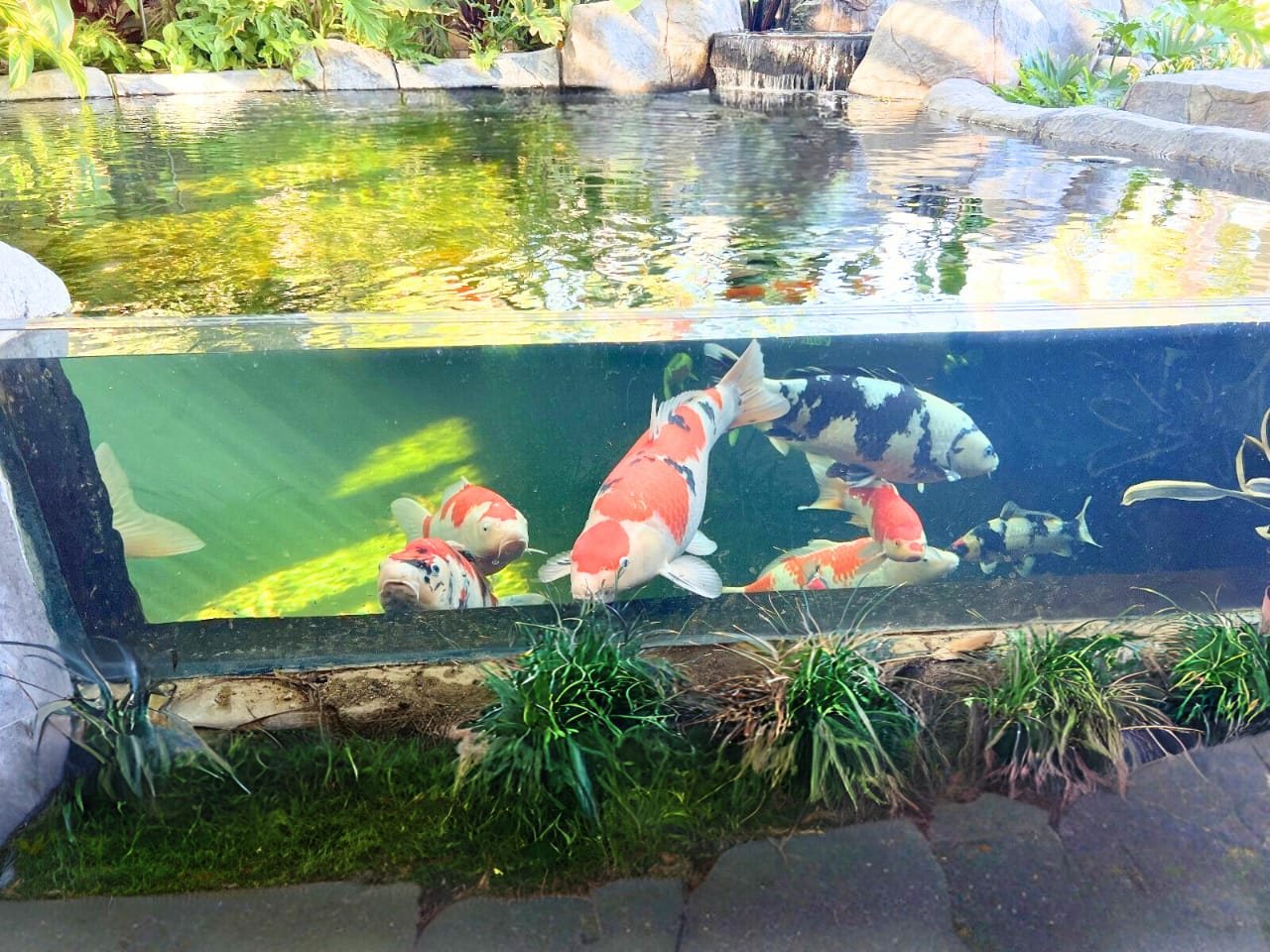
Most pond maintenance guides assume winter shuts everything down. In California, it never does. Coastal ponds in Orange County and Los Angeles County sit under marine layer cover that holds water temperatures in a narrow band. Inland ponds in Riverside County and San Bernardino swing 15°F or more between day and night, creating higher dissolved oxygen and evaporation pressure. Biology stays active all year. Algae pressure runs nine months or longer along the coast, and fire season between June and November deposits airborne ash that loads phosphates and heavy metals into pond water. Water districts like the Metropolitan Water District of Southern California compound the problem by treating supply lines with chloramines year-round, making every water change a potential fish health risk if left untreated. A national calendar built around freeze-thaw cycles misses every one of these variables.
An annual pond maintenance calendar built for California organizes four task categories (water chemistry, biological filtration, equipment inspection, and fish care) across weekly, monthly, and seasonal cadences that never pause. Koi Pros builds and executes this calendar across Orange County, Los Angeles County, and Riverside County, scheduling each client’s system around the temperature thresholds, water district treatment cycles, and seasonal risk windows that govern their specific pond. No off-season.
Why California Ponds Need a Year-Round Maintenance Calendar
California ponds require a 12-month maintenance calendar because the state’s mild winters never shut down biological activity, algae grows continuously from March through November in coastal zones, and inland ponds face summer dissolved oxygen stress that cold-climate guides do not address.
The marine layer along coastal Orange County and Los Angeles County holds pond water temperatures between 65°F and 80°F from March through November. That is the exact range where string algae and suspended green water algae reproduce fastest. Cold-climate guides treat algae as a summer problem that freezing eliminates by December. In coastal Southern California, the window never closes. Pond owners managing against a four-month algae season are underestimating the actual exposure by five months. Nine months of uninterrupted growth allows phosphate to accumulate in rock surfaces and pond floor sediment, creating a nutrient bank that feeds algae regrowth even after visible blooms are treated. Cold-climate ponds break this cycle naturally when freezing disrupts the substrate.
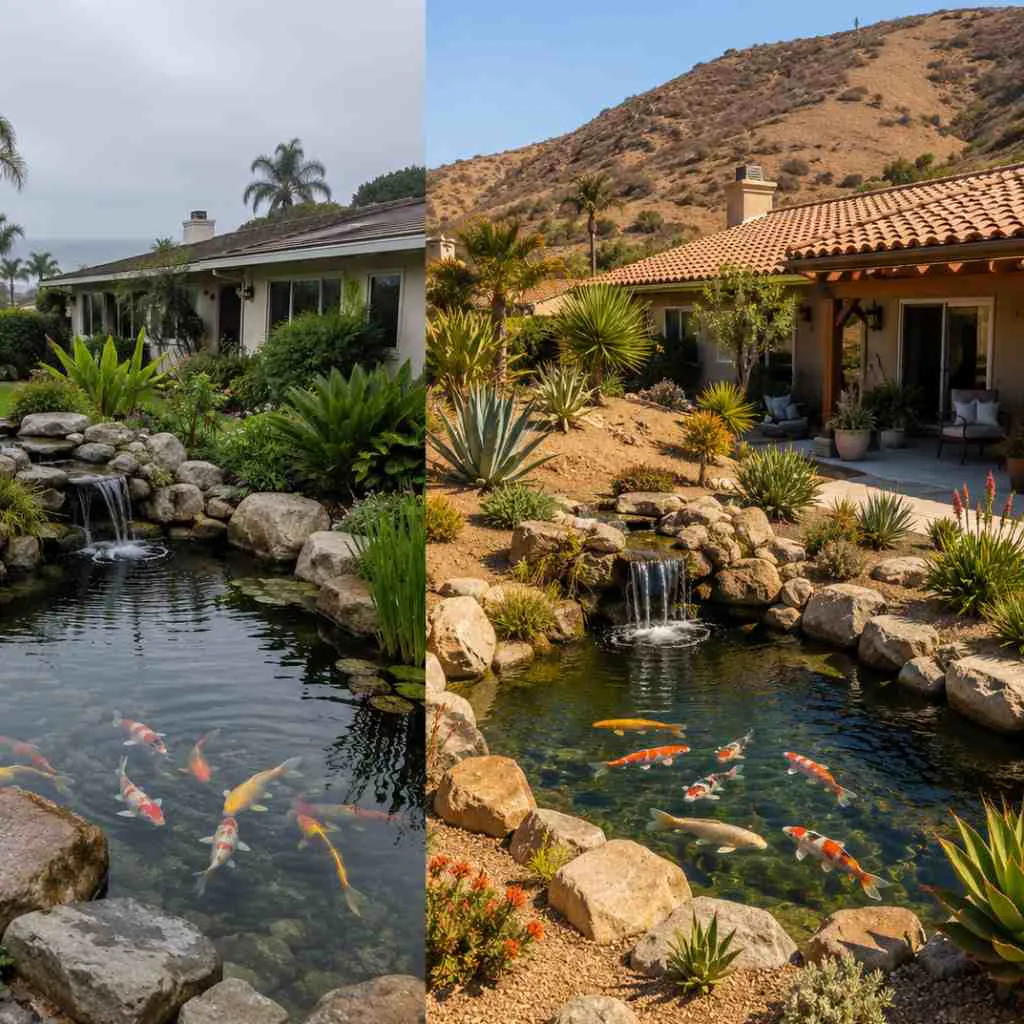
Inland ponds in Riverside County and San Bernardino face a different failure mode. Summer water temperatures regularly exceed 85°F, and at that threshold dissolved oxygen drops below the 5 mg/L minimum that koi need for normal gill function per Koi Organization International and Merck Veterinary Manual guidelines. That is not a monthly monitoring problem. Evaporation pulls 2 to 3 inches of water per week during peak summer. That rate concentrates waste compounds and forces the auto-fill valve to replace lost volume with chloramine-treated municipal water from Metropolitan Water District of Southern California supply lines. Generic guides recommend monthly water level checks. From June through September in inland Southern California, daily monitoring is the baseline, not the exception.
Two environmental overlays unique to California add scheduling demands that no national guide addresses. Fire season runs from June through November per CalFire’s Southern California operational calendar. Wildfires deposit airborne ash containing phosphates, nitrogen, and heavy metals (iron, lead, and zinc per USGS California Water Science Center post-fire water quality studies) directly onto pond surfaces. Fine ash dissolves on contact. It enters the water column where mechanical filtration cannot capture it, feeding algae blooms and stressing fish gill tissue simultaneously. Atmospheric river events between October and March produce the opposite problem. NOAA’s Center for Western Weather and Water Extremes tracks and categorizes these concentrated moisture corridors using the Ralph scale, rating each event from AR-1 through AR-5 by intensity and duration. A single event rated AR-3 or higher can swing pond pH by a full point within hours. That volume of rainfall also deposits enough debris to overwhelm a skimmer system designed for normal leaf load.
Weekly Maintenance Tasks That Run All Year
Weekly pond maintenance in California consists of five non-negotiable tasks performed every seven days regardless of season: skim surface debris, empty and rinse skimmer baskets, test water parameters with a liquid test kit, dose beneficial bacteria, and visually inspect fish behavior and equipment function.
Five tasks keep the system stable between monthly and seasonal interventions. Skip any one for two consecutive weeks and the gap shows up in water parameters or fish behavior before the month is out.
- Skim floating debris and empty skimmer baskets after each skim to restore full flow through the filtration intake
- Test pH, ammonia, and nitrite using a liquid reagent kit such as the API Freshwater Master Test Kit, not strip tests that lack precision to detect early drift
- Dose beneficial bacteria on the manufacturer’s recommended schedule to sustain the nitrogen cycle’s conversion capacity from ammonia to nitrite to nitrate
- Visually inspect fish for behavioral stress signals: surface gasping, flashing against rocks, isolation from the group, or clamped fins pressed flat against the body
- Check pump flow rate and confirm the auto-fill valve is maintaining water level within one inch of the skimmer basket’s optimal intake line
Fish behavior is the earliest warning system in the pond. Gasping at the surface signals dissolved oxygen depletion or ammonia irritation. Flashing signals parasites or pH instability. These behavioral shifts appear 24 to 48 hours before liquid test results confirm the underlying parameter problem, which is why visual inspection runs on the same weekly cycle as testing rather than as a separate monthly task.
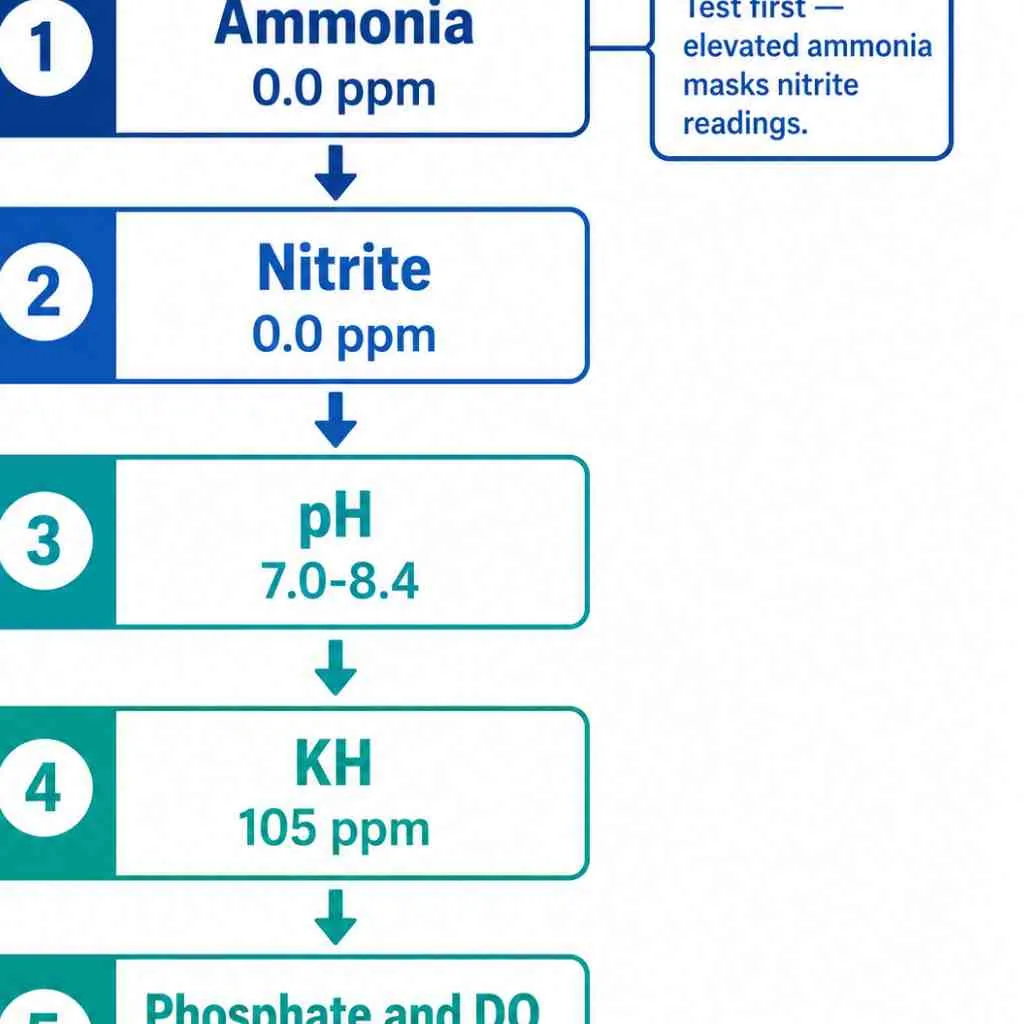
Weekly water testing follows a parameter priority sequence that determines the order in which results are read and acted on. The sequence exists because certain failures mask others. Elevated ammonia inhibits Nitrosomonas bacteria, slowing the conversion that produces nitrite, so a nitrite reading of 0.0 in the presence of high ammonia is a false negative rather than a clean result.
- Ammonia: target 0.0 ppm, any reading above 0.0 requires immediate investigation per Central California Koi Society guidelines
- Nitrite: same zero-tolerance threshold at 0.0 ppm, tested immediately after ammonia to confirm the nitrogen cycle is completing conversion
- pH: target range 7.0 to 8.4, flagged before bacteria dosing because beneficial bacteria perform optimally within this band and dosing outside it wastes product
- KH: minimum 105 ppm with a tolerance of plus or minus 15 ppm per Central California Koi Society recommended parameter ranges, the buffering capacity that prevents pH crashes between water changes
- Phosphate and dissolved oxygen: added to the weekly rotation from June through September when summer nutrient loading and the K.O.I. threshold of 5 mg/L increase the risk of oxygen depletion
Reading results out of sequence leads to misdiagnosis. A pond owner who tests pH first and finds it low may add buffer, not realizing that the pH drop was caused by an ammonia spike that consumed KH reserves overnight. Correcting the pH without addressing the ammonia treats the symptom. The ammonia continues climbing. Testing ammonia first catches the root cause before secondary effects compound.
Monthly Checkpoints for Equipment and Water Chemistry
Monthly maintenance adds four checkpoints beyond weekly testing: inspect and clean filter media using pond water only, check pump performance and flow rate, verify UV clarifier bulb function, and perform a 10% to 15% partial water change with dechlorinated water matched to pond temperature within 3°F.
Monthly inspections catch degradation that weekly testing cannot detect. Pump impellers wear gradually. UV bulbs lose germicidal output months before they burn out. Filter media compacts. None of these failures trigger a parameter spike until the system has already lost capacity.
- Rinse filter media in a bucket of pond water only, squeezing or swirling until debris releases, never under a tap or garden hose connected to treated municipal supply
- Inspect the pump impeller for wear, debris binding, or reduced flow by measuring output against the manufacturer’s rated gallons per hour
- Verify UV clarifier bulb function monthly and replace the bulb annually regardless of whether it still illuminates, because UV-C germicidal output degrades below effective wavelength well before the bulb fails visually
- Perform a 10% to 15% partial water change using dechlorinated water matched to pond temperature within 3°F to avoid thermal shock to fish
A single filter media rinse with chlorinated or chloraminated tap water kills the Nitrosomonas and Nitrobacter colonies that convert ammonia to nitrite. Recolonization typically takes 4 to 8 weeks of daily bacteria dosing before the biofilter returns to full conversion capacity, a timeline consistent with nitrogen cycling rates documented in recirculating aquaculture system research. During that window ammonia and nitrite spike with no biological buffer between the fish and toxic exposure. One rinse under a garden hose can undo months of colony establishment. Use pond water. Every time.
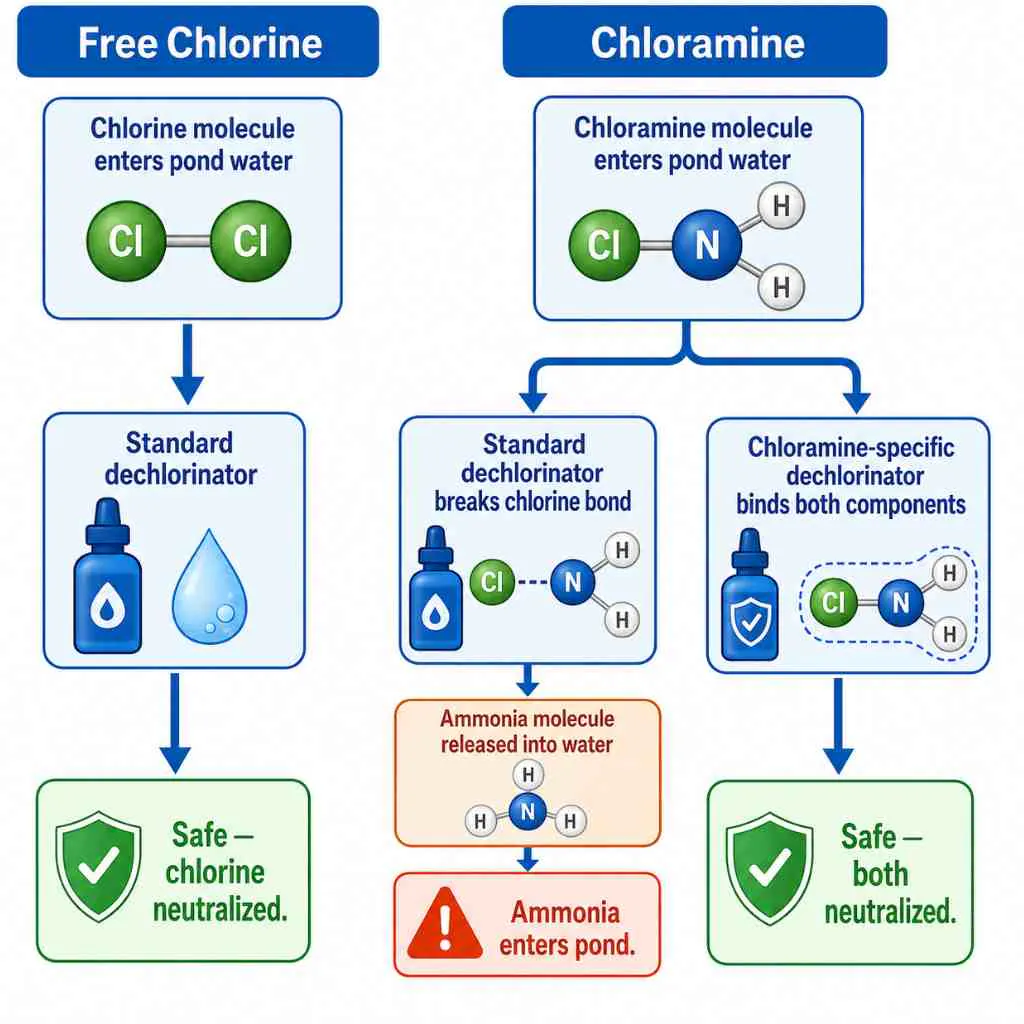
Chloramine-specific dechlorination is required for every partial water change in areas receiving Metropolitan Water District of Southern California supply water. Chloramines are a chlorine-ammonia compound. That distinction matters because standard chlorine neutralizers and aeration break the chlorine bond but release the ammonia directly into the pond.
- MWDSC treats its supply with chloramines year-round, and the Diemer Filtration Plant in Yorba Linda processes the water that reaches most Orange County municipal suppliers including IRWD
- Standard dechlorinators neutralize free chlorine but do not bind the ammonia molecule that chloramines release upon breakdown
- Chloramine-specific dechlorinators bind both the chlorine and the ammonia, preventing a post-water-change ammonia spike that weekly testing would not catch until the next test cycle
- Chloramines do not off-gas through aeration or dissipate by sitting in an open container, so aging tap water in a bucket before adding it to the pond does not make it safe per Contra Costa Water District aquatic safety documentation
Every water change in MWDSC-supplied areas is an ammonia introduction event unless the dechlorinator is chloramine-specific. Pond owners using standard chlorine neutralizers are adding free ammonia directly into their pond water with every fill, compounding the load their biofilter must process between weekly tests. The IRWD Water Quality Report confirms chloramine treatment through MWDSC supply lines. Check the label on the dechlorinator bottle. If it does not specify chloramine treatment, it is the wrong product.
Spring Tasks: March Through May
Spring maintenance in California centers on restarting bacteria colonies as water temperatures cross 55°F, transitioning fish feed from cold-water wheat germ formula to standard protein pellets above 65°F, replacing UV clarifier bulbs, and increasing water testing frequency to catch the ammonia vulnerability window when fish metabolism outpaces biofilter recovery.
The 50°F to 65°F water temperature window is the highest-risk period for koi health in the entire calendar year. Pond contractors call it Aeromonas Alley. Pathogenic bacteria including Aeromonas and Pseudomonas activate at 48°F per Central California Koi Society temperature guidance, but the koi immune system does not reach functional levels until water stabilizes above 65°F. That gap leaves the fish defenseless.
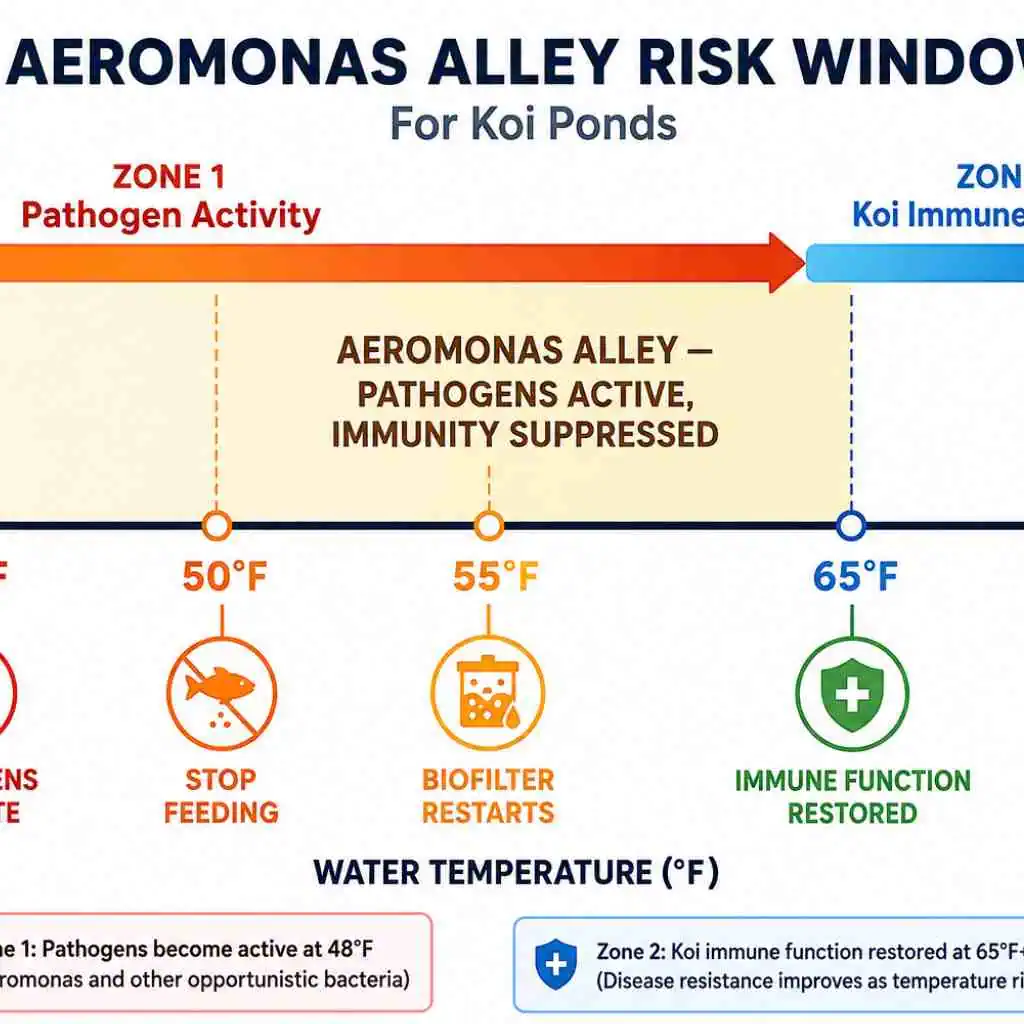
- Begin daily visual inspection of every fish when pond water first reaches 50°F, replacing the weekly cycle used during winter months
- Watch specifically for ulcers on the body wall, fin rot presenting as frayed or disintegrating fin edges, and flashing behavior that signals early parasitic attachment
- Do not introduce new fish to the pond during this window because the immune suppression makes existing stock vulnerable to any pathogen a new arrival carries
- Increase water testing from weekly to twice weekly between 50°F and 65°F to catch ammonia and nitrite movement while the biofilter is still reactivating at reduced capacity
- Replace the UV clarifier bulb at the start of this window regardless of visual output, because germicidal effectiveness has degraded over the prior 12 months of continuous operation
Daily observation during Aeromonas Alley catches ulcers and fin rot before they penetrate past the epidermis. Surface lesions treated early respond to topical intervention. Lesions that reach muscle tissue require extended quarantine and medicated treatment that stresses an already immunocompromised fish. The difference between a surface catch and a deep infection is often 48 hours of missed observation.
Spring bacteria dosing follows a restart protocol timed to water temperature thresholds, not calendar dates. The protocol exists because the biofilter’s Nitrosomonas colonies slow to near dormancy below 50°F and cannot process the ammonia load that resumed feeding introduces.
- Apply cold-water beneficial bacteria formulation when pond water first reaches 50°F to begin seeding colonies adapted to low temperatures
- Transition to standard-temperature bacteria once water holds above 55°F for three consecutive days, confirming the threshold with a pond thermometer reading taken at the same time each morning
- Increase dosing frequency to every other day for the first two weeks after the 55°F transition to accelerate colony establishment ahead of the feeding restart
- Begin feeding wheat germ formula once daily when water stabilizes above 55°F, using the 5-minute consumption rule established in the weekly routine
- Transition from wheat germ to standard protein pellets only after water holds above 65°F consistently, per Hikari and Ultra Balance feeding protocol guidelines for koi
The restart protocol is a race. Fish metabolism increases as water warms, producing more ammonia through gill respiration and waste output. The biofilter needs colony density to match that load. Dosing every other day for two weeks closes the gap before the ammonia curve overtakes the bacteria curve. Skipping this acceleration window is the most common cause of spring ammonia spikes in ponds that test clean through winter.
Summer Tasks: June Through September
Summer maintenance in California spans three distinct management domains that peak simultaneously between June and September: dissolved oxygen and evaporation control during sustained heat, feeding protocol adjustments tied to water temperature thresholds, and fire season preparation that protects pond water from airborne ash contamination.
How to Manage Dissolved Oxygen and Evaporation in Summer Heat
When pond water temperatures exceed 85°F, dissolved oxygen drops below the 5 mg/L threshold koi need for normal metabolic function per K.O.I. and Merck Veterinary Manual guidelines, requiring supplemental aeration through air stones or additional waterfall flow, combined with daily water level monitoring to catch evaporation losses that can exceed 2 to 3 inches per week in inland zones.
Dissolved oxygen testing frequency must increase in steps as water warms. The thresholds are not arbitrary. Each one marks a physiological shift in how much oxygen the water can physically hold.
- Move DO testing from monthly to weekly when water temperature first exceeds 80°F, the point where oxygen saturation capacity begins declining measurably
- Shift to daily testing when water exceeds 85°F, because readings taken in the afternoon will not reflect the overnight minimum that determines whether fish survive to morning
- Add supplemental aeration through air stones, a secondary pump, or increased waterfall flow when any single reading drops below 5 mg/L, not after fish begin surface gasping
- Monitor water level daily during peak summer, confirming auto-fill valve function, because evaporation during Santa Ana wind events can exceed the standard 2-to-3-inch weekly rate by double within 48 hours
- Test ammonia within 24 hours of any auto-fill event that adds more than 5% of total pond volume, since the replacement water carries chloramines from the municipal supply
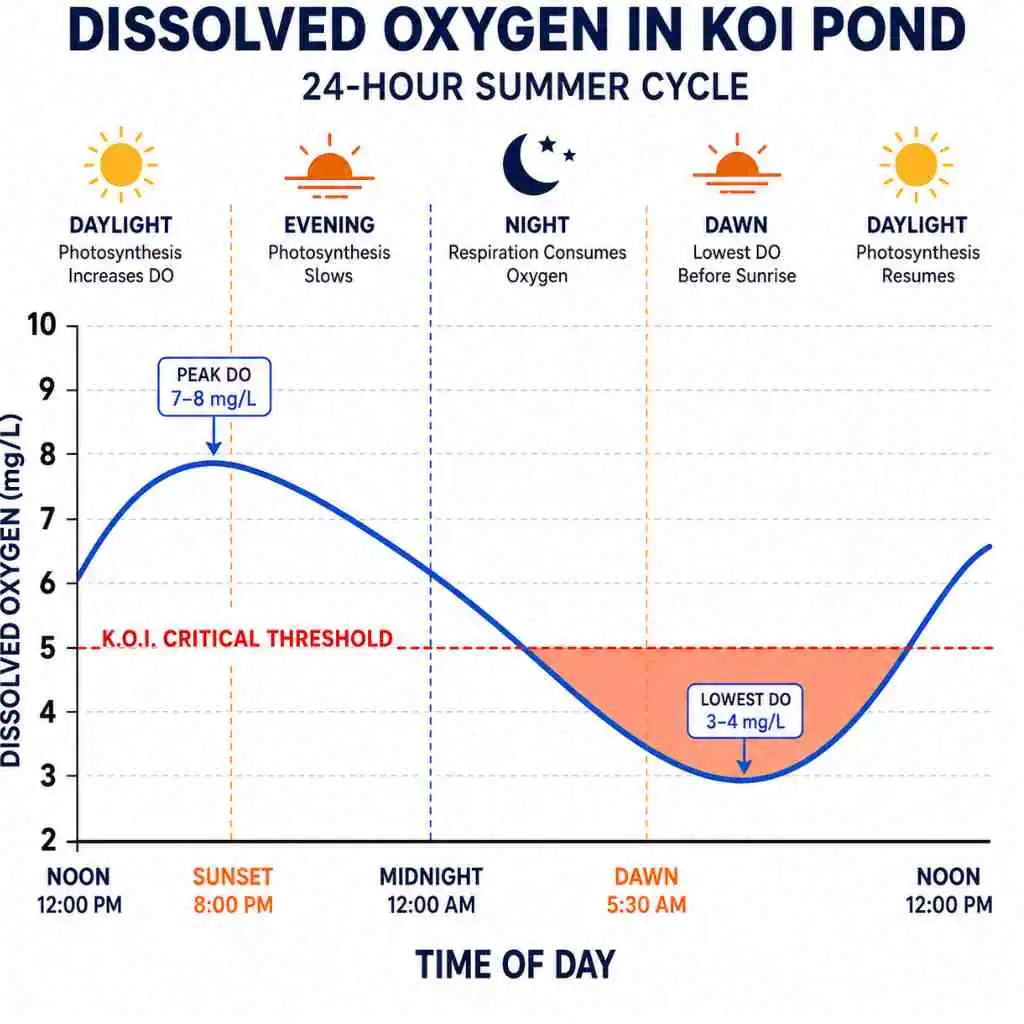
The overnight window between midnight and dawn is when dissolved oxygen crashes hardest. Photosynthesis stops when sunlight disappears, but fish gill respiration continues at the same rate and bacterial oxygen demand in the biofilter holds steady through the night. The pond consumes oxygen all night without producing any. A pond that reads 6 mg/L at sunset can drop below 4 mg/L by dawn. Surface gasping at sunrise is not the first warning sign. It is the last one. By the time fish are at the surface, DO has been critical for hours.
Summer Feeding Rules by Water Temperature
Summer feeding follows a temperature-tiered schedule: feed high-protein pellets twice daily at 70°F to 85°F using the 5-minute consumption rule, reduce to once daily above 85°F, and stop feeding entirely if water temperature exceeds 90°F because koi digestion slows despite continued surface activity that mimics hunger.
The 5-minute consumption rule is the single largest controllable variable in summer algae prevention. Overfeeding does not just waste food. It directly funds the nutrient cycle that drives algae growth independent of every other factor in the system.
- Feed high-protein floating pellets twice daily when water temperature holds between 70°F and 85°F, offering only the amount koi consume within five minutes per feeding
- Remove any uneaten food immediately after the five-minute window closes, because every gram that sinks becomes invisible organic load on the pond floor
- Reduce feeding to once daily when water temperature exceeds 85°F per Hikari and Ultra Balance temperature-based feeding protocols, because koi metabolism slows even though surface activity continues
- Stop feeding entirely when water temperature exceeds 90°F, a threshold consistent with Hikari’s published temperature-based feeding charts for koi, because digestive function cannot process food at that temperature without risking internal bacterial infection
- Feed floating pellets exclusively through summer, never sinking pellets, because sinking food that reaches the pond floor cannot be monitored for consumption and decomposes into phosphate and ammonia
Uneaten food is the most underestimated input in the pond nutrient budget. One overfeeding session adds more phosphate to the water column than a week of fish waste production. Algae does not distinguish between nutrient sources. It consumes whatever is available. A pond owner who controls feeding controls the single variable that most pond owners blame on sunlight, water temperature, or insufficient filtration.
Fire Season Preparation for Pond Water Quality
During California’s fire season (June through November per CalFire’s Southern California operational calendar), airborne ash from wildfires deposits phosphates, heavy metals, and organic particulates onto pond surfaces, depleting dechlorinator reserves and feeding algae blooms. Pond owners within smoke-affected areas should increase skimming frequency to twice daily, test phosphate levels weekly, and run activated carbon in the filter to adsorb dissolved contaminants.

Wildfire ash is not the same as leaf debris. Leaves float and can be skimmed. Fine ash dissolves on contact with the water surface and enters the water column within minutes.
- Increase surface skimming to twice daily during any smoke event to remove ash particulates before they dissolve, prioritizing early morning skimming when overnight settling concentrates material at the surface
- Test phosphate weekly during fire season rather than monthly, because ash introduces phosphate, nitrogen, and heavy metals (iron, lead, and zinc per USGS California Water Science Center post-fire water quality studies) that fuel algae independent of feeding or fish waste inputs
- Add activated carbon at fire season’s start and replace every 6 to 8 weeks per manufacturer guidelines, since adsorption capacity depletes as carbon binds dissolved contaminants
- Monitor dechlorinator effectiveness after ash events by testing chloramine levels before and after treatment, since ash deposits can deplete existing dechlorinator reserves in the water column faster than the normal dosing schedule replenishes them
Activated carbon is the only filter media that captures dissolved ash contaminants. Mechanical filtration catches particles. It cannot capture phosphate, dissolved metals, or nitrogen compounds that have already entered solution. The carbon adsorbs these compounds through chemical bonding, pulling them out of the water column where they would otherwise feed algae and irritate fish gill tissue per California State Water Resources Control Board wildfire and water quality documentation. Carbon exhausts its binding capacity over time. Leaving depleted carbon in the filter does nothing. Replace it on schedule or remove it entirely.
Fall Tasks: October Through November
Fall maintenance in California focuses on three priorities between October and November: installing leaf netting before the primary leaf drop window, transitioning fish feed to cold-water wheat germ formula as water temperatures drop below 65°F, and scheduling the annual cleanout between November and February while water temperatures remain below 60°F for safe fish handling.
Leaf netting is the single most effective fall intervention. It blocks organic input at the surface before it enters the water column. Timing the installation matters more than the netting itself.
- Install leaf netting before the first significant leaf drop, typically mid-October in Orange County and Los Angeles County and two to three weeks earlier in inland areas with deciduous landscape plantings
- Stretch the net across the entire water surface with enough tension to prevent sagging under accumulated leaf weight, because a net that sags into the water transfers tannins and organic acids directly into the pond
- Secure edges beyond the pond perimeter to catch wind-blown debris from adjacent properties, not just overhanging trees
- Transition fish feed from standard protein pellets to cold-water wheat germ formula when water temperature drops below 65°F per Hikari and Ultra Balance seasonal feeding guidelines
A single mature tree overhanging a pond can deposit enough leaves in one fall season to add a measurable sludge layer by spring. That layer is not just cosmetic. Decomposing leaves consume dissolved oxygen as they break down, release tannins that stain water and suppress pH, and create anaerobic pockets in the substrate where hydrogen sulfide gas builds. Leaf netting eliminates this entire chain at the source. Skipping it means spending spring fighting the consequences of a problem that took two weeks to prevent in October.
Atmospheric river events between October and March produce the heaviest rainfall California ponds experience. NOAA’s Center for Western Weather and Water Extremes categorizes these storms on the Ralph scale from AR-1 through AR-5. Events rated AR-3 or higher dump enough volume to overwhelm unprotected pond systems within hours.
- Clean all downspout filters connected to roof drainage before the first forecast atmospheric river event, because clogged filters redirect unfiltered stormwater directly into the pond or its overflow path
- Confirm overflow drains are unobstructed by testing flow with a garden hose before the rain season begins, since a blocked overflow during heavy rainfall floods the pond perimeter and introduces landscape runoff
- Verify that landscape grading directs surface runoff away from the pond perimeter, not toward it, because stormwater carries fertilizer residue, soil sediment, and landscape chemicals that spike nutrient levels and crash pH
- Remove activated carbon from the filter if fire season has ended and replace with fresh mechanical media to handle the increased debris load that atmospheric rivers deliver
Stormwater runoff is the fall equivalent of fire season ash. Both introduce contaminants the pond owner did not put there. The difference is volume. A single AR-3 event can deliver more water to the pond’s immediate surroundings in 12 hours than the auto-fill valve adds in a month. Preparation before the first event is the only reliable defense. Once the rain starts, the runoff path is fixed.
The annual cleanout window exists within a narrow temperature band. Water below 60°F reduces koi metabolism and suppresses cortisol production during handling per Central California Koi Society stress reduction guidelines, making the netting, temporary relocation, and full drain-and-rinse process safer for the fish. Scheduling the cleanout between November and February keeps the process inside this low-stress window. Scheduling too early creates one problem. Scheduling too late creates a worse one. An October cleanout risks handling fish in water still warm enough to trigger full stress hormone response, elevating cortisol levels that suppress immune function for days after the fish return to the pond. Miss the window in either direction and the fish pay the cost.
A March cleanout overlaps with Aeromonas Alley, the 50°F to 65°F window where pathogenic bacteria are active and the koi immune system has not yet recovered. Handling fish during that window introduces physical stress at the exact moment their defenses are lowest. The November-through-February window avoids both risks. Water is cool enough to suppress stress response but warm enough that the biofilters bacteria colonies survive the drain-and-refill cycle at reduced capacity. Recovery begins within days rather than the 4-to-8-week timeline a full colony crash requires.
Winter Tasks: December Through February
Winter maintenance in California requires continuous pump operation to maintain dissolved oxygen, biological filtration, and mosquito prevention. Feeding stops entirely below 50°F because koi cannot digest food at that metabolic rate and undigested food causes internal infection risk. The annual cleanout, if not completed in November, should be executed during this window before water temperatures climb back above 60°F in early spring.
National guides say to shut the pond down for winter. California ponds cannot shut down. Three functions depend on uninterrupted pump flow regardless of how cool the water gets.
- Dissolved oxygen delivery to the biofilter, where Nitrosomonas and Nitrobacter colonies remain active at reduced conversion rates and still require oxygen to process the low-level ammonia that fish produce even at minimal metabolic output
- Circulation that prevents mosquito breeding on the water surface, a year-round vector control requirement under California Department of Public Health guidelines that applies even when air temperatures drop below levels most residents associate with mosquito activity
- Water movement that prevents localized temperature stratification in ponds deeper than 24 inches, where still water creates cold pockets at the bottom that can trap fish in temperature zones 5°F to 10°F below the surface reading
Shutting the pump off for even 48 hours in a California winter creates three simultaneous failures. Dissolved oxygen drops because the biofilter loses its oxygen supply while bacteria continue consuming what remains, pushing readings toward the critical threshold within a single overnight cycle. The water surface goes still, giving mosquitoes standing water to lay eggs within a single day. Temperature layers form in deeper zones, and fish that settle to the bottom encounter water cold enough to suppress immune function below the threshold the surface thermometer reports. DO recovery takes hours. Mosquito larvae already laid require manual removal, and stratification takes a full cycle to equalize.
The annual cleanout follows a fixed sequence where skipping or reordering steps causes problems that surface weeks later. Every step exists for a specific reason. The order is not flexible.
- Relocate fish to aerated holding tanks filled with pond water, never fresh tap water, to avoid temperature shock and chloramine exposure from untreated municipal supply
- Drain the pond completely and remove accumulated sludge and sediment from the pond floor and rock surfaces by hand or wet vacuum
- Rinse rocks without pressure washing closer than 12 inches to the EPDM liner surface, because high-pressure spray at close range can puncture or weaken liner seams
- Inspect the liner at all seams and along the waterline for UV degradation, which presents as cracking, chalking, or loss of elasticity in the rubber surface
- Inspect all equipment: skimmer baskets for cracks, biofilter media for compaction, check valves for seal integrity, and the pump impeller for wear
- Refill with dechlorinated water temperature-matched within 3°F of the holding tank water to prevent thermal shock when fish are returned
- Restart bacteria dosing daily for 7 consecutive days before returning fish to rebuild colony density in the biofilter after the drain disrupted established populations
The 7-day bacteria restart is not optional. A freshly refilled pond has zero biological filtration capacity. The first ammonia the fish produce after returning has no bacterial colony to process it. Seven days of daily dosing before fish reintroduction gives the biofilter enough colony density to handle the initial ammonia load without spiking above the 0.25 ppm action threshold. Skipping this step is the single most common cause of post-cleanout ammonia emergencies.
Water Temperature Thresholds That Trigger Task Changes
Seven water temperature thresholds govern the California pond maintenance calendar: 50°F (stop feeding, start cold-water bacteria), 55°F (biofilter bacteria activate, koi immune restart begins), 60°F (cleanout window ceiling, wheat germ formula zone), 65°F (full immune function, standard feed transition), 70°F–75°F (optimal koi range, twice-daily feeding), 85°F (DO risk, reduce feeding to once daily), and 90°F (stop feeding, mandatory supplemental aeration).
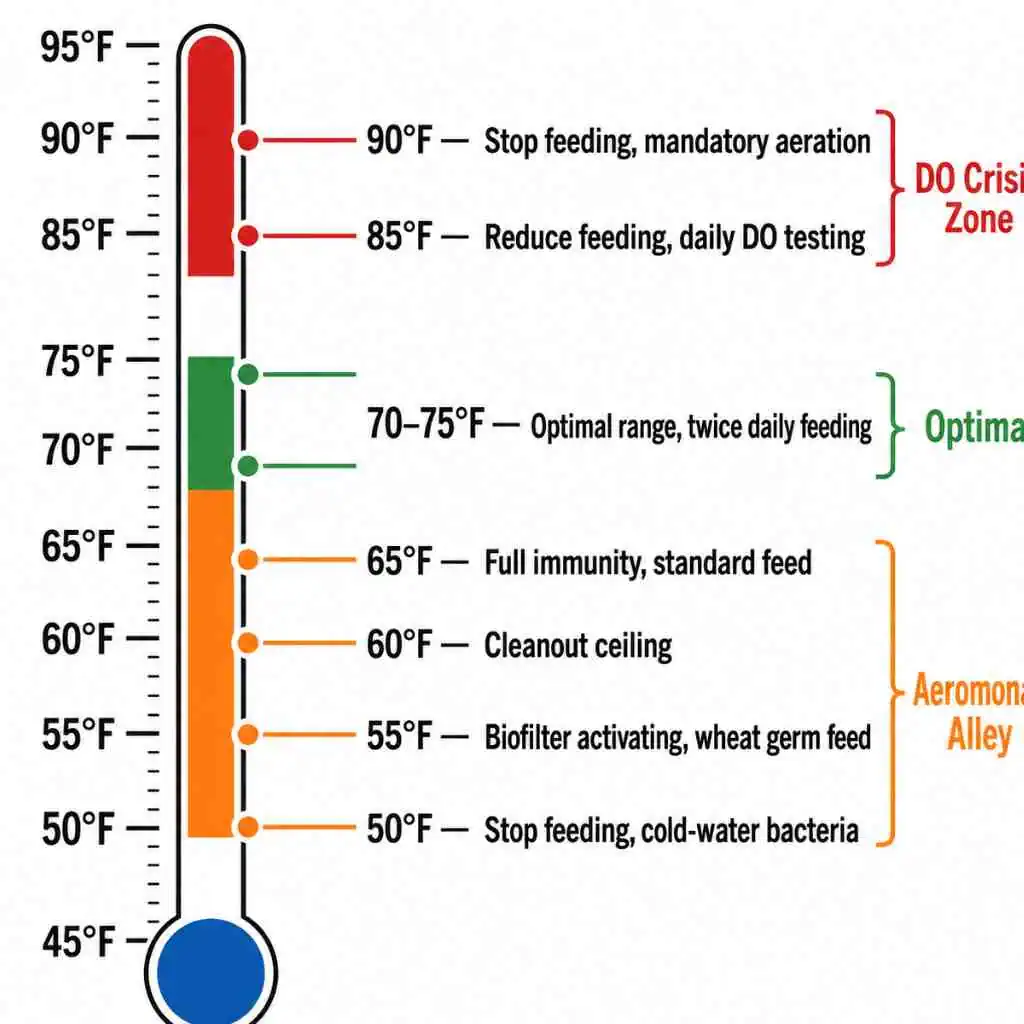
This table consolidates every temperature-based decision point from the seasonal sections into a single reference. The pattern it reveals is that the two highest-risk zones are not the extremes but the transitions: 50°F to 65°F where pathogens outpace immunity, and 85°F to 90°F where oxygen supply collapses faster than feeding reductions can compensate.
| Temperature | Feeding Action | Biofilter Status | DO Risk Level | Primary Maintenance Action |
|---|---|---|---|---|
| 50°F | Stop feeding entirely | Dormant, cold-water bacteria dosing begins | Low | Begin daily visual fish inspection, start cold-water bacteria dosing per Central California Koi Society guidance |
| 55°F | Wheat germ formula, once daily | Activating, Nitrosomonas colonies resume conversion at reduced rates | Low | Transition to standard bacteria formulation, increase dosing to every other day for two weeks |
| 60°F | Wheat germ formula continues | Active at reduced capacity | Low | Cleanout window ceiling, schedule annual cleanout before water rises above this threshold |
| 65°F | Transition to standard protein pellets | Full conversion capacity restored | Moderate | Full immune function restored, resume weekly testing cycle per Hikari and Ultra Balance feeding protocols |
| 70°F–75°F | Standard protein pellets, twice daily, 5-minute consumption rule | Full capacity | Moderate | Optimal koi range, maintain weekly water testing and monthly equipment inspection |
| 85°F | Reduce to once daily per Hikari feeding protocols | Full capacity but oxygen-stressed | High | Shift DO testing to daily, add supplemental aeration when readings drop below 5 mg/L per K.O.I. and Merck Veterinary Manual guidelines |
| 90°F | Stop feeding entirely | Stressed, reduced bacterial efficiency | Critical | Mandatory supplemental aeration, daily water level monitoring, daily DO testing |
When to Call a Pond Contractor Instead of Doing It Yourself
Four measurable conditions signal that a calendar task requires professional intervention rather than DIY execution: ammonia or nitrite readings above 0.5 ppm on two consecutive weekly tests, water loss exceeding expected evaporation by more than half an inch per day, any annual cleanout on a pond with more than 500 gallons of volume, and fish showing behavioral stress signs that do not resolve within 24 hours of aeration adjustment.
The 0.5 ppm threshold on two consecutive tests is the line between a recoverable fluctuation and a biofilter failure. One elevated reading can follow overfeeding, a skipped bacteria dose, or a large water change. Two consecutive readings mean the nitrogen cycle has lost conversion capacity.
- Ammonia or nitrite above 0.5 ppm on two consecutive weekly liquid tests indicates the biofilter cannot process the current load without controlled intervention
- Water loss exceeding expected evaporation by more than half an inch per day after confirming the auto-fill valve is functioning signals a leak that requires pressure testing to locate
- Fish displaying stress behaviors (surface gasping, flashing, isolation, clamped fins) that persist 24 hours after supplemental aeration is added indicate a cause beyond dissolved oxygen depletion
- Persistent parameter instability across three or more consecutive weekly tests despite bacteria dosing and partial water changes signals a systemic problem that single-variable adjustments cannot resolve
Biofilter crash recovery is not a single corrective action. It is a staged process. Controlled rebalancing requires partial water changes calibrated to the current ammonia and nitrite readings, not a fixed percentage. Media cleaning must be staged across multiple days so the surviving bacteria colonies are never fully disrupted at once. The full re-cycling timeline runs 4 to 8 weeks of monitored daily dosing before the biofilter returns to conversion capacity, a period where a single misstep restarts the clock. Most pond owners who attempt this without monitoring equipment and experience end up extending the crash rather than resolving it.
The annual cleanout is the single calendar event where professional execution has the highest measurable impact. Koi Pros has executed this process across more than 10,000 client ponds over 40 years. The difference between professional and DIY cleanout is not speed or equipment. It is sequencing.
- Fish handling in a pond above 500 gallons requires aerated holding tanks filled with pond water and temperature-matched within 3°F to prevent shock during transfer
- The drain-rinse-inspect-refill sequence follows a fixed order established in the winter section, and reordering steps causes biological failures that surface weeks later
- Liner inspection at seams and the UV-degraded waterline is only possible during a full drain, making the cleanout the single annual opportunity to catch damage invisible under water
- The 7-day bacteria restart protocol before fish reintroduction requires daily dosing, daily parameter testing, and the discipline to wait the full period before returning fish
A pond owner can execute every weekly, monthly, and seasonal task on this calendar independently. The cleanout is different. The system’s tolerance for error drops to near zero. Fish are in holding tanks, the liner is exposed, and the biofilter is disrupted. Every variable is in play simultaneously. Forty years and 10,000 ponds have taught Koi Pros where the margin for error disappears. It is the one calendar task worth handing to a contractor who has executed the sequence thousands of times.
Need a hand with your pond?
Koi Pros designs, builds, maintains and repairs ponds, waterfalls, fountains and lakes across Southern California and Arizona. Start with an on-site assessment.