A koi pond can have a properly installed UV clarifier, a functioning pump, and an established filtration system and still develop green water. In most cases, the problem comes down to one of five things: an undersized UV unit, incorrect water flow, an aging UV bulb, a dirty quartz sleeve, or an imbalance between algae growth and filtration capacity.
A UV clarifier works by exposing suspended single-cell algae to ultraviolet light as pond water passes through its chamber. The treated algae cells clump together and are then captured by the mechanical filter. If the UV unit is not receiving enough water, the bulb has lost its effectiveness, or the filtration system cannot remove the treated algae, the water can remain green.
The distinction matters because not all pond algae respond to UV treatment. String algae attached to rocks, waterfalls, and pond walls will not pass through the UV chamber and requires a different approach. Our guide to algae removal and control explains the different types of pond algae and how to manage them.
For pond owners in Southern California, prolonged warm weather, strong sunlight, nutrient accumulation, and high fish loads can make green water particularly persistent. Understanding which part of the system is failing is the first step towards restoring water clarity without compromising koi health.
Why Does a Koi Pond Turn Green?
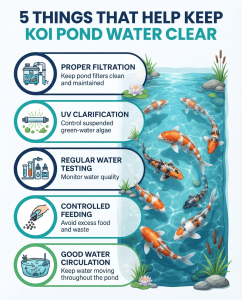
Green pond water is usually caused by microscopic, free-floating algae that reproduce in the water column. These single-celled organisms multiply when sunlight, available nutrients, and suitable water temperatures create favourable growing conditions.
Unlike string algae, which attaches to surfaces and forms visible strands, suspended algae remain distributed throughout the water. As their population increases, the water gradually changes from clear to cloudy green and can eventually become difficult to see through.
Three conditions contribute most to green water development.
1. Excess Nutrients in the Water
Nitrogen and phosphorus are essential nutrients for algae growth. In a koi pond, these nutrients enter the water through fish waste, uneaten food, decomposing leaves, and accumulated organic material.
Overfeeding is a particularly common contributor. Koi produce waste as part of normal digestion, and any uneaten food that remains in the pond adds to the organic load as it breaks down.
Nutrients can also accumulate in filter chambers, pond sediment, and areas where water circulation is poor. Even after an algae bloom has been treated, these nutrient sources remain available to support another growth cycle.
Reducing excess nutrients requires more than adding an algae treatment. It involves controlling feeding, removing accumulated debris, maintaining filtration, and performing appropriate partial water changes. Regular pond water quality testing and management helps identify nutrient imbalances before they contribute to recurring algae problems.
2. Too Much Direct Sunlight
Sunlight provides the energy algae need for photosynthesis. Ponds exposed to several hours of direct sunlight each day can experience faster algae reproduction, particularly when nutrient levels are already elevated.
This is especially relevant in Southern California, where long periods of sunshine and relatively mild winters can extend the algae-growing season.
Adding shade through strategically placed aquatic plants, pergolas, or other landscaping features can help reduce direct sunlight exposure. However, shading alone will not correct an existing nutrient imbalance or inadequate filtration.
3. Insufficient Biological and Mechanical Filtration
A koi pond relies on two different filtration processes to maintain water quality.
Biological filtration uses beneficial bacteria to convert toxic ammonia produced by fish waste into nitrite and then nitrate. Mechanical filtration removes suspended particles, debris, and other physical material from circulating water.
When either process is inadequate, organic waste and nutrients can accumulate.
A UV clarifier does not replace either type of filtration. It treats suspended organisms passing through its chamber, but the filtration system must still remove the resulting material.
This is why a pond can have a functioning UV clarifier and still struggle with persistent green water.
Understanding how biological filtration for koi ponds works and when it fails can help identify problems that may otherwise be mistaken for a UV equipment issue.
Why Is My UV Clarifier Not Clearing the Green Water?
A UV clarifier should make a noticeable difference when it is correctly sized, installed, and maintained. Most manufacturer guidance indicates that ordinary green-water problems should begin improving within approximately one week, although heavier algae blooms can take two to three weeks.
If the pond remains green after this period, the following areas should be investigated.
1. The UV Clarifier Is Too Small for the Pond
One of the most common equipment-related problems is choosing a UV clarifier based on its wattage without considering the actual pond volume and water flow.
A UV unit needs to expose the passing algae to an adequate amount of ultraviolet radiation. The effectiveness of this process depends on the lamp output, chamber design, and amount of time water spends inside the unit.
A unit that is too small for the pond may not process enough water to control algae reproduction.
When selecting a replacement or upgrading an existing system, consider:
- Total pond volume, including connected filtration chambers where applicable.
- UV wattage and the manufacturer’s recommended pond capacity.
- Maximum and recommended flow rates for green-water clarification.
- Fish stocking levels and the amount of waste entering the system.
- Sunlight exposure and seasonal algae pressure.
There is no universal wattage-per-gallon formula that applies to every UV clarifier. Different manufacturers use different chamber designs and flow specifications.
The correct unit should be selected using the manufacturer’s clarification rating rather than wattage alone.
2. Water Is Moving Through the UV Unit Too Quickly
Water flow directly affects how much UV exposure suspended algae receives.
If water moves through the chamber faster than the manufacturer’s recommended clarification rate, algae may pass through without receiving an effective UV dose.
However, reducing the flow too much can create another problem. Even if individual algae cells receive sufficient exposure, the system may not circulate enough pond water through the unit to control the overall algae population.
The objective is to balance adequate exposure with sufficient water turnover.
Check the following:
- Compare the pump’s actual operating flow with the UV manufacturer’s recommended flow rate.
- Account for pipe restrictions, bends, elevation changes, and filter resistance.
- Check whether a bypass is diverting water around the UV chamber.
- Confirm that the pump is delivering enough water to circulate the pond effectively.
Pump specifications printed on the packaging do not always reflect actual operating flow once the equipment is installed.
For larger koi ponds, it may be necessary to adjust the plumbing or install a UV unit with a higher flow capacity.
3. The UV Bulb Has Lost Its Effectiveness
A UV bulb can continue to produce visible light long after its effective ultraviolet output has declined.
This creates a common maintenance problem. Pond owners see that the bulb is illuminated and assume the unit is still working correctly.
Most conventional pond UV clarifier bulbs require replacement approximately every 12 months of continuous operation, although the exact interval depends on the manufacturer and bulb type.
An aging bulb may no longer produce enough UV radiation to control suspended algae effectively.
When inspecting the system:
- Check the installation date of the current bulb.
- Compare its operating hours with the manufacturer’s replacement schedule.
- Inspect the bulb for damage or signs of failure.
- Replace the bulb with the correct model specified for the unit.
- Record the replacement date to make future maintenance easier.
Replacing an old bulb is often a more practical solution than immediately purchasing an entirely new UV system.
4. The Quartz Sleeve Is Dirty
The quartz sleeve protects the UV bulb while allowing ultraviolet light to pass into the water chamber.
Over time, mineral deposits, algae, and other debris can accumulate on its surface. This reduces the amount of UV light reaching the water and can significantly affect the unit’s performance.
Hard water can make mineral scale particularly troublesome, especially in areas where dissolved calcium and other minerals are present in higher concentrations.
A quartz sleeve should be inspected regularly and cleaned according to the manufacturer’s instructions.
Before servicing the unit, always disconnect the power supply. Remove the sleeve carefully and clean it using an appropriate non-abrasive method. Avoid scratching or damaging the glass.
If the sleeve is cracked or damaged, it should be replaced rather than reused.
A clean quartz sleeve and a correctly functioning bulb are both necessary for effective UV clarification.
5. The Mechanical Filter Cannot Keep Up
A UV clarifier does not physically remove algae from the pond.
Instead, ultraviolet exposure damages suspended algae cells and encourages them to clump together. These particles must then be captured by the mechanical filtration system.
If the filter is undersized, clogged, or poorly maintained, the treated algae may remain suspended in the water.
This can result in cloudy water even when the UV clarifier is functioning correctly.
Check the following:
- Clean skimmer baskets and mechanical filter screens.
- Remove accumulated sludge from filter chambers.
- Inspect filter media for blockages or excessive buildup.
- Confirm that water is flowing through all filtration stages.
- Check that the filter is appropriately sized for the pond’s fish load.
Mechanical filtration should be maintained without unnecessarily disrupting the biological filter. Biological media should generally be rinsed in pond water or otherwise maintained according to the manufacturer’s recommendations to protect beneficial bacteria.
Does a UV Clarifier Remove All Types of Pond Algae?
No. A UV clarifier is designed primarily to control free-floating, single-cell algae responsible for green water. It does not remove every type of algae found in koi ponds.
Identifying the type of algae is important because different problems require different solutions.
|
Type of algae |
What it looks like |
Does UV help? |
|
Suspended green-water algae |
Water looks cloudy or opaque green |
Yes, when correctly sized and maintained |
|
String algae |
Long green strands attached to rocks and surfaces |
No |
|
Blanketweed |
Dense mats of filamentous algae |
No |
|
Algae growing on pond walls |
Green coating on rocks, liner, and surfaces |
No |
String algae and blanketweed are particularly common around waterfalls, rocks, and areas where water movement and sunlight encourage growth.
These forms of algae require a combination of physical removal, nutrient management, appropriate water circulation, and ongoing pond maintenance.
Increasing UV wattage will not solve a string algae problem because the algae never passes through the UV chamber.
For more information about identifying and managing different algae problems, read our guide to algae removal and control.
How to Clear Green Water in a Koi Pond
Clearing green water requires addressing both the algae already present and the conditions allowing it to reproduce.
Rather than immediately adding chemicals, start by checking the filtration system and identifying the underlying cause.
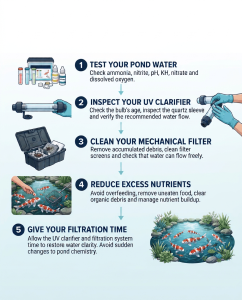
Step 1: Test the Pond Water
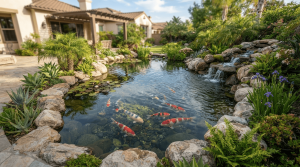
Before making significant changes, establish the current water quality.
Test the following parameters:
- Ammonia: should be undetectable.
- Nitrite: should be undetectable.
- pH: should remain stable and within a suitable range for koi.
- KH: should provide adequate buffering capacity to prevent sudden pH changes.
- Nitrate: monitor accumulation as an indicator of nutrient loading.
- Dissolved oxygen: check particularly during warmer weather and periods of heavy algae growth.
A green pond is not automatically an indication of toxic water. However, poor water quality can exist alongside an algae bloom and should not be overlooked.
Our detailed guide to pond water quality testing and management explains the key parameters to monitor and what different readings can tell you about your pond.
Step 2: Inspect the UV Clarifier
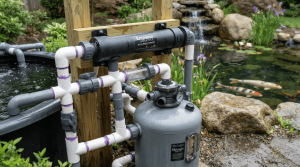
Check the bulb’s age, inspect the quartz sleeve, and confirm that the unit is receiving the correct water flow.
Make sure there are no plumbing restrictions or bypasses preventing sufficient pond water from passing through the chamber.
If the unit is undersized, consider whether an upgrade is necessary.
Step 3: Clean the Mechanical Filter
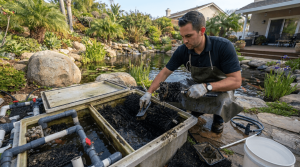
Remove accumulated debris from skimmer baskets, filter screens, and mechanical filtration chambers.
A heavily blocked filter can reduce circulation and prevent the system from removing treated algae effectively.
Avoid washing biological filter media with untreated tap water, as chlorine and chloramine can damage the beneficial bacteria responsible for biological filtration.
For a more comprehensive maintenance schedule, see our Annual Pond Maintenance Calendar for California.
Step 4: Reduce Excess Nutrients
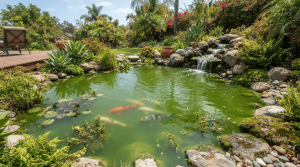
Review the amount of food being given to the koi and remove uneaten food promptly.
Remove decomposing leaves, organic debris, and accumulated sludge where appropriate.
Partial water changes can also help manage nutrient accumulation, provided replacement water is properly treated and temperature differences are controlled.
Step 5: Allow the Filtration System Time to Work
Once the underlying problems have been addressed, allow the UV clarifier and filtration system time to restore water clarity.
Depending on the severity of the algae bloom and the capacity of the equipment, visible improvement may take several days or longer.
Avoid repeatedly changing treatments or making large adjustments to water chemistry in an attempt to clear the pond faster.
Sudden changes can place unnecessary stress on koi and disrupt the biological balance of the pond.
Can Green Pond Water Harm Koi Fish?
Green water itself is not necessarily harmful to koi. However, the conditions responsible for an algae bloom can create problems for fish health.
Large algae populations can contribute to fluctuations in dissolved oxygen. During daylight hours, algae produce oxygen through photosynthesis. At night, they consume oxygen through respiration.
When algae populations are particularly dense, oxygen levels can fall significantly overnight.
This is especially concerning during warm weather, when water naturally holds less dissolved oxygen and koi have higher oxygen demands.
Watch for the following warning signs:
- Koi gathering near waterfalls or air stones.
- Fish gasping at the water surface.
- Reduced appetite or unusual swimming behaviour.
- Fish becoming lethargic or separating from the group.
- Increased flashing or signs of irritation.
Surface gasping can indicate low dissolved oxygen, but it may also be associated with other water quality problems.
If fish show signs of distress, check dissolved oxygen, ammonia, and nitrite promptly and seek professional aquatic veterinary advice where necessary.
Maintaining adequate aeration is particularly important during periods of high temperatures and heavy algae growth.
When Should You Call a Professional Pond Maintenance Company?
Persistent green water is not always caused by a faulty UV bulb or inadequate filtration. In some cases, the problem involves several interconnected issues that require a closer inspection of the entire pond system.
A professional pond assessment can help identify whether the problem is related to:
- Incorrectly sized filtration equipment.
- Inadequate pump capacity or poor circulation.
- Accumulated organic waste and sludge.
- An imbalance in biological filtration.
- Excessive nutrient loading.
- Poorly maintained UV clarification equipment.
- Inadequate aeration or water movement.
Replacing equipment without understanding the underlying problem can result in unnecessary expenses without delivering lasting improvements.
Koi Pros provides professional pond maintenance services, including water chemistry testing, filter cleaning, pump and UV inspections, debris removal, and algae control.
For ponds with substantial sludge buildup, accumulated debris, or filtration problems that require more extensive attention, our pond cleaning and clean-out services can help restore the system.
If the problem involves damaged equipment, plumbing, pumps, filters, or UV components, our pond repair services can help identify and address the underlying issue.
Frequently Asked Questions About Green Koi Pond Water
Why is my koi pond still green after installing a UV clarifier?
A pond can remain green if the UV clarifier is undersized, the bulb has lost its effectiveness, the quartz sleeve is dirty, or water is moving through the chamber too quickly. The mechanical filter must also be capable of removing the treated algae. Check all five areas before replacing the equipment.
How long does it take a UV clarifier to clear green pond water?
Most properly functioning UV clarifiers begin clearing ordinary green water within approximately one week. Heavy algae blooms can take two to three weeks, depending on pond volume, water flow, UV capacity, and filtration performance. Always follow the manufacturer’s guidance for the specific unit.
Should I leave my pond UV light on all the time?
Most pond UV clarifiers are designed for continuous operation during the algae-growing season. Running the unit consistently allows it to treat water as it circulates through the system. Follow the manufacturer’s operating instructions and disconnect the unit before maintenance.
Does a bigger UV clarifier mean clearer pond water?
Not necessarily. A higher-wattage unit can provide greater UV capacity, but performance also depends on chamber design, actual water flow, exposure time, and the condition of the bulb and quartz sleeve. The unit should be selected according to its manufacturer’s clarification rating and the requirements of the pond.
Will a UV clarifier remove string algae?
No. UV clarifiers target suspended single-cell algae that passes through the treatment chamber. String algae attaches to rocks, pond walls, and waterfalls, so it requires physical removal and appropriate nutrient management.
Can I add algae treatment while my UV clarifier is running?
Some algae treatments can be used alongside UV systems, but compatibility depends on the specific product and its instructions. Certain treatments may need UV equipment switched off temporarily. More importantly, rapidly killing large quantities of algae can increase oxygen demand during decomposition and create risks for koi. Identify the cause of the bloom before introducing chemical treatments.
Does green pond water mean my filter is not working?
Not necessarily. A pond can have functioning biological filtration and still develop green water if suspended algae are reproducing faster than the UV and mechanical filtration system can control them. Both filtration processes need to work together to maintain water clarity.
How can I prevent green water from returning?
Maintain a properly sized UV clarifier, replace bulbs according to the manufacturer’s schedule, clean the quartz sleeve, and keep mechanical and biological filtration in good condition. Control feeding, remove organic debris, monitor water chemistry, and maintain adequate water circulation. Regular maintenance is more effective than repeatedly treating visible algae blooms.
Keep Your Koi Pond Clear With the Right Filtration and Maintenance
Green water is often a symptom of an imbalance somewhere within the pond system. A UV clarifier can be an effective way to control suspended algae, but it cannot compensate for inadequate filtration, excessive nutrients, or poor water circulation.
The most reliable approach is to understand how the different parts of the pond work together. When UV clarification, mechanical filtration, biological filtration, and water quality are properly managed, maintaining clear and healthy pond water becomes much easier.
For persistent algae problems or filtration concerns, Koi Pros’ pond maintenance team can help assess your pond and identify the maintenance or equipment issues affecting its performance.
Need a hand with your pond?
Koi Pros designs, builds, maintains and repairs ponds, waterfalls, fountains and lakes across Southern California and Arizona. Start with an on-site assessment.