
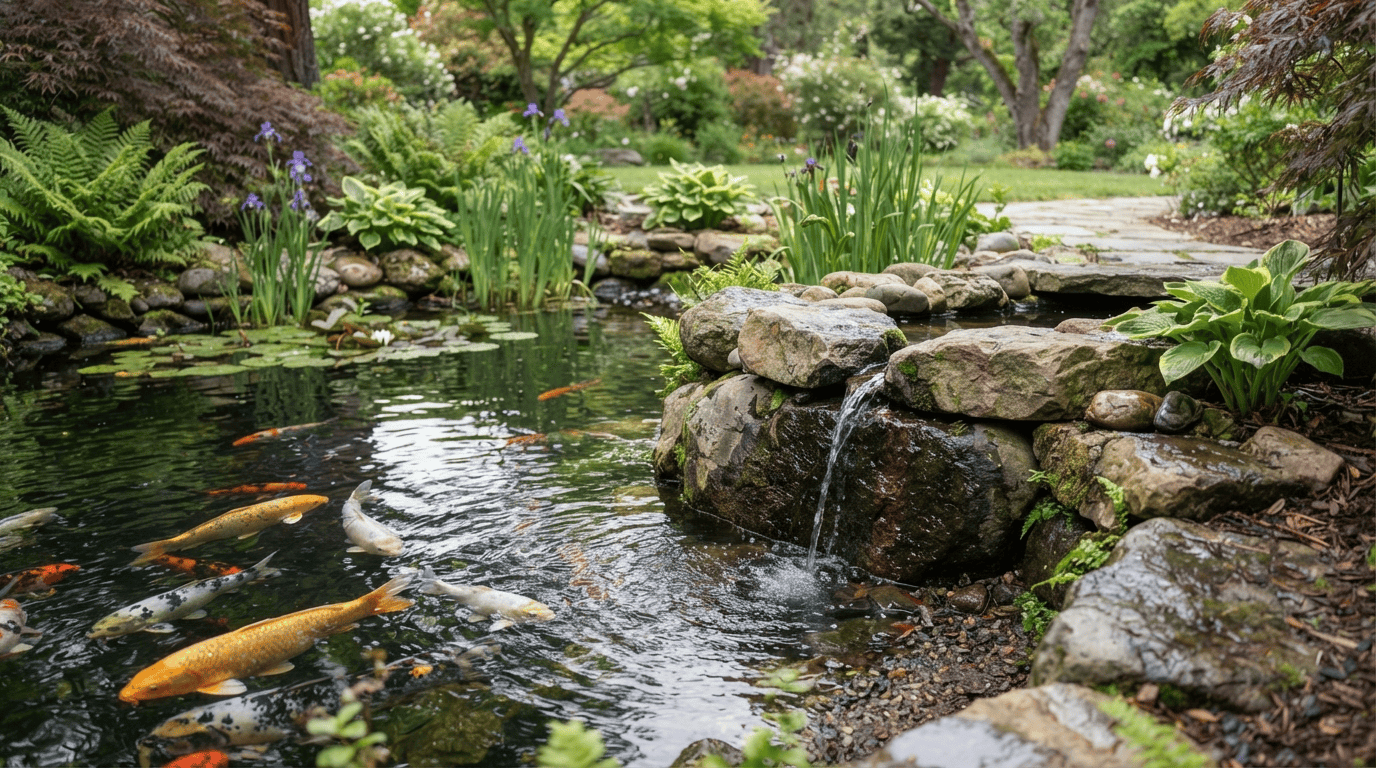
A koi pond should not need constant refilling. You top it off on Saturday, check it again on Wednesday, and the water line has dropped several inches. The waterfall is still running, the fish seem fine, and there is no obvious wet patch around the pond. So where is the water going?
Some water loss is normal. Evaporation, wind, splashing, and water carried out on plants or equipment all contribute to a gradual drop in water level. In Southern California, summer heat, low humidity, and Santa Ana winds can accelerate that loss considerably. But a pond that keeps dropping faster than the weather can explain has a problem that needs attention.
A koi pond losing water can have several different causes. The liner may be damaged, a waterfall may be sending water behind its edge, a plumbing connection may have failed, or the pond’s water level may simply be escaping over a section of settled edging. Finding the source before attempting a repair matters. Replacing a liner when the actual problem is a loose plumbing fitting wastes time and money.
Koi Pros has spent more than 40 years diagnosing and repairing ponds, waterfalls, and water features across Orange County and Southern California. Here is how to determine whether your pond has a leak, narrow down where the water is going, and decide when professional leak detection is the better option.
How Much Water Loss Is Normal in a Koi Pond?
A koi pond can lose approximately 1 to 2 inches of water per week during warm Southern California weather from evaporation alone, particularly when it has an active waterfall, fountain, or exposed water surface. A pond losing more than that, dropping noticeably overnight, or continuing to lose water when the pump is off needs further investigation.
There is no single evaporation rate that applies to every pond. The amount depends on several environmental and mechanical variables.
- Air temperature: Higher temperatures increase evaporation by providing more energy for water to change from liquid to vapor.
- Humidity: Dry inland air allows water to evaporate faster than humid coastal conditions.
- Wind exposure: Moving air carries water vapor away from the pond surface, allowing more evaporation to take place.
- Water surface area: A large pond has more exposed surface area through which water can evaporate.
- Waterfalls and fountains: Moving water creates additional exposed surfaces and fine droplets that increase evaporation and splash loss.
- Sun exposure: Direct sunlight warms the water and can increase evaporation, particularly in shallow areas.
Orange County ponds experience different conditions depending on their location. Coastal properties in Newport Beach and Huntington Beach may have cooler, more humid conditions, while inland properties in Orange, Anaheim, and Riverside experience higher summer temperatures and stronger evaporation pressure.
A pond with a large waterfall exposed to afternoon sun can lose considerably more water than a shaded pond with little circulation. That does not automatically mean there is a leak.
The important distinction is whether the water loss follows the weather or continues independently of it. Evaporation generally increases during hot, dry, windy periods and slows when conditions cool. A leak continues regardless of the weather, although the rate can change depending on the water level and pump operation.
How to Tell Whether Your Koi Pond Has a Leak
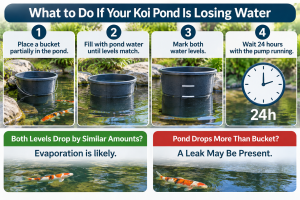
The bucket test is the simplest way to distinguish normal evaporation from unexplained water loss. It compares the drop in pond water level with the drop in a container of pond water exposed to the same weather conditions.
A bucket test takes approximately 24 hours and does not require specialist equipment.
How to Perform the Bucket Test
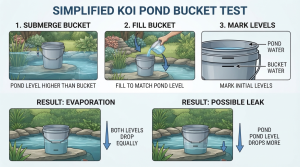
- Find a stable pond shelf or step where you can place a bucket so that it sits partly submerged in the pond.
- Fill the bucket with pond water until the water inside is approximately level with the surrounding pond water.
- Mark the water level inside the bucket.
- Mark the pond’s water level on the outside of the bucket or use a fixed reference point nearby.
- Leave the pump and waterfall operating as normal during the test, keeping other conditions unchanged.
- Check both marks after 24 hours and measure how much each water level has dropped.
The bucket water is exposed to approximately the same air temperature, humidity, and wind as the pond. Because the bucket is partially submerged, the water inside also experiences similar ambient conditions.
The difference between the two measurements is what matters.
- If the pond and bucket drop by approximately the same amount, evaporation is the most likely explanation.
- If the pond drops noticeably more than the bucket, water is escaping from the pond system.
- If the difference is small, repeat the test for another 24 hours to confirm the result before assuming there is a leak.
The bucket test identifies unexplained water loss. It does not locate the leak. That requires a second round of investigation.
Why a Pump-Off Test Matters
Once the bucket test suggests a leak, the next step is to determine whether the problem is associated with the pond itself or the circulation system.
Run a controlled test with the pump switched off, while keeping the fish adequately aerated and monitoring their condition. Do not leave koi without circulation or supplemental aeration for an extended period, particularly in warm weather.
Compare the water loss during the pump-off period with the normal operating level.
If the water loss slows considerably or stops when the pump is off, the problem may be in the plumbing, waterfall, stream, or another section that only carries water while the pump is operating.
If the water continues to drop with the pump off, the problem is more likely to involve the pond shell, liner, skimmer, bottom drain, or another submerged fitting.
This is a diagnostic starting point, not a final diagnosis. A plumbing leak can behave differently depending on whether the line is under pressure or operating through gravity.
The pump-off test is particularly useful because it prevents pond owners from assuming that every leak is a liner problem. Koi Pros isolates the different sections of the system before recommending a repair, which avoids unnecessary liner replacement when the actual failure is somewhere else.
How to Find Where Your Koi Pond Is Leaking
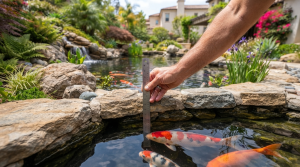
Once you have confirmed that your koi pond is losing more water than evaporation can explain, the next step is to identify the approximate location of the leak.
One of the most useful clues is the water level at which the pond stops dropping.
Water naturally drains through an opening until the level falls below that opening. If the pond consistently stops losing water at the same height, that level provides a starting point for locating the problem.
If the Water Stops at a Certain Level
A leak near the waterline or along the pond’s upper edge is a likely possibility when the water repeatedly stops dropping at the same height.
Walk around the pond and inspect the perimeter at that level.
Look for:
- A section of liner that has slipped below the intended waterline.
- Settled soil or edging that allows water to escape over the side.
- Gaps between rocks where water can travel behind the liner.
- Roots that have shifted the liner or surrounding structure.
- A skimmer opening or connection that is no longer sealed correctly.
The water does not always escape directly through the visible opening. It can travel behind rocks, through soil, or underneath surrounding landscaping before appearing somewhere else.
A dry-looking pond edge does not necessarily mean the leak is elsewhere.
If the Water Continues to Drop
If the pond continues losing water below the normal operating level, the problem may be deeper in the system.
Potential causes include a puncture in the liner, a failed bottom drain connection, or a damaged fitting below the waterline.
A small liner puncture can be difficult to identify because the damaged area may be hidden underneath gravel, rocks, or accumulated debris.
Do not assume that a pond needs a completely new liner because the water continues to drop. A localized puncture or failed seam may be repairable without replacing the entire liner.
If the Water Loss Changes When the Pump Is Turned Off
A leak that becomes noticeably smaller when the pump is switched off points toward the circulation system.
The pump moves water through suction and return plumbing, filters, skimmers, streams, and waterfalls. A damaged connection or pipe can release water outside the pond while the system is operating.
Inspect the accessible plumbing and equipment area for:
- Wet soil around underground pipe routes.
- Water collecting beneath pump connections.
- Cracked PVC fittings or loose unions.
- Leaking filter housings or bulkhead connections.
- Water escaping behind waterfall rocks or stream edges.
Underground plumbing leaks can be particularly difficult to find because water may travel along the pipe trench before surfacing several feet away from the actual break.
The Most Common Reasons a Koi Pond Loses Water
Pond leaks generally fall into five categories: waterfall and stream losses, liner-edge problems, plumbing failures, damaged liners, and leaking fittings or structural connections.
Waterfalls and streams are particularly common sources of unexplained water loss because water moves across multiple surfaces before returning to the pond. A small change in the flow path can send water outside the intended basin.
1. Waterfall and Stream Leaks
Waterfalls are one of the most common sources of water loss in ponds. They can lose water without having a single hole in the main pond liner.
Water travels over rocks, through stream channels, and around constructed waterfall edges. If a rock shifts or a section of liner settles, water can escape behind the feature instead of returning to the pond.
Several problems can cause this:
- Splashing sends water outside the waterfall basin.
- A liner edge settles below the normal water level.
- Rocks shift and redirect the flow behind the liner.
- Mortar joints crack and allow water to escape through the structure.
- A waterfall weir or filter box develops a failed seal.
- Debris blocks a channel and forces water over an unintended edge.
A waterfall can lose water at the same time the main pond liner remains completely intact.
This is why the waterfall should be inspected before anyone recommends replacing the pond liner.
Run the waterfall and watch the entire flow path. Check behind the rocks, along the stream edges, and around the point where water returns to the pond. Look for water collecting in surrounding soil or flowing into areas that should remain dry.
If the leak appears to be associated with the waterfall, see our waterfall repair services for more information.
2. A Settled or Damaged Liner Edge
The liner edge is another frequent source of water loss, particularly in older ponds where the surrounding soil and rockwork have shifted over time.
A pond liner needs to extend above the intended waterline and remain properly secured around the perimeter. If one section settles, water can escape over the edge even when the liner itself has no punctures.
This problem often develops gradually.
Soil moves through natural settling, changes in moisture content, root growth, and the weight of surrounding rockwork. Over time, a section that was originally above the waterline may become low enough to allow water to escape.
Look for:
- Low sections along the pond perimeter.
- Exposed liner that appears to have shifted.
- Rocks that have moved or settled.
- Damp soil immediately outside the pond.
- Water escaping behind edging or landscaping.
A low liner edge can sometimes be corrected by adjusting the surrounding material and securing the liner properly. However, if the liner has stretched, torn, or deteriorated, a more substantial repair may be necessary.
3. Damaged Plumbing and Connections
Pond plumbing carries water between the pond, pump, filter, skimmer, bottom drain, and return outlets.
A failure anywhere along this route can cause significant water loss, particularly when the pump runs continuously.
PVC pipes can crack, fittings can loosen, and seals can deteriorate. Underground plumbing is especially difficult to diagnose because the water may escape beneath landscaping without creating an obvious puddle.
Common problem areas include:
- Pump inlet and outlet connections.
- Skimmer bulkhead fittings.
- Bottom drain connections.
- Filter inlet and outlet plumbing.
- Underground suction and return lines.
- Valves, unions, and check valves.
A plumbing leak may become more noticeable when the pump is running because the system is actively moving water through the affected line.
Replacing the pond liner will not fix a leaking pipe. The plumbing needs to be isolated and tested separately to establish where the failure is occurring.
Koi Pros offers pond repair services covering pumps, filters, liners, plumbing, and other system components.
4. A Puncture or Tear in the Pond Liner
Pond liners provide the waterproof barrier that holds the water in the pond. When that barrier is damaged, water can escape directly into the surrounding soil.
EPDM liners are durable and flexible, but they are not indestructible. Sharp rocks, shifting substrate, roots, and damage during maintenance can all create punctures.
The difficult part is finding the damaged section.
A small hole may be completely hidden beneath rocks or gravel. Water can also travel underneath the liner before appearing at the surface, making the visible wet area misleading.
Signs of liner damage include:
- Water continuing to drop with the pump switched off.
- A pond that consistently stops losing water at a particular level.
- Wet ground around a section of the pond.
- Visible cracks, tears, or separated seams.
- Repeated water loss despite previous repairs.
A small puncture may be suitable for an EPDM patch. A failed seam or liner that has deteriorated in multiple areas may require a more extensive repair or replacement.
The correct approach depends on the liner’s condition, the location of the damage, and whether the surrounding material is still structurally sound.
5. Skimmer and Bottom Drain Leaks
Skimmers and bottom drains are essential parts of many koi pond filtration systems, but their connections can also become leak points.
A skimmer is installed at the pond’s edge to collect floating debris and direct water toward the filtration system. If the seal between the skimmer body and the liner fails, water can escape around the connection.
Bottom drains sit at the lowest point of the pond and carry water and settled waste toward the filtration system. A failed connection or damaged fitting can allow water to escape below the normal pond level.
These problems are not always visible from above the water.
Look for:
- Persistent dampness around the outside of the skimmer.
- Water loss that stops near the skimmer opening.
- Wet soil around accessible bottom drain plumbing.
- Cracked fittings or deteriorated seals.
- Water loss that continues below the normal operating level.
Because these fittings are often integrated into the pond structure, repairing them can require more than simply tightening an exposed connection.
What to Do If Your Koi Pond Is Losing Water
Finding a leak can take time. While you investigate, protecting the fish and the pond equipment should take priority.
A falling water level affects more than the appearance of the pond. It can expose equipment, reduce circulation, increase temperature fluctuations, and concentrate fish waste in the remaining water.
Protect the Pump and Filtration System
Check the pump intake and operating water level regularly.
If the water drops below the pump’s required operating level, the pump may draw air or run dry. This can cause overheating and permanent equipment damage.
Switch the pump off if the water level becomes unsafe for its operation. Make sure the koi continue receiving adequate oxygen through a separate aeration source while circulation is interrupted.
Do not assume that a pump can safely continue operating simply because it is still producing some water flow.
Refill the Pond Carefully
If you need to add water while investigating the leak, treat the incoming water before it reaches the fish.
Municipal water supplies commonly contain chlorine or chloramine, both of which can harm koi and damage beneficial bacteria in biological filtration systems.
Use a dechlorinator specifically rated for the disinfectant in your water supply. If the supply contains chloramine, the treatment must also address the ammonia released when chloramine is neutralized.
Add replacement water gradually and avoid sudden temperature changes.
Monitor Fish Behavior
A pond losing water can become more stressful for koi, particularly during warm weather.
As water volume decreases, waste compounds become more concentrated. Shallow water can also warm more quickly, reducing the oxygen available to fish.
Watch for:
- Gasping at the surface.
- Fish gathering near waterfalls or aeration outlets.
- Unusual isolation from the group.
- Flashing against rocks or pond surfaces.
- Clamped fins or reduced activity.
These signs can indicate oxygen depletion or water-quality problems and should not be ignored.
If fish show signs of distress, prioritize aeration and water-quality testing rather than continuing to investigate the leak.
Our guide to pond water quality testing explains the parameters that help identify problems before they become more serious.
When to Call a Professional Pond Leak Detection Service
A small leak does not always require a complete pond repair. A settled liner edge, loose connection, or waterfall splash-out may be relatively straightforward to correct.
Professional leak detection becomes important when the source is hidden, the water loss continues despite basic troubleshooting, or finding the problem requires isolating plumbing and structural components.
Four situations are particularly worth taking seriously:
- The pond loses more than expected from evaporation. Repeated water loss beyond approximately 1 to 2 inches per week in warm weather, especially when the bucket test confirms a difference, warrants further investigation.
- The water level continues dropping with the pump off. This suggests the pond shell, liner, or a submerged fitting may be allowing water to escape.
- The surrounding soil remains wet. Persistent dampness near underground plumbing, skimmers, or waterfalls can indicate water escaping outside the visible pond area.
- Previous repairs have not solved the problem. A pond that continues losing water after repeated patching or sealing may have more than one failure point.
How Professional Pond Leak Detection Works
Finding a leak properly means testing the system in sections rather than immediately draining the pond or replacing the liner.
A professional assessment typically follows a sequence designed to eliminate possible causes one at a time.
- Establish the evaporation baseline. Measure water loss and compare it against environmental conditions to confirm that the pond is losing more water than expected.
- Perform a pump-off test. Determine whether the water loss continues when circulation is stopped under controlled conditions.
- Isolate the waterfall and stream. Test individual sections to identify splash-out, failed liner edges, and structural leaks.
- Inspect and pressure-test plumbing. Test accessible suction and return lines to identify underground breaks or failed connections.
- Use specialist leak detection methods. Depending on the pond construction, dye testing and acoustic testing can help identify hidden leaks in liners and concrete shells.
- Prepare a repair recommendation. Once the source is identified, determine whether the appropriate solution is a liner patch, fitting replacement, plumbing repair, or more extensive resealing.
The order matters. A pond owner who replaces a liner before testing the plumbing may spend thousands of dollars without correcting the original problem.
Professional leak detection is about identifying the actual point of failure before deciding what needs to be repaired.
Koi Pros provides pond and water feature leak detection and repair throughout Orange County and Southern California, including liner repairs, plumbing testing, waterfall isolation, and concrete shell assessment.
Can a Leaking Koi Pond Be Repaired Without Replacing the Liner?
Yes. Many koi pond leaks can be repaired without removing the entire liner. The correct repair depends on the material, location, size, and condition of the damaged area.
A small puncture in an otherwise healthy EPDM liner may only require a compatible patch. A failed seam may need to be resealed, while a loose bulkhead or plumbing fitting can often be replaced without disturbing the rest of the pond.
Waterfall and stream leaks may require repositioning rocks, correcting the liner edge, repairing a weir box, or restoring a damaged mortar joint.
Concrete ponds are different. Cracks may require injection repair or a flexible waterproof coating, depending on the structure and extent of the damage.
There is an important distinction between a localized failure and a liner that has reached the end of its useful life.
If the liner is brittle, extensively cracked, or failing at multiple seams, repeated patching may only delay a larger repair. In that situation, pond resealing and relining may be the more reliable long-term solution.
The pond should be assessed as a complete system before making that decision. The liner, plumbing, filtration, rockwork, and waterfall all affect whether a repair will last.
Need Help Finding a Koi Pond Leak in Orange County?
A pond that keeps losing water is not something to ignore. What begins as a small leak can become a much bigger repair if water continues escaping behind rockwork, beneath landscaping, or through damaged underground plumbing.
The first step is finding out whether the problem is evaporation, the waterfall, the liner, or the plumbing. The second is choosing a repair that addresses the actual cause.
Koi Pros has been building, maintaining, and repairing ponds, waterfalls, fountains, and lakes across Southern California for more than 40 years. Our technicians assess the complete system, isolate the source of water loss, and recommend the repair that makes sense for the pond.
Whether your koi pond is losing water overnight, your waterfall keeps lowering the water level, or you have noticed persistent wet ground around the pond, we can help identify the problem.
Call Koi Pros at (714) 613-0123 or request a leak detection assessment to get started.
Need a hand with your pond?
Koi Pros designs, builds, maintains and repairs ponds, waterfalls, fountains and lakes across Southern California and Arizona. Start with an on-site assessment.